
Since the previous research note · Partly supported
Track continuity
Since the previous research note: How text-based AI became a maneuvering agent in Kerbal Space Program
Previous expectation: Operators could delegate more individual maneuvering corrections if models could turn spacecraft state information into timely actions within validated safety constraints.
What this study adds: The January 2026 preprint supports the narrower control-generation premise through environment-specific training across four control problems, including coupled spacecraft rotational control with numerical commands and accompanying explanations. It does not establish the earlier forecast's combined operational capability or reduced need for human direction; hardware validation and multi-system transfer remain future directions.
What changed in this study
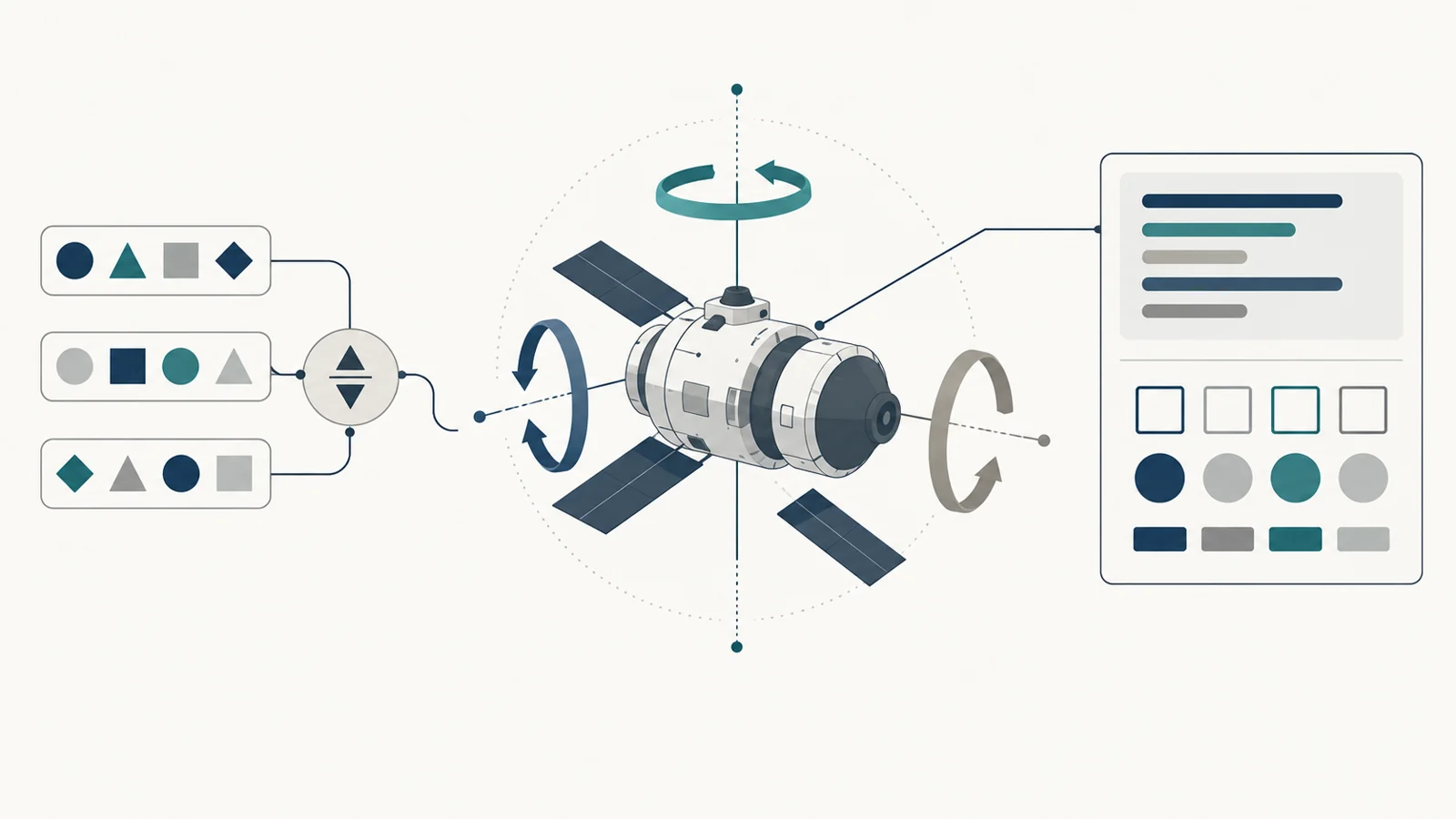
Picture a spacecraft rotating about several axes at once. Its rotational motions interact, so slowing the tumble requires coordinated commands. A controller has to produce numbers that change the motion in the intended way, while working within the limits of the available actuators.
A January 7, 2026 arXiv preprint investigates whether a large language model—AI that generates text—can learn to produce those commands together with a readable explanation of its proposed strategy. The researchers apply the same two-stage training approach to four control problems, progressing from simple linear motion to coupled, three-dimensional spacecraft rotation. They train controllers separately for each environment.
The contribution is a computational demonstration of how text generation can become numerical control. Examples teach the model the required response structure and control patterns; subsequent training uses the performance of competing command sequences to improve its choices.
Where the words become commands
The researchers express a control problem as a structured language input containing physical context and state information. The model then generates a response with separate reasoning and control fields. One holds an explanation of the strategy; the other holds numerical commands that can be parsed and evaluated in the control environment.
That separation makes the proposal easier to understand. The explanatory field describes an intended approach to changing the motion. The command field specifies the actions through which the controller attempts it. The physical trajectory follows from applying the numbers to the modeled system, so an evaluation can connect the proposed actions to the resulting motion.
The training examples contain ten-step control sequences. This gives the model a sequence to construct, with choices that affect what happens at later steps. Producing usable output therefore involves both following a precise format and selecting numbers that work together over time.
Learning from examples, then from competing sequences
The first stage is supervised fine-tuning. The model learns from prepared examples of control problems and responses, including explanations and numerical sequences. Each system has 1,800 training samples and 200 evaluation samples.
The examples span more than a single preferred solution. The described dataset includes optimal solutions, alternatives emphasizing energy efficiency or time, practical suboptimal approaches, and recovery scenarios. This variety exposes the model to different ways of approaching a control objective. The accompanying explanations average 150–250 words, giving the training process examples of how a proposed strategy can be expressed alongside its commands.
Before proceeding, models are checked for output formatting and basic control performance. The paper specifies a format-compliance target above 95 percent. That is a training gate, not an observed success rate to attribute to the finished controllers.
The second stage uses Group Relative Policy Optimization, or GRPO. In plain language, the method generates several candidate command sequences for the same starting state, evaluates them, and compares each candidate with the group’s average performance. Those relative scores guide updates to the model, encouraging choices associated with better outcomes.
Comparing candidates for the same state keeps the starting problem consistent within a group. The method also avoids training a separate value-function model to estimate how promising a state is. The learning signal comes from the relative performance of the candidates themselves. This is the central shift between stages: prepared demonstrations establish an initial pattern of behavior, and interaction with the control environment supplies further feedback.
What changes when the motion becomes coupled
The simplest benchmark is a double integrator, a linear system in which the control input determines acceleration. It represents translational motion and provides a basic test of whether generated commands can bring a moving system toward its target.
Across the four problems, the study moves through nonlinear oscillatory dynamics to spacecraft rotational control. The spacecraft case adds gyroscopic coupling, meaning that rotation about different axes interacts, along with limits on the available thrust. A controller must coordinate its commands while accounting for those interactions. The same training procedure is being tested against increasingly demanding dynamics.
The authors report stabilizing behavior in both linear and nonlinear systems. In one spacecraft-results passage, trajectories for an angular-velocity component approach zero within about 2.5–3.0 seconds. This is a result for particular simulated trajectories and a particular component of the motion; it should not be read as a settling-time guarantee for a whole spacecraft under arbitrary conditions.
The training process shows a separate pattern. Its reported variance grows with problem complexity, from steadier convergence on the double integrator to greater variability during spacecraft detumbling. Here, convergence describes how learning progresses, rather than how quickly the spacecraft stops rotating. Keeping those two meanings apart helps explain the result: the learned commands can produce stabilizing trajectories even while learning coordinated control becomes more variable.
These experiments support the feasibility of the training approach across several kinds of dynamics. They do not supply a basis here for declaring it generally better than conventional controllers or other learning methods.
Reaching the target is only part of control
A controller’s final error measures how close the system ends up to its target. The study also evaluates trajectory cost, which accounts for what happens along the way. Its objective weighs state error and control effort, so two sequences that reach similar endpoints can still differ in how they get there.
This distinction matters for a spacecraft with limited control authority. A sequence that demands excessive thrust cannot become a usable maneuver merely because its calculated endpoint looks good. The problem formulation includes bounds on control actions and on system states, making the permitted commands and operating region part of the task.
Defining those bounds, checking them on evaluation trajectories, and proving that a controller will always respect them are different achievements. Successful computational examples show behavior under the tested conditions. Dependable constraint handling across the situations a spacecraft may encounter remains a stronger requirement, and readable language accompanying the commands does not change the physical limits they must satisfy.
What the computational tests leave open
The authors explicitly place hardware validation on spacecraft attitude-control testbeds in future work. Moving from computed trajectories to physical equipment would test whether the proposed control approach remains useful when its commands have to operate through real hardware. Practical use also depends on producing commands in time to affect the evolving motion. The evidence described here does not establish flight-ready execution timing, sufficient onboard computing resources, radiation-compatible operation, or dependable behavior across operational disturbances.
Transfer between systems is another distinct question. Applying a training recipe to four environments means each controller can learn its own problem. It does not show that one trained model can move between those environments without further fine-tuning. The authors identify that broader capability as a future direction.
The explanations deserve their own test as well. They are generated outputs that describe a strategy, and could help a person inspect a proposal. Their readability does not establish that they faithfully reveal the model’s internal decision process. An account can be assessed against the numerical commands and their effects, but fluency alone cannot establish its accuracy.
Taken as a January 2026 preprint, the work therefore supports a specific step forward: environment-specific language-model training can produce numerical sequences that stabilize the control problems studied. Operating spacecraft with less human direction involves additional capabilities beyond that demonstrated step.
What this could change
If hardware performance, timely execution, and dependable constraint handling can be established, spacecraft teams could delegate more individual stabilization decisions to a controller that also supplies a readable account of its proposed strategy. The numerical sequence would provide the actionable proposal, while the accompanying explanation could help an operator understand what the controller is trying to accomplish.
That combination could make supervising maneuvers more informative. A team could examine both the intended approach and the predicted or measured response, helping it decide when to accept a proposal or intervene. The potential payoff is greater delegation of bounded control decisions with more context for human oversight. The explanation would serve as an aid to inspection within that process; authority to act would still depend on validated control performance and operating limits.
Key Sources
- Primary source: Autonomous Reasoning for Spacecraft Control: A Large Language Model Framework with Group Relative Policy Optimization
arXiv · Preprint · 2026-01-07