
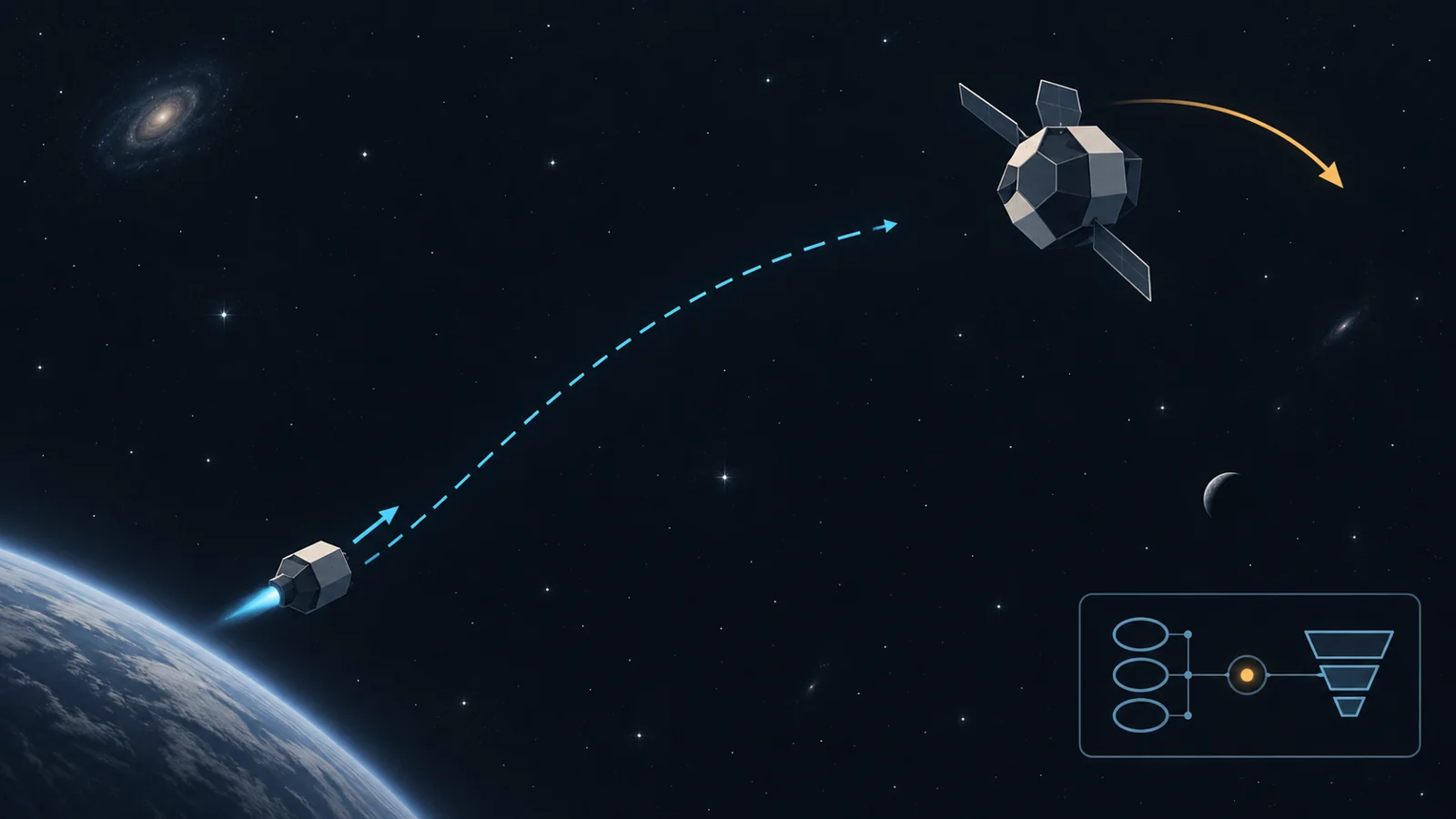
Since the previous research note · Earlier expectation not tested
Track continuity
Since the previous research note: Turning spacecraft mission priorities into maneuver plans and paths
Previous expectation: Spacecraft teams could specify mission priorities and let onboard guidance choose bounded maneuver sequences and paths if learned choices generalized and execution proved reliable.
What this study adds: The current source compares architectures and training methods for adapting a thrust-constrained safety filter, including simulated encounters with actively uncooperative targets. It reports a configuration advantage at the control layer without testing priority-to-plan translation.
What changed in this study
A spacecraft can avoid trouble yet fail to finish its approach. It can also reach its destination while spending more propellant than necessary. During docking or close inspection, success requires reconciling several demands: respecting safety constraints, completing the maneuver and working within limited thrust. Giving two controllers the same mathematical approach to safety does not necessarily make them behave alike.
An arXiv preprint dated June 16, 2026 investigates how much that behavior depends on the learning system inside the controller. The researchers compare ways of retaining information from past observations and ways of training those systems, then test them in simulated spacecraft encounters. Their strongest overall configuration combines a memory architecture called Mamba2 with a training method called PPO. The differences become more consequential as the tasks grow harder, including when a target deliberately moves in ways that complicate the approaching spacecraft’s job.
What the learning system adjusts
The starting point is an existing safety-control method called an input-constrained control barrier function. Its purpose is to define conditions under which a system can remain inside a safe set of states while obeying limits on its actuators. For a spacecraft, those limits matter because a mathematically desirable correction is useless if the thrusters cannot deliver it.
A safe set is more than a region drawn around another spacecraft. It describes acceptable conditions in the system’s state, which can include how the spacecraft is moving. The underlying mathematical aim is forward invariance: starting within that set, the controlled system stays within it under the conditions required by the method. That connects safety to what the vehicle can actually do next.
The learned component tunes mathematical functions within this construction, known as class-K functions. These functions help shape the filter’s constraints on control. Fixed choices can make the filter unnecessarily restrictive or shortsighted near a constraint boundary. Learning offers a way to adapt those choices using experience across different conditions.
This locates the contribution at a specific layer of spacecraft autonomy. The study concerns how a safety filter is adjusted during control; it does not test a system that converts an operator’s mission priorities into a complete plan. Nor does the learning component simply replace the whole guidance and control system. Its influence comes through the functions it tunes inside the existing safety method.
The researchers compare three architectures that carry information forward through a sequence of observations. Two are recurrent neural networks, LSTM and GRU. The third, Mamba2, is a selective state-space model, another way to maintain and update an internal representation of past information. For readers, the important distinction is how these designs retain information that may help interpret the current situation. With uncertain vehicle properties and imperfect state information, an observation history can be useful in ways that a single snapshot is not.
A shared set of tests
The cooperative comparison pairs each architecture with two reinforcement-learning algorithms, Proximal Policy Optimization, or PPO, and Soft Actor Critic, or SAC. These algorithms govern how the system learns from experience. Architecture and training method are therefore separate choices: the experiment asks both how to represent past information and how to learn to use it.
Evaluation was separated from training. For each scenario, the researchers established a fixed bank of 500 test cases, with randomized initial conditions and environmental parameters such as mass and inertia. Every compared policy encountered the same bank. The evaluation also included hidden-parameter, state and thrust uncertainty, making the comparison broader than a single carefully chosen trajectory.
The policies ran deterministically during evaluation. PPO used the mean of its action distribution, and SAC’s exploration noise was disabled. This reduces the chance that a comparison is driven by random exploratory actions during a test. Together with the shared cases, it provides a consistent basis for comparing the learned controllers. It does not isolate architecture from every influence of training, but it makes the test conditions comparable.
The adversarial stage was narrower. Because PPO performed better in the cooperative tasks, only PPO-trained variants continued to docking and inspection tests with an actively uncooperative target. Those results compare memory architectures within PPO. They cannot establish how SAC would have fared against PPO in the same adversarial encounters.
Harder maneuvers expose different weaknesses
The simplest task was cruise control, a teaching benchmark outside spacecraft proximity operations. A following vehicle tracked a leader moving at constant speed. Here, the paper reports that fuel use separated the configurations. That makes the simple task useful as a starting comparison, but less revealing about whether a controller can handle a demanding spacecraft maneuver.
Docking changed the picture. The authors report that Mamba2 with PPO stood out for achieving a high completion rate, while the other configurations struggled to finish. This distinction is central to interpreting a learned safety filter. Remaining within constraints does not, by itself, show that a controller can make the sustained progress needed to dock. A configuration can be cautious and still be ineffective at the assigned maneuver.
Inspection exposed another weakness. The SAC variants suffered a collapse in safety performance in the more demanding spacecraft tasks. The authors associate SAC’s difficulties with exploration during learning and with reusing older experience while the learned filter changes the safe set. Experience collected under an earlier filter may fit the current learning problem poorly. That is the paper’s explanation for the behavior in this setting, rather than a general verdict that SAC is unsuitable for all safety-related control.
The evasive targets add a different challenge. In the adversarial scenarios, the target acts to degrade the approaching spacecraft’s safety or sensor coverage. The controller must therefore contend with motion that makes its assigned task harder, rather than rely on a cooperative partner. Among the PPO variants, the researchers report that Mamba2 offers the best overall balance of task completion, safety and propellant use across their evaluation.
These are distinct outcomes. Completion records whether the assigned maneuver succeeds; safety concerns adherence to the modeled constraints; fuel consumption measures the control effort spent. A favorable overall result does not mean one configuration wins every individual measure. It also does not make all forms of uncooperative behavior equivalent. The adversarial result concerns the target behaviors constructed for these tests, not an unlimited range of hostile actions.
The comparison thus shows why the choice of memory model can matter even when the mathematical safety approach is shared. Changing the learned tuner changes how that approach behaves during a maneuver. As the task becomes more demanding, differences that look modest on a simple benchmark can become differences in whether the controller finishes at all.
Safety between computer updates
There is a further step between a safety argument and its execution on a spacecraft computer. The modeled dynamics evolve continuously, but a digital controller receives measurements and issues updates at discrete times. The spacecraft keeps moving between those updates.
The paper highlights this gap with an analogy to navigating a maze while opening one’s eyes only intermittently. Knowing where the walls are at the moments of observation is not enough to establish what happens throughout the intervening motion. For control, the corresponding issue is whether the assumptions behind a continuous-time safety construction remain valid when sensing and commands occur at intervals.
This matters when interpreting the word “safety.” Mathematical guarantees apply under defined conditions; successful Monte Carlo trials provide evidence about tested cases. Neither should be read as an unconditional promise of collision prevention. Moving toward operational use requires connecting the modeled conditions to the timing, measurements and actuation of the implemented system.
The authors identify validation on flight-representative hardware as future work. That step would test whether the approach can execute appropriately under the constraints of a relevant computer and control setup. The architecture’s favorable simulation results do not establish a particular onboard memory footprint, response time or power requirement. Those are implementation questions, and a promising sequence model is not yet a demonstrated flight system.
The other stated research direction is to adapt off-policy learning methods, such as SAC, to the changing safe set induced by the learned filter. That leaves room for the training comparison to evolve. The present result identifies a strong tested pairing within this approach, while also pointing to a specific reason another learning method may need modification.
What this could change
If the behavior survives flight-representative implementation and the uncertainties of real operations, spacecraft teams could gain a more capable control component for autonomous docking and inspection. A filter that adapts effectively to the encounter could help an approaching vehicle continue a useful maneuver when the other object’s motion complicates the task, while respecting thrust limits and conserving propellant.
The downstream benefit would be greater practical scope for close-range operations around objects that cannot be assumed to cooperate. More effective local control could make inspection or docking feasible in circumstances where a controller otherwise becomes too restrictive to finish. The path runs from learning better filter adjustments, through reliable execution on representative hardware, to spacecraft that can carry out demanding proximity maneuvers with less dependence on predictable target behavior.
Key Sources
- Primary source: Memory-Efficient Meta-Reinforcement Learning for Adaptive Safety-Critical Control in Adversarial Spacecraft Proximity Operations
arXiv · Preprint · 2026-06-16