
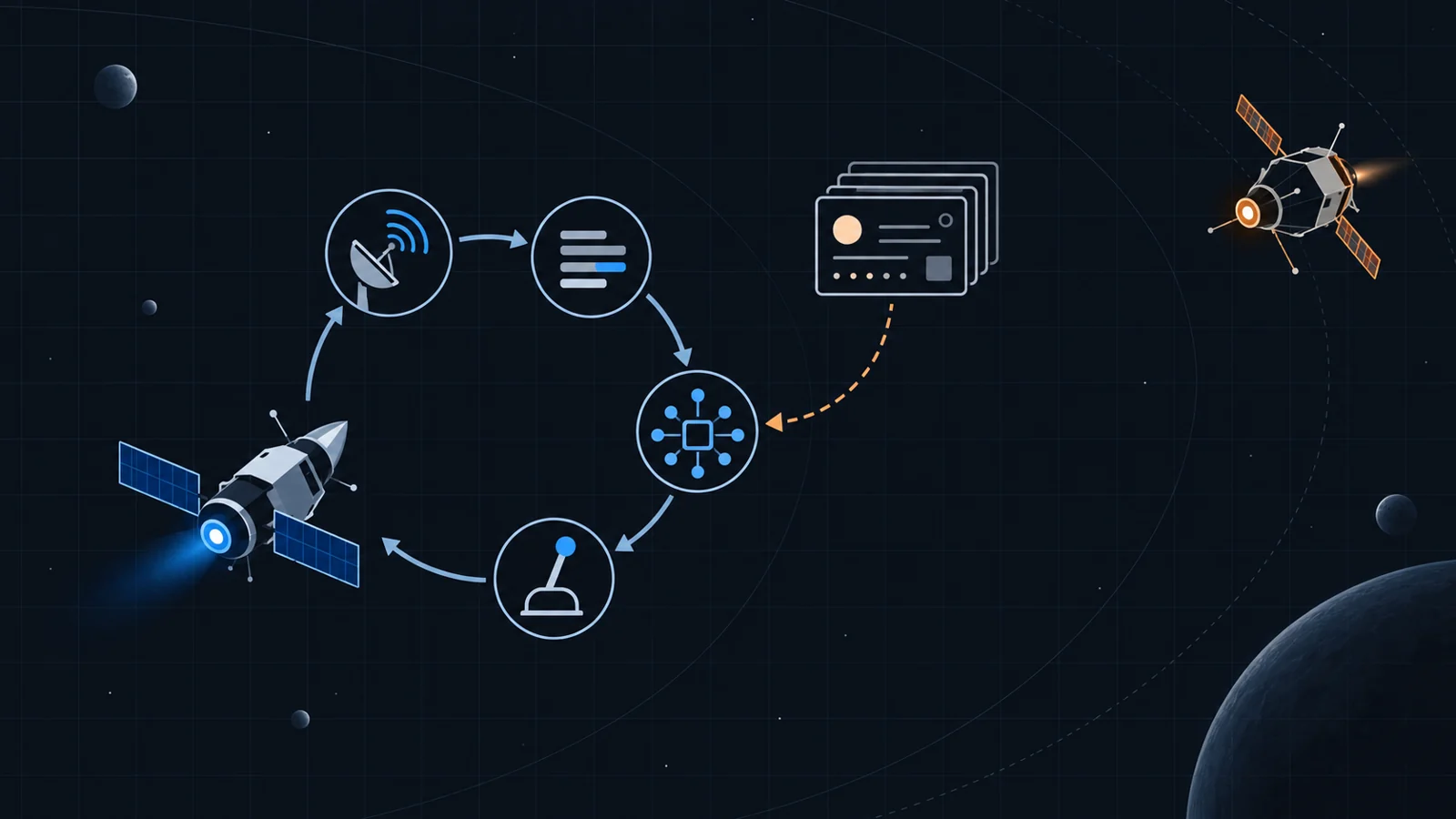
A simulated spacecraft pursues an evader. Its controller receives mission telemetry, processes it as text and returns a command telling the pursuer how to thrust. As the situation changes, another prompt brings the controller an updated view. The language model’s output becomes an action inside the simulation.
An August 16, 2024 preprint, Fine-tuning LLMs for Autonomous Spacecraft Control, explores whether recorded examples can improve this unusual control loop. Using the Kerbal Space Program Differential Games suite, or KSPDG, the researchers concentrate on one pursuer–evader scenario, designated PE1_I3_E3. They report that fine-tuning improves pursuit performance over baseline configurations. The result concerns approaching a target in a simulated orbital encounter; it offers an early test of a control method, with substantial distance still to travel toward spacecraft operations.
The central question is how much useful behavior a model can learn when observations and control actions are expressed through language.
From telemetry to throttle
The interface connects two kinds of information. The simulation produces telemetry describing the current mission state. Software formats that information into a textual prompt, which the language model processes to produce a control response. An agent then translates the response into a throttle command that acts on the simulated spacecraft.
That translation matters. The model’s words affect the next state of a moving system, so usefulness depends on the resulting maneuver. A fluent response alone accomplishes little. The command has to move the pursuer in a way that helps it approach the evader as their relative positions and motion change.
The model can also supply a textual justification alongside its throttle vector—the command specifying thrust along the available control directions. Such an explanation may make an action easier for a person to inspect, but it is another generated output. It does not independently establish that the command is physically appropriate or that the model understands orbital motion. The spacecraft’s simulated behavior provides the relevant performance evidence.
The authors motivate this approach partly through the difficulty of obtaining enough simulated experience for reinforcement learning in their setting. Their experiment asks whether an existing language model can be adapted using mission demonstrations. It does not establish that this method replaces reinforcement learning or conventional spacecraft controllers.
What the mission examples teach
Fine-tuning adapts an already trained model by adjusting it using additional examples. Here, those examples connect mission observations with control responses. Logs from completed gameplays are converted into text suitable for training, giving the model examples of how a controller acted during a pursuit.
The study uses different demonstration sources for its two model families. The GPT-3.5 experiments draw on human gameplay. The LLaMA-3-8B experiments use gameplay produced by a navball agent, an automated controller associated with the simulator’s navigation display. These are different teachers, with potentially different habits and strengths.
For LLaMA, the researchers select 50 top-performing missions from randomly generated orbit missions. They then experiment with subsets containing 10, 25 and 50 gameplay files. Selection concentrates training on successful examples, but also shapes what the model gets to see. Fifty selected missions do not represent every way an approach can unfold, especially when a controller makes an unusual mistake.
One configuration using 10 files also includes previous actions through a sliding window. This gives the model a limited recent action history alongside its current input. A snapshot tells a controller where the mission stands; action history adds context about what the controller has just been doing. Including it is a distinct experimental choice from simply increasing the number of training missions.
The shift toward open-source tools and LLaMA also gives the researchers more flexibility to explore training choices. That is useful for experimentation, although openness itself does not explain the performance of a particular controller.
Reading the pursuit results
The main performance question is how closely the pursuer approaches the evader. A smaller closest-approach distance indicates a better result on that measure. It is a concrete way to assess whether the generated commands help the spacecraft close the gap.
Distance alone, however, leaves out much of an encounter. Passing near another spacecraft and maintaining a controlled position beside it are different achievements. A closest-approach result does not describe the full relative motion or demonstrate a completed docking maneuver.
The authors report improvement in the GPT experiments after fine-tuning, with trained configurations surpassing their baseline. They also report that the LLaMA configurations consistently exceed their own baseline performance. Their discussion highlights strong results from the larger demonstration sets and from the configuration that includes recent actions.
These findings support the narrower conclusion that adapting the models to mission examples can improve pursuit in this setup. They do not provide a clean ranking of model families. GPT learns from human demonstrations, while LLaMA learns from navball-agent demonstrations; prompting and training arrangements also differ. A performance difference between them can therefore reflect several changes at once.
The reported benefit from larger datasets is encouraging within the tested configurations. It does not establish that adding further gameplays would keep improving control, or that file count alone caused the observed differences. The content and diversity of the demonstrations matter alongside their number.
When more instructions do not help
The paper also describes behavior that depends on how the model is prompted. Its discussion draws attention to overshoot, when the pursuer goes past the evader, and contrasts more prescriptive guidance with a less directive, “agnostic” prompt. The authors report that the latter can even outperform the demonstration results.
Overshoot makes instruction sensitivity consequential. After passing a target, a controller has to respond to a changed relationship between the spacecraft. A strategy that helped close the gap earlier may no longer be appropriate. Written guidance intended to help the model can instead steer its response poorly if that guidance is too restrictive for the situation.
This observation complicates the idea that supplying more explicit reasoning instructions necessarily produces better decisions. A prompt can encourage a plausible explanation while influencing the action in an unhelpful direction. In this experiment, how the task is presented is part of the controller’s behavior.
That is separate from the question of training-set size. Additional demonstrations change the material used to adapt the model; prompt wording changes the instructions it receives when acting. The reported results give reasons to examine both, without isolating every contribution to the final pursuit performance.
The gap between pursuit and dependable control
This is a preprint case study in one simulated pursuit scenario. Its selected demonstrations and tested configurations leave open how the controllers would behave across a broader range of initial conditions, disturbances and spacecraft tasks. They also leave open whether the models can recover reliably from states poorly represented in their training examples.
The experiment does not establish collision avoidance, validated safety constraints or formal guarantees about permitted behavior. Those requirements are particularly significant when the performance measure rewards getting closer to another object. A useful operational controller would need to satisfy restrictions on how it approaches, as well as achieve the mission objective.
The paper reports latency alongside distance, bringing attention to the time required to generate actions. But measuring response time is only part of assessing a control system. The evidence supplied here does not show that the controller meets an operational flight-control deadline or remains timely under the conditions a mission would impose.
Nor do the pursuit gains isolate an improvement in reasoning. Fine-tuning may improve the model’s ability to produce useful actions in familiar circumstances without establishing a general capacity to reason through unfamiliar orbital situations. Generated justifications cannot resolve that uncertainty. Taken together, these limits define the result as a demonstration of language-mediated control, rather than evidence of flight readiness.
What this could change
If controllers trained on mission examples can learn reliable approach behavior beyond this particular simulation, spacecraft could eventually carry out more of an encounter without continuous human direction. Recorded missions would provide training examples, current telemetry would guide each decision, and the controller could adapt its actions as the approach develops.
For mission operators, the potential benefit would be greater capacity to supervise autonomous maneuvers while spending less effort directing individual control steps. That prospect depends on the approach generalizing beyond the training scenario, producing commands within suitable response times and operating under validated safety constraints.
From the August 2024 perspective, the contribution is an initial demonstration that a language interface can connect learned mission examples to useful simulated actions. Making that connection dependable could expand the ways engineers build and adapt autonomous spacecraft control.
Key Sources
- Primary source: Fine-tuning LLMs for Autonomous Spacecraft Control: A Case Study Using Kerbal Space Program
arXiv · Preprint · 2024-08-16