
Evidence date · 2022-08-20 · Research note 2 of 3
1 2 3
See current Track status →
Since the previous research note · Partly supported
Track continuity
Since the previous research note: Did adding immune therapy improve response at surgery in both PD-L1 groups with triple-negative breast cancer?
Previous expectation: Presurgery immune treatment might reduce later disease events if the effect endured and added toxicity could be managed.
What this study adds: This 2022 synthesis associated the immune-plus-platinum combination with better disease-free or event-free survival than its chemotherapy reference, while also finding more premature treatment discontinuation. It did not establish an overall-survival gain or resolve treatment tolerability.
What changed in this study
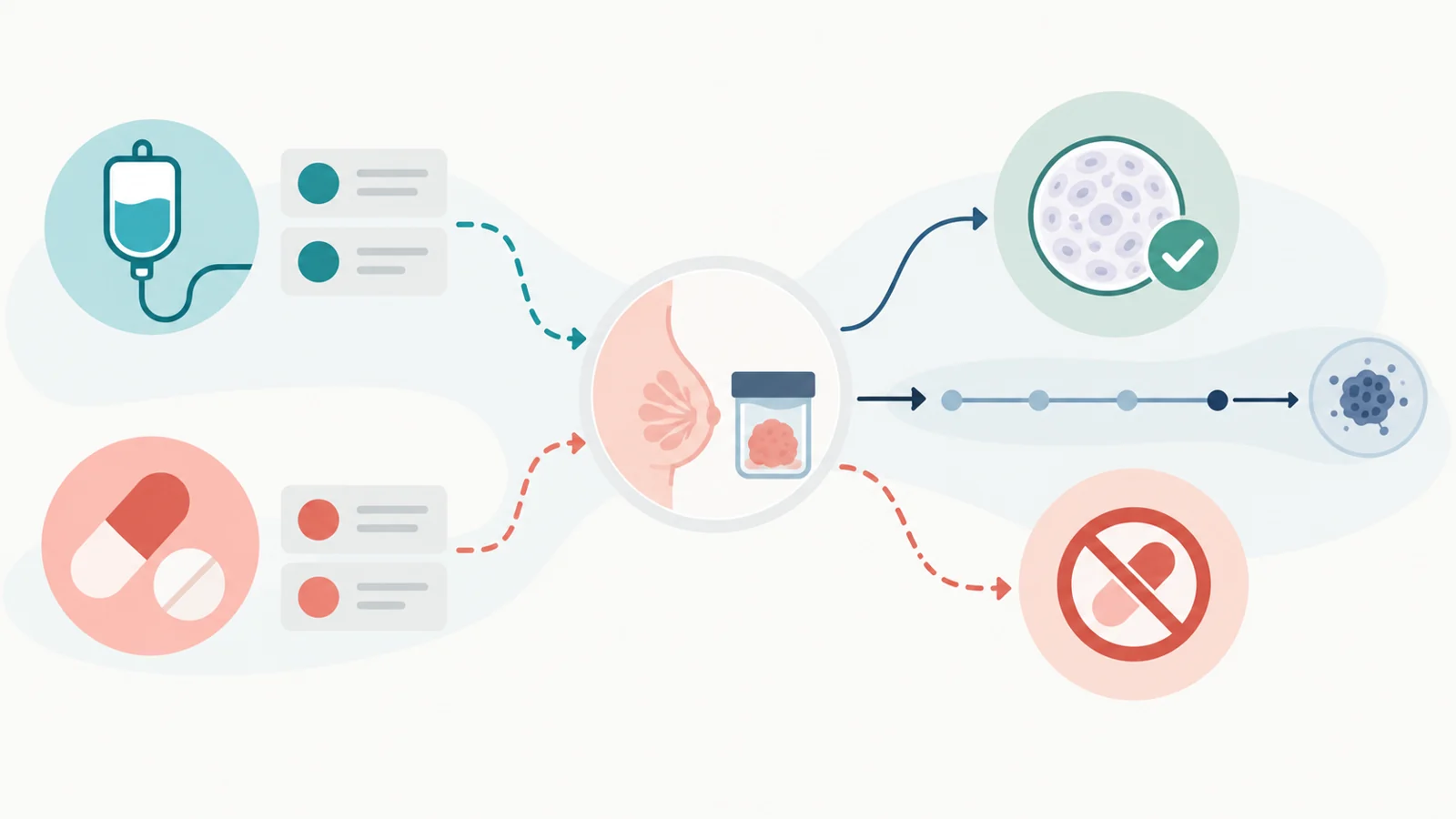
For early triple-negative breast cancer, a combination of an immune checkpoint drug, platinum, and chemotherapy was associated with stronger tumor response at surgery and better disease-free or event-free survival than a standard chemotherapy reference. More patients also stopped treatment early. Those findings describe separate outcomes: a promising response and later-event result came with a cost in treatment tolerance.
The evidence comes from a 2022 analysis of randomized trials, not one trial directly comparing every regimen. It also leaves open whether the later-event association translated into longer overall survival or came specifically from treatment given before surgery.
A response at surgery is one milestone
Triple-negative breast cancer describes tumors whose cells test negative for estrogen and progesterone receptors and HER2, three common treatment targets. Treatment before surgery is called neoadjuvant therapy. It can shrink or eliminate detectable invasive cancer before the operation, and the tissue removed at surgery lets researchers assess how much tumor remains.
The analysis defined a pathologic complete response as no residual invasive disease in the removed breast tissue and lymph nodes. This is a useful sign that the cancer responded to treatment, and earlier research has linked it with long-term clinical benefit. It is still an intermediate outcome. A complete response in those tissues does not guarantee that an individual will avoid recurrence or live longer.
The authors searched for phase 2 and 3 randomized trials published through February 12, 2022. They included 41 trials with 7,109 people with triple-negative disease. For the main response comparison, the network included 27 treatment regimens. The paper was published on August 20, 2022; the search date marks how recent its evidence could be.
A network meta-analysis combines direct trial comparisons with indirect ones. If one set of trials compares regimen A with a shared chemotherapy regimen, and another compares regimen B with the same reference, the network can estimate A against B even without a head-to-head trial of the two. Those indirect estimates depend on the trials being comparable enough for the shared reference to be meaningful. Here, only 11 of the 27 regimens had been tested in two or more trials, and 12 of the 41 trials were assessed as having high risk of bias. Some comparisons also showed substantial variation between studies.
The reference treatment changed how strong the response looked
Against anthracycline- and taxane-based chemotherapy, the combination of a PD-1 immune checkpoint inhibitor, platinum, and anthracycline- and taxane-based chemotherapy was associated with higher odds of pathologic complete response. The estimated odds ratio was 3.95, with a 95% credible interval from 1.81 to 9.44. The interval stayed above 1, supporting higher odds than the reference in this network.
An odds ratio is not the same as a ratio of patient counts. An estimate of 3.95 does not mean almost four times as many patients had a complete response; the absolute difference would depend on the response rate with the reference regimen. The analysis instead estimates how the odds compared across the trial network.
The result looked less decisive against a dose-dense schedule of anthracycline- and taxane-based chemotherapy, with shorter intervals between treatment cycles. There, the estimated odds ratio was 2.57, but its 95% credible interval ranged from 0.69 to 9.92. Because that range includes 1 and is wide, the analysis did not establish a response advantage over the dose-dense regimen. The comparison shows why a treatment’s apparent standing depends on what it is measured against. The leading combination ranked highest for response in the broader network, but it did not demonstrate superiority to every alternative in direct trials.
Later disease-event results did not settle the survival question
For disease-free or event-free survival, the network drew on 18 trials and 5,247 patients, comparing 10 treatment strategies. These measures track time from randomization to outcomes such as recurrence, a secondary cancer, or death. Against anthracycline- and taxane-based chemotherapy, the immune-plus-platinum combination was associated with longer disease-free or event-free survival: the hazard ratio was 0.42, with a 95% credible interval of 0.19 to 0.81. In this analysis, the estimated rate of those events over follow-up was lower than with the reference regimen.
That result is encouraging, but it is not the same as an established overall-survival gain. The overall-survival analysis included 15 trials and 4,863 patients. Its estimate for the combination was a hazard ratio of 0.55, with a 95% credible interval of 0.24 to 1.15. Because that interval includes 1, the analysis did not establish that patients lived longer overall.
The later-event result also cannot be assigned solely to the treatment given before surgery. Some regimens continued a PD-1 or PD-L1 checkpoint inhibitor after the operation, in some cases for up to a year. The network compared treatment strategies across the whole course; it could not separate the contribution of presurgery treatment from postoperative checkpoint therapy.
Completing treatment carried a separate cost
The discontinuation comparison used a different set of evidence: 33 trials and 9,489 patients, including people with and without triple-negative breast cancer. Against anthracycline- and taxane-based chemotherapy, the immune-plus-platinum combination was associated with higher odds of premature treatment discontinuation. The odds ratio was 3.25, with a 95% credible interval of 1.26 to 8.29.
This is not a precise estimate of discontinuation risk for people with triple-negative disease alone. It is also a relative comparison of odds, not an absolute percentage of patients who stopped. The larger number of participants than in the main response analysis reflects that the discontinuation network included patients without triple-negative disease as well.
Stopping early matters because the intended treatment is a course, and the authors linked the higher discontinuation rate primarily to treatment-related adverse events. Across the regimens, severe events were often associated with chemotherapy. The paper also described distinct serious events seen with PD-1 or PD-L1 inhibitors, including adrenal insufficiency, hepatitis, severe skin reactions, and infusion reactions. Some immune-related endocrine effects can be irreversible and may require long-term hormone replacement. The analysis does not provide a triple-negative-only absolute risk that would show how often these harms occur for an individual patient.
The chemotherapy backbone may shape the immune effect
The authors proposed a biological reason why the drugs might work differently in combination. The PD-1 pathway helps restrain T-cell responses; blocking it may help immune cells act against a tumor. Triple-negative tumors can have features associated with immune activity, including immune cells within the tumor and PD-1 or PD-L1 expression, making checkpoint treatment a plausible partner.
The chemotherapy partner may matter too. The authors suggested that anthracyclines and cyclophosphamide could help restore immune surveillance and promote tumor-cell death in ways that make immune attack more effective. Platinum-containing regimens were also generally associated with stronger pathologic response than their platinum-free counterparts in the network. These explanations offer a rationale for testing the combination. The meta-analysis compared clinical outcomes; it did not demonstrate which biological process caused the differences between regimens.
How treatment before surgery could become more selective
If future trials can identify which patients are most likely to benefit from this combination, which chemotherapy backbone best supports it, and how treatment harms affect completion, care could be matched more closely to each person. That could help preserve response and disease-event benefits for people likely to gain while reducing exposure to a burdensome regimen for those less likely to benefit. This analysis points toward that capability, but it does not supply a patient-level selection rule or establish longer overall survival.
Key Sources
- Primary source: Neoadjuvant therapy in triple-negative breast cancer: A systematic review and network meta-analysis.
DOI or Journal Page · Review or Meta-Analysis · 2022-08-20