
Evidence date · 2021-03-21 · Research note 1 of 3
1 2 3
See current Track status →
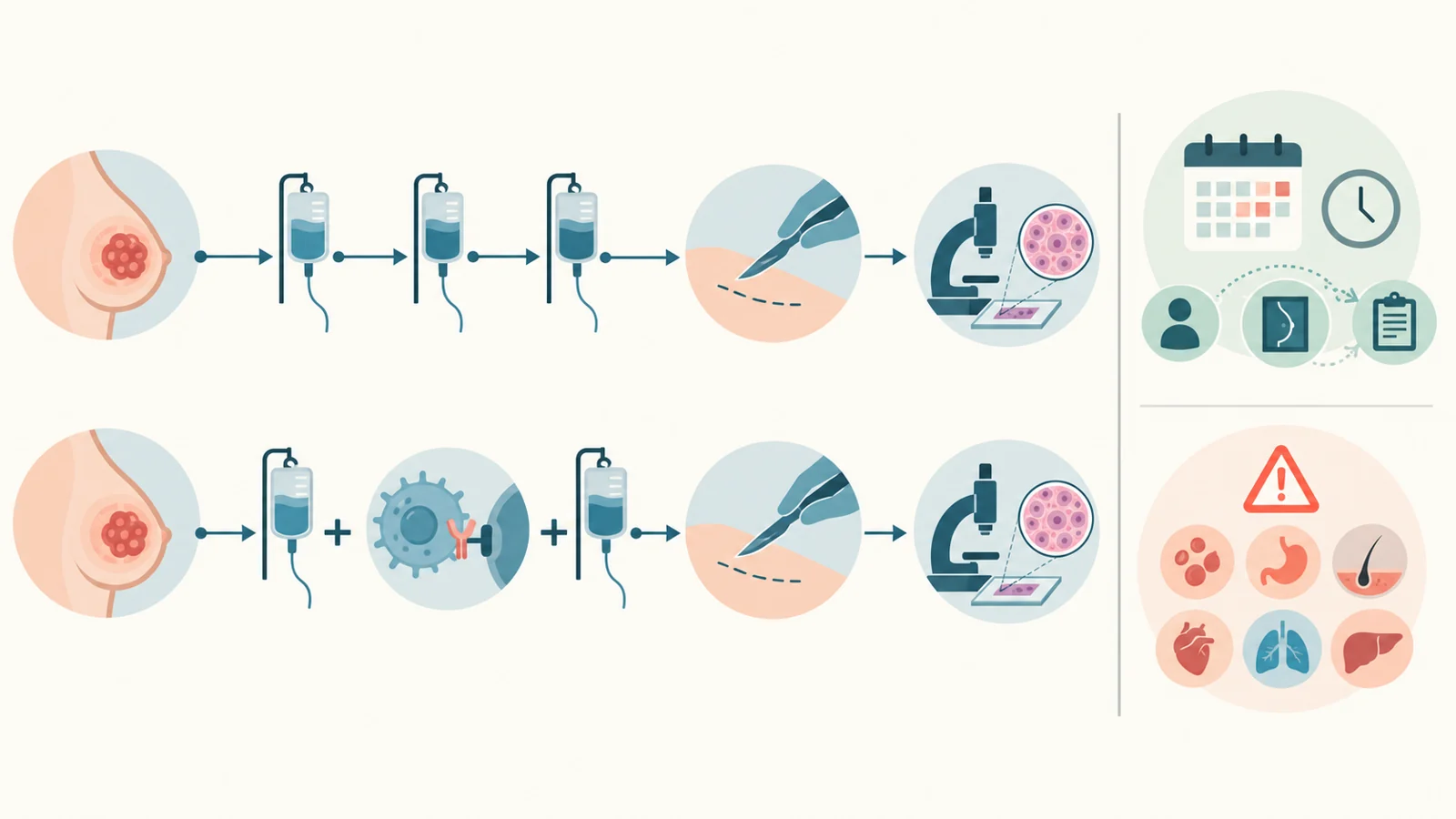
In March 2021, a systematic review and meta-analysis found that adding an immune checkpoint inhibitor to chemotherapy before surgery was associated with more complete responses in early-stage triple-negative breast cancer, alongside more serious side effects. Triple-negative breast cancer is named for the absence of three common treatment targets. The analysis also asked whether the response gain differed according to tumors’ PD-L1 test results, and found similar measured gains in the positive and negative groups.
The researchers pooled five randomized trials involving 2,075 people. They compared chemotherapy before surgery with chemotherapy combined with an immune checkpoint inhibitor. The results offer a snapshot of both tumor response and follow-up events, but the outcomes did not all draw on the same number of trials or the same treatment schedules.
A complete response was more common at surgery
The main response measure was pathological complete response, or pCR: the pathology assessment after treatment found no cancer under the criteria used in the trials. Across the five trials, the odds of pCR were higher with the combination than with chemotherapy alone. The pooled odds ratio was 1.75, with a 95% confidence interval of 1.25 to 2.47 and a p-value of 0.001. The authors also reported an absolute difference of 13.8 percentage points.
An odds ratio compares the odds between treatment groups; it is not a person’s chance of cure. And a response seen in tissue at surgery is a different outcome from remaining free of disease events over time. The distinction matters because a stronger result on pathology can be encouraging without, by itself, telling us whether more people will live longer.
Event-free survival adds a longer view
The analysis also found that event-free survival (EFS) favored the combination. EFS tracks how long people remain free of the disease events each trial counted, including recurrence. The pooled hazard ratio was 0.66 (95% CI 0.48 to 0.91; p = 0.01), which the authors described as about a one-third reduction in the risk of recurrence events. A hazard ratio compares how events accumulate over time between groups; it does not mean that every person’s chance of an event fell by one-third.
This estimate had a narrower base than the pCR result. Two trials reported EFS, and the researchers estimated it for a third from published graphs of when disease events occurred. Overall-survival data were unavailable to this analysis. The authors also noted that higher pCR rates after experimental treatment have not always translated into longer survival in previous breast-cancer research. So the EFS finding adds a meaningful follow-up result, but it does not establish an overall-survival gain or guarantee that the response difference will prevent later recurrences.
PD-L1 status did not split the response result
PD-L1 is an immune marker assessed by tumor tests. The question was whether it could distinguish who appeared more likely to gain a response from adding an immune checkpoint inhibitor. In four trials that reported pCR by PD-L1 status, both test groups had higher response odds with combination treatment. The odds ratio was 1.65 in the PD-L1-positive group and 1.56 in the PD-L1-negative group. A test comparing the subgroup effects found no statistically significant difference (p = 0.80).
That result says the trials did not detect a different response effect between the two groups. It does not prove the effects were identical or show that PD-L1 testing is useless for individual treatment decisions. The trials used different assays and definitions of PD-L1 positivity, and the authors noted that those tests are not fully interchangeable. The pooled comparison therefore cannot settle how the marker should guide a decision for any one person.
Serious and immune-related effects were more frequent
The combination increased the odds of reported grade 3 or 4 adverse events (OR 1.31; 95% CI 1.05 to 1.64; p = 0.02) and serious adverse events (OR 1.84; 95% CI 1.19 to 2.84; p = 0.006). These are separate safety categories, and the odds ratios compare groups rather than giving the number of people affected.
Immune-related effects were an important part of the added burden. The analysis found higher rates of thyroid problems and liver inflammation, as well as rash and infusion reactions. Most measured non-immune effects were comparable between groups, although vomiting was more frequent with combination treatment. Some rare effects, including myocarditis and encephalitis, appeared in only one or two trials and could not be pooled into a reliable estimate.
The odds of adverse events leading to death were also estimated to be higher with combination treatment (OR 1.67), but the confidence interval was very wide (0.36 to 7.76) and the difference was not statistically significant (p = 0.51). This uncertain estimate cannot show that the rates were equal, nor does it provide a precise measure of any increase.
Not every pooled result came from the same treatment schedule
The trials differed in their treatment plans. Two included immune checkpoint treatment after surgery as part of the protocol, so their results did not represent only treatment given before surgery. The pooled estimates combine evidence across these schedules rather than describing one identical regimen.
The populations contributing safety data also varied. One trial enrolled people with triple-negative disease and people with another early breast-cancer subtype. It reported efficacy separately for the triple-negative group, but its adverse-event figures covered the wider cohort. That limits how specifically those safety results can be attributed to people with triple-negative disease. Together with the smaller evidence base for EFS and the differing PD-L1 tests, these differences help define what the pooled results can answer.
Could treatment before surgery prevent more later disease events?
If longer follow-up were to confirm a durable reduction in disease events, and the added immune-related toxicity could be managed, including immune checkpoint treatment in presurgical regimens could help more people with early triple-negative breast cancer remain free of recurrence events. That would extend the value of treatment beyond a more favorable pathology result at surgery. In March 2021, this was a possible clinical payoff, not an established survival benefit.
Key Sources
- Primary source: Efficacy and safety of neoadjuvant immune checkpoint inhibitors in early-stage triple-negative breast cancer: a systematic review and meta-analysis.
DOI or Journal Page · Review or Meta-Analysis · 2021-03-21