
Evidence date · 2023-09-01 · Research note 3 of 3
1 2 3
See current Track status →
Since the previous research note · Earlier expectation not tested
Track continuity
Since the previous research note: Why better tumor response did not settle the treatment trade-off in triple-negative breast cancer
Previous expectation: Future evidence might identify which patients and chemotherapy backbones benefit most from immune-plus-platinum treatment while limiting harm.
What this study adds: This synthesis compares 26 studies involving 9,714 patients and highlights the combination’s pathological complete response and safety profile among treatment options. Its searches covered reports published before March 31, 2022.
What changed in this study
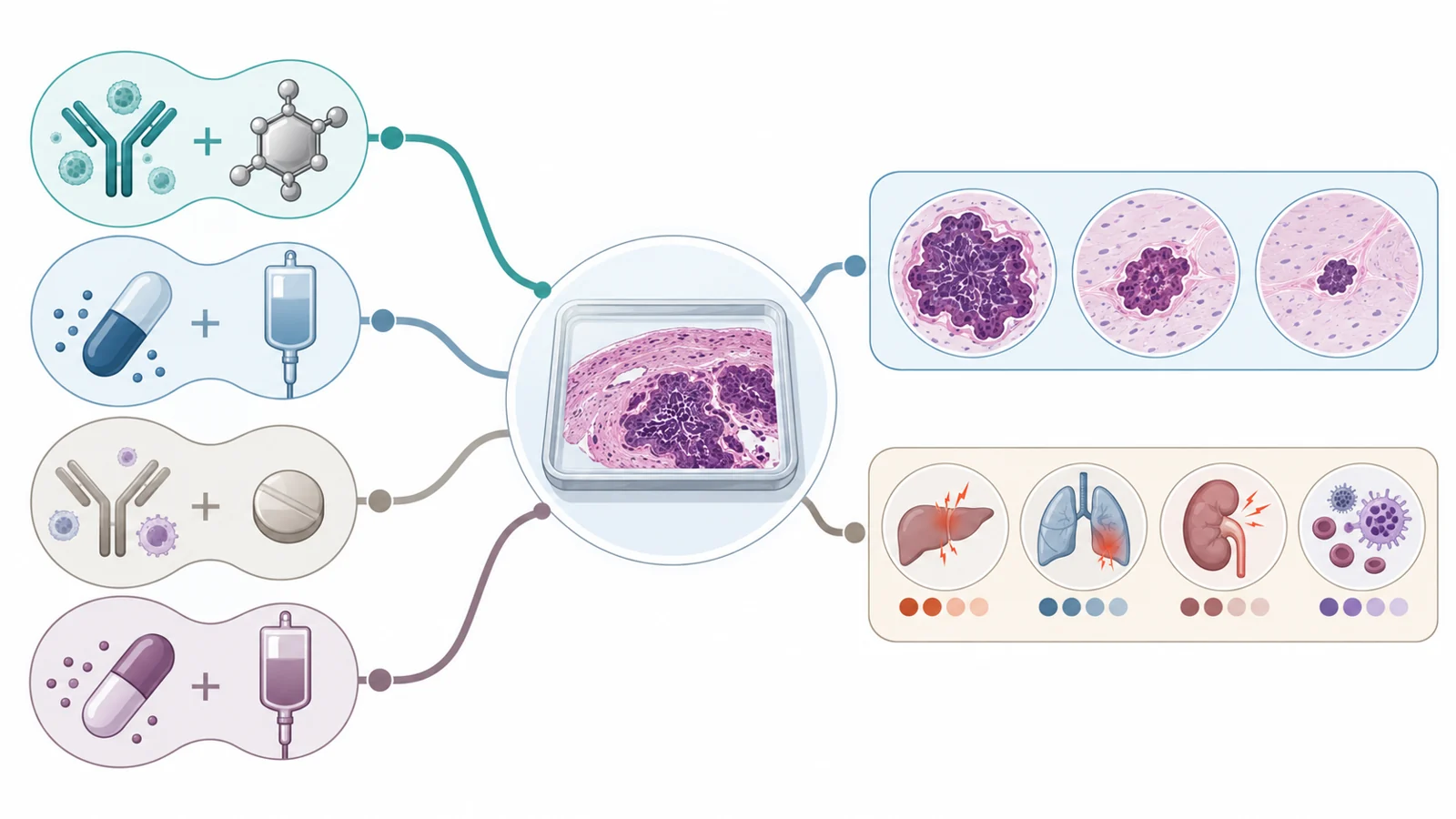
Triple-negative breast cancer describes breast tumors that lack three treatment-guiding markers. When drug treatment is given before surgery, it is called neoadjuvant treatment. A review of these approaches found that immune treatments called checkpoint inhibitors, paired with platinum-containing chemotherapy, stood out on pathological complete response, or pCR—whether cancer remained detectable in tissue examined at surgery. The authors also described this combination as comparatively balanced when response and safety were considered together. The finding is tied to a specific point in care: the tumor response seen at surgery after pre-surgery treatment.
A network linked studies that compared different pairs
The authors searched for reports published before March 31, 2022, across PubMed, Embase and the Cochrane Library, as well as major oncology meeting records. They included 26 studies involving 9,714 people with triple-negative breast cancer.
A pairwise analysis compares treatments that were evaluated against each other in a study. A Bayesian network analysis can also estimate a comparison indirectly: if one set of studies compares treatment A with a shared option, and another compares treatment B with that same option, the network can estimate how A and B relate even if no included study tested them head to head. This lets researchers compare more regimens across the evidence they found, while an indirect estimate remains a model-based link across studies rather than a direct test of the two treatments together.
The response finding came from a wider treatment comparison
The specific finding was that immune checkpoint inhibitors paired with platinum-containing regimens had better pCR results than other joint regimens. The authors also reported higher pCR rates for a wider set of pre-surgery drug regimens than for standard chemotherapy.
These are related but distinct comparisons. The first highlights immune treatment plus platinum among combinations. The broader result concerns regimens containing several added drug classes; it does not show that each class alone produced the difference, or that every mixture had the same result. The summary does not support a complete ranking of all possible combinations.
A surgery-time response has a specific meaning
Pathological complete response is based on tissue assessed at surgery after treatment. It indicates whether cancer is detected in the tissue examined, giving a measure of tumor response at that point in care. In this analysis, pCR was the primary outcome, so it is the clearest basis for the reported comparison.
A stronger pCR result can tell clinicians that a regimen was associated with better tumor clearance by surgery across the compared evidence. It does not, on its own, show that more people live longer or are cured. Those are different outcomes over a longer period, and the surgery-time response finding cannot be treated as a patient-specific prediction.
Safety is part of the treatment comparison
Tumor response is only one part of how a pre-surgery regimen performs. The authors also considered safety endpoints and described immune checkpoint inhibitors plus platinum as comparatively balanced in efficacy and toxicity. That helps explain why the combination stood out in their assessment: a response result was considered alongside treatment harms.
An aggregate balance across studies cannot tell an individual person their own likelihood of experiencing harm. It summarizes outcomes across groups, and it is not a personal risk estimate. The supplied evidence also does not provide the regimen-specific absolute adverse-event rates needed to quantify those risks here.
How comparing combinations could guide pre-surgery care
If direct comparisons and longer-term outcomes confirm that the apparent response advantage is durable and tolerable, evidence like this could help clinicians make better-informed choices among pre-surgery drug combinations for people with triple-negative breast cancer. The practical value would be clearer decisions among available options, grounded in both surgery-time response and safety, with longer follow-up showing whether the difference matters beyond the operation.
Key Sources
- Primary source: Comparative efficacy and safety of first-line neoadjuvant treatments in triple-negative breast cancer: systematic review and network meta-analysis.
DOI or Journal Page · Review or Meta-Analysis · 2023-09-01