
Evidence date · 2026-04-01 · Research note 3 of 3
1 2 3
See current Track status →
Since the previous research note · Partly supported
Track continuity
Since the previous research note: In the brain, should damaged cells be cleared or their signals quieted?
Previous expectation: Carefully chosen treatments might reduce harmful cellular signals while preserving the brain systems needed for memory, provided their biological effects, safety and clinical benefit are demonstrated.
What this study adds: The April 1, 2026 tomatidine study adds improved cognitive-task performance in aged mice alongside reduced inflammatory and senescence-associated markers, while tested human cell cultures primarily showed suppression of secretion-related genes. It did not test a strategy for matching treatments to individual cell populations or establish clinical benefit.
What changed in this study
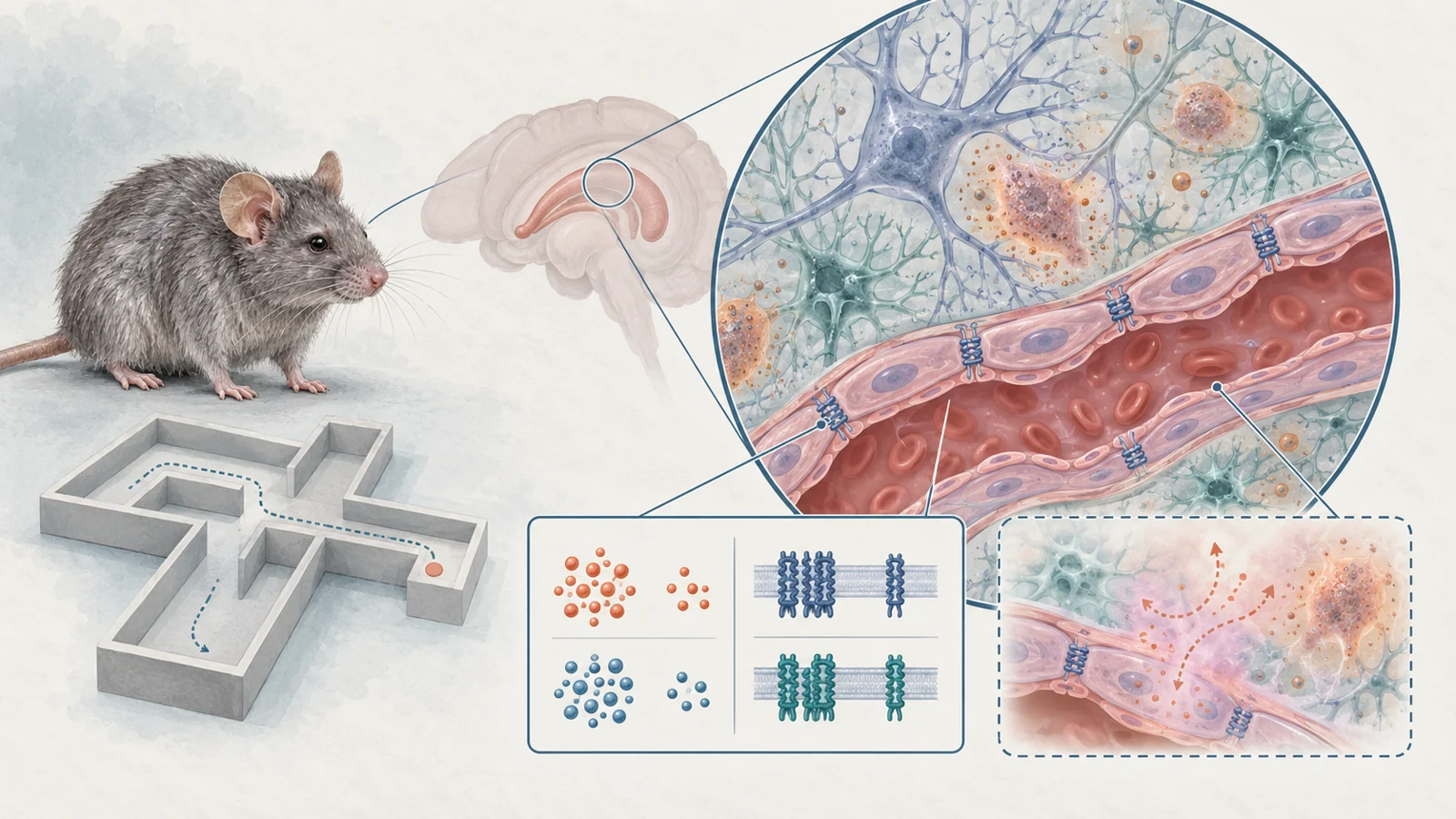
A study published on April 1, 2026, tested tomatidine, a compound related to tomatine found in tomatoes, in mice already well into old age. After three months of receiving tomatidine in their chow, the animals performed better on several measures of learning, memory, coordination and frailty. Their tissues also showed fewer senescence-associated markers and lower signs of inflammation.
The intriguing question is what connects those findings. Did tomatidine remove damaged cells, quiet harmful signals released by those cells, strengthen the brain’s environment, or act through several routes at once? The answer matters because better performance in a mouse maze is not the same as a demonstrated memory treatment for people. It is evidence that a late-life intervention changed both behavior and biology in the same animals, while leaving the causal route unresolved.
The test was a late-life intervention
The researchers used wild-type C57BL/6 mice of both sexes. The animals were 20 months old when obtained and began the dietary experiment at 21 months. One group received standard chow, while the treatment group received chow containing 0.05% tomatidine for three months. A separate group of four-month-old mice served as young untreated controls.
This design tested whether tomatidine could affect age-related function after old age had already begun, rather than starting treatment early and following animals through most of their lives. The researchers assessed a 27-item frailty index, motor coordination and balance, spatial working memory, spatial learning and memory, and performance on a rotating rod.
The dose and route belong to this mouse experiment. They do not provide a human dose, establish that eating tomatoes produces the same exposure, or turn tomatidine into a consumer supplement recommendation.
Better maze performance was selective
Treated aged mice had lower frailty scores than untreated aged mice. They also performed better on the pole test, which measures coordination and balance. The cognitive results came from two maze tasks that answer slightly different questions.
In the Y maze, the animals’ time in a novel arm was used as a measure of spatial working memory. Tomatidine-treated mice showed improved performance on this task. In the Stone T maze, the main result was fewer errors during testing. Treated mice improved across trials and reached error levels comparable to young controls on that measure.
Fewer errors did not mean the mice completed the maze faster. Overall completion time did not differ significantly between aged treatment and control groups. The Rotarod test also showed no significant difference between the groups. That variation is important. The intervention was associated with a pattern of functional improvements, not a blanket return to young-mouse performance across every test.
The findings therefore support a careful statement: older mice receiving tomatidine performed better on several measures of learning, memory and coordination. They do not show that tomatidine reversed biological aging, restored all youthful abilities, or improved memory in humans.
Senescence can be quieted without removing cells
Cellular senescence is a state in which a cell has stopped dividing after stress such as DNA damage or other injury. Senescent cells can still remain active in tissues. One of their effects is to release a collection of inflammatory and tissue-altering molecules known as the senescence-associated secretory phenotype, or SASP.
A senotherapeutic compound can influence this state in more than one way. A senolytic effect means selectively killing or removing senescent cells. A senomorphic effect means changing their harmful behavior, such as reducing SASP-related secretion, without necessarily removing the cells themselves. Tomatidine did not show one universal pattern across the models in this study.
The initial screen used senescent mouse embryonic fibroblasts. At lower concentrations, tomatidine reduced a senescence-associated signal without reducing the total number of cells, which was consistent with phenotype or secretion modulation. At higher concentrations, cell numbers also fell, producing a result consistent with senolytic activity in that particular mouse-cell system.
The human-cell experiments were different. The researchers induced senescence in human lung fibroblasts and human brain microvascular endothelial cells using X-ray irradiation. In both tested cell types, tomatidine reduced SASP-related gene expression without changing p16 or p21 expression. The results were therefore consistent mainly with senomorphic activity in these models, not with broad cell removal.
The timing matters. In the secretion assay, tomatidine was added immediately after irradiation and replenished during a ten-day culture period. That setup can show how treatment affects the cells as they move through the experimental senescence protocol. It should not be described as proof that tomatidine reversed long-established senescence in human tissue.
Tissue markers point to several changes
The investigators then moved from cell cultures to organs in the aged mice. In the liver and skin, tomatidine was associated with lower levels of p16, p21 and telomere-associated DNA damage foci. These measurements provide different views of senescence-associated biology: p16 and p21 are regulators linked to the senescent growth-arrest program, while telomere-associated damage foci indicate persistent damage at chromosome ends.
The brain findings focused on the hippocampus, especially the CA3 region involved in memory processing. Tomatidine-treated mice had fewer hippocampal neurons positive for p16, p21 and telomere-associated damage foci. Similar reductions in senescence-associated markers appeared in the cortex. Neuronal density in the dentate gyrus and CA1 remained unchanged, which argues against interpreting the lower marker counts as simple loss of neurons.
The study also measured microglia, immune cells that respond to changes in the brain environment. In treated aged mice, microglial number and soma size in the hippocampus were reduced, and cytokine profiling showed broad reductions in inflammatory factors. These findings place the behavioral results alongside changes in neuronal markers and inflammatory activity rather than reducing the story to one measurement.
Even so, a lower tissue marker is not a direct record of which cells were removed or which intracellular process changed. The liver, skin and brain results suggest that the dietary intervention had effects across several tissues, but they do not by themselves identify the route by which maze performance improved.
Brain vessels suggest a possible bridge
The study offers one possible connection between cellular senescence and brain function through the cells lining blood vessels. Brain endothelial cells help form the blood–brain barrier, a selective interface between the circulation and brain tissue. The researchers identified these cells using the marker Glut1 and measured senescence-associated markers within them.
Tomatidine-treated mice had fewer Glut1-positive endothelial cells that also expressed p16 or p21. At the same time, the brain vessels showed higher measurements of ZO-1, claudin 5 and occludin, proteins associated with endothelial tight junctions. Single-cell RNA sequencing supported a reduction in p21 expression in brain endothelial cells and an increase in several tight-junction-related genes, although p16 did not significantly change in that analysis.
Those observations make preserved barrier integrity a plausible hypothesis. They do not demonstrate that the blood–brain barrier became less permeable or that this change caused better memory performance. The study did not directly measure blood–brain barrier permeability. The measured protein and gene changes are therefore evidence about the vessel lining, while the functional barrier consequence remains to be tested.
What the experiment still cannot tell us
The study’s results line up across behavior, tissue markers, inflammation and vessel-associated proteins, but coordination is not causation. The experiments do not establish whether tomatidine improved cognition by suppressing SASP factors, removing a subset of senescent cells, changing immune-mediated clearance, altering endothelial function, or acting through several of these routes together. The authors also note that tomatidine’s precise molecular targets have not been defined.
The methods provide some safeguards. The aged mice were randomly assigned to dietary groups, and the study included both males and females. The general methods state that investigators were blinded to group allocation during data collection and analysis when feasible. They also state that no formal power calculation was performed. Those details help readers judge the strength of the evidence without turning a controlled animal experiment into a clinical result.
The treatment period was three months. The authors reported no detectable adverse effects during those three months, with treated mice maintaining normal behavior, body-weight trajectory and overall health. That is a short-term tolerability observation, not comprehensive toxicology or long-term safety. Nor does a mouse study establish improved memory, dementia treatment or dementia prevention in people.
The next scientific challenge is not simply to repeat that several markers moved in a favorable direction. It is to determine which biological change is necessary for the behavioral benefit, whether the effect survives in other aging models, and whether an acceptable safety profile can support translation. Until then, the findings remain preclinical evidence of behavioral improvements accompanied by changes in tissue markers, inflammation and vessel-associated proteins.
What quieter cellular signals could mean for memory
A treatment that could be started later in life and preserve memory or everyday cognitive function by reducing harmful cellular signaling would offer a different path from trying to restore every aging cell to a youthful state. Tomatidine gives that possibility a concrete experimental test: in human cell cultures, secretion-related genes were reduced without broad evidence of cell removal, while aged mice receiving the compound performed better on several cognitive tasks.
That possibility remains conditional. The mechanism must be established, the relevant benefits must translate from mice to people, and acceptable long-term safety must be demonstrated. If those hurdles are cleared, the broader benefit would be a way to protect the brain’s working environment and preserve cognitive function without assuming that every senescence-associated cell has to disappear. This study does not provide that therapy, and it is not evidence that tomatoes or a dietary substitute can deliver it. It shows why the question is now worth testing more precisely.
Key Sources
- Primary source: Tomatidine is a senotherapeutic compound that improves cognitive function and reduces cellular senescence in aged mice.
DOI or Journal Page · Peer-Reviewed Paper · 2026-04-01