
Evidence date · 2024-09-30 · Research note 2 of 3
1 2 3
See current Track status →
Since the previous research note · Earlier expectation not tested
Track continuity
Since the previous research note: What did a five-person Alzheimer's trial learn about drugs intended to clear senescent cells?
Previous expectation: Targeting senescent cells might eventually slow Alzheimer's-related cognitive and functional decline if controlled studies establish effective biological action, acceptable safety and meaningful benefit.
What this study adds: The September 2024 review organizes clearance and suppression around cell identity, delivery and measurement, explaining why a strategy suitable for replaceable cells may differ from one aimed at neurons. This synthesis does not itself test the earlier clinical-benefit forecast.
What changed in this study
What if some cells help drive neurodegeneration not because they have disappeared, but because they remain alive in a harmful state? That question has made senotherapeutics—treatments intended to target senescent cells—an increasingly important area of brain research. It also creates a difficult therapeutic choice. Removing a damaging cell might help, but removing the wrong cell, or interfering with a survival pathway that healthy neurons need, could create a different problem.
A review published on September 30, 2024, in Nature Reviews Drug Discovery examines that problem across neurological conditions. It separates encouraging findings in animal models from the still-uncertain human evidence, and organizes the field around three practical questions: which cells are being targeted, how can a treatment reach them, and how can researchers tell whether it acted as intended? The review describes movement into clinical trials, but it does not establish that senotherapeutics slow cognitive or functional decline in people.
Why a damaged brain cell is not simply a cell that stopped dividing
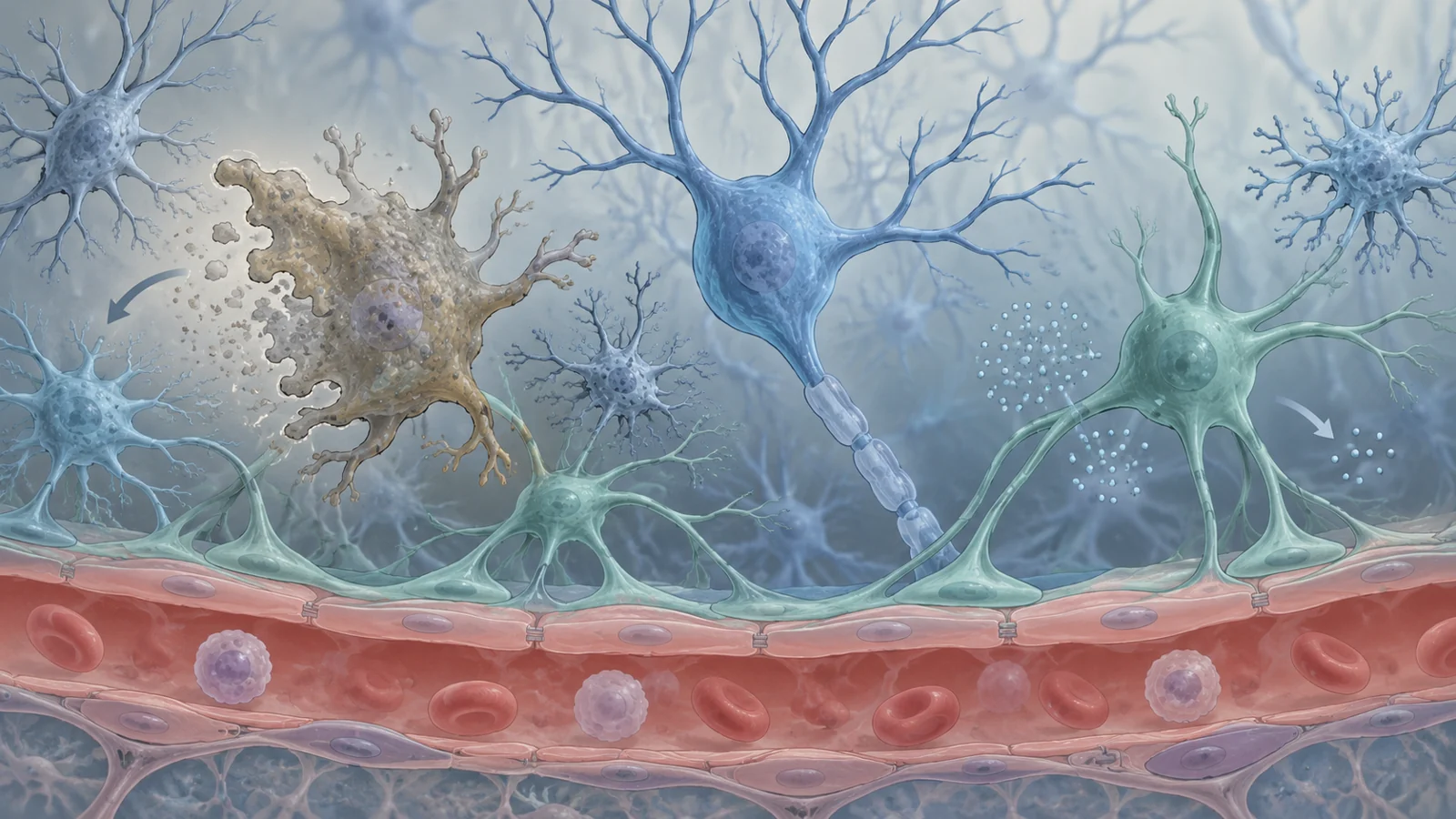
Cellular senescence was first understood as a limit on how many times dividing cells could reproduce. That definition became harder to apply to the brain, where many important cells do not normally divide. Evidence summarized by the review has broadened the concept. Pathological senescence is a sustained change in cell state caused by chronic stress, with altered metabolism, resistance to cell death and persistent changes in signalling. A senescent cell remains active; it is not merely switched off.
Senescent cells can enlarge, change how they process energy and release a mixture of molecules known as the senescence-associated secretory phenotype, or SASP. Those secretions can alter the local environment, communicate with immune cells and promote inflammation. If the cells are not cleared, their signals may damage nearby cells or push healthy neighbours toward a similar state. In the brain, that matters because neurons, support cells and blood-vessel cells operate as an interconnected system rather than as isolated units.
The review describes evidence that several brain cell types can acquire senescence-like features after different kinds of stress. Protein aggregates associated with Alzheimer’s disease may contribute to senescence in neurons, astrocytes, oligodendrocyte precursor cells and vascular cells. Microglia may enter a senescent state after taking up protein aggregates or clearing senescent neurons. In another route, inflammatory signals such as tumour necrosis factor can contribute to neuronal senescence and increase the release of proteins involved in Parkinson disease. These examples do not show that one process explains every neurodegenerative disease. They show why a brain strategy has to account for interactions among cell populations.
The distinction also matters for measurement. A single marker is not enough to identify a senescent cell confidently. The review emphasizes the need for overlapping features in the same cell, such as persistent cell-cycle arrest where relevant, altered morphology, molecular damage and an inflammatory secretory profile. This broader definition is especially important for postmitotic neurons, whose biology cannot be judged by cell division alone.
Two treatment ideas with different consequences
Senolytics are drugs designed to eliminate senescent cells. Senescent cells often survive by increasing several anti-death or pro-survival pathways even while carrying substantial damage. Senolytics aim to disable those survival supports and allow the cell to undergo programmed death. Senomorphics take a different approach: they leave the cell in place while dampening the harmful signals it releases, including parts of the SASP.
The choice is not simply a contest between a stronger and a weaker treatment. It depends on what the cell is doing, how replaceable it is and whether its harmful activity comes mainly from its presence or its secretions. A senolytic approach may be more plausible for a replaceable cell population such as microglia. A non-clearing strategy may be more appropriate for neurons, which are difficult to replace and perform functions the brain depends on. The same broad senescence biology can therefore lead to different treatment choices in different cell types.
One example illustrates the problem. BCL-2 family proteins are among the survival pathways investigated as senolytic targets. Yet BCL-XL, one member of that family, also supports the development and survival of neurons. The review summarizes laboratory findings in which ABT-737 was toxic to stem-cell-derived dopaminergic neurons, while another related compound, ABT-263, had limited ability to cross the blood–brain barrier. In tau-related mouse models, ABT-263 was nevertheless associated with fewer senescent cells in the brain and better behaviour. Those findings make the target interesting, but they also show why a pathway that helps eliminate senescent cells may not be safe to disrupt broadly.
A suppressive approach can have its own tradeoffs. Rapamycin, for example, is not a senolytic, but it has attracted interest because it may reduce SASP activity and promote cellular recycling. The review also notes concerns relevant to translation, including metabolic effects, impaired wound healing and raised blood lipids. A treatment that quiets a harmful signal may preserve a cell, but it still has to be tested for what else it changes in the body.
Reaching the right cells is an anatomical problem
A treatment can be selective in the laboratory and still fail to act where the disease is occurring. The blood–brain barrier limits the movement of many molecules from the circulation into brain tissue. Small molecules with suitable chemical properties may cross more readily, while peptides and antibodies can offer greater molecular specificity but often face difficulties with access, stability or administration. Improving delivery may involve engineering the treatment itself or using transport systems that help it cross the barrier, but the dose reaching one tissue may not match the dose reaching another.
The barrier is not only an obstacle around the brain. Its own vascular cells can become senescent. The review discusses evidence of increased senescence-related gene activity in brain vascular cells from post-mortem Alzheimer’s disease tissue, as well as findings that vascular cells are prominent among senescent cell populations across human tissues. That raises a qualified possibility: a therapy might influence brain function by acting on blood-vessel cells or peripheral immune cells without having to reach every senescent cell inside the brain’s tissue.
Animal findings support the possibility but do not settle the mechanism. ABT-263 does not readily penetrate the blood–brain barrier, yet studies summarized by the review found brain-related benefits after systemic treatment in mouse models involving irradiation, Alzheimer’s-like pathology and glioblastoma. The effects could reflect clearance of peripheral senescent cells, changes in brain vasculature or, in some experimental settings, altered barrier conditions that allowed more exposure than expected. The findings do not by themselves demonstrate direct drug action on senescent cells in the brain.
This is why drug delivery and cell identity have to be considered together. A treatment may be useful even when it does not reach the brain parenchyma uniformly, but that claim requires evidence showing which compartment changed and how that change could affect brain function. The relevant question is not simply whether a molecule entered the brain. It is whether the intended cell population experienced the intended biological action at a tolerable exposure.
The hardest step is proving what the treatment did
There are three different claims in this field, and they should not be collapsed into one. First, researchers must identify a senescent cell. Second, they must show that a treatment engaged its intended target or changed the relevant senescence-related process. Third, they must determine whether that biological change improved something meaningful for a patient. Each step needs its own evidence.
In animal studies, target engagement can be assessed directly through brain tissue, using histology, protein measurements and gene-expression patterns. In living people, researchers need less direct approaches. MRI can track changes in brain structure and physiology over time, but it does not show that a senotherapeutic disabled a survival pathway or reduced the SASP in a particular cell. A changed scan may be useful as a measure of tissue effects, yet it is not a direct readout of senescent-cell clearance.
Imaging designed to label senescent cells faces a related problem. Tracers aimed at lipofuscin or beta-galactosidase are being developed, but the review notes that both features can also appear in healthy central nervous system tissue over the lifespan. A signal may therefore be difficult to interpret without additional evidence about cell type and context.
Blood and cerebrospinal-fluid measurements offer another route. Levels of p16 messenger RNA in circulating T cells have been explored as a possible surrogate for overall senescent-cell burden, and panels of cytokines, chemokines, proteases and growth factors can describe inflammatory activity. But those secreted factors can rise for reasons other than senescence. A lower inflammatory measurement might reflect a treatment effect, a change in another cell population or ordinary variation in a complex disease. The review describes these markers as promising tools, while emphasizing the need for better understanding of how the secretory profile differs by cell type and situation.
Clinical activity therefore represents progress in testing the idea, not proof that the idea works. The review reports more than 20 senolytic trials under way at the time of publication, including four focused on central nervous system conditions. The existence of those trials shows that the field has moved beyond purely theoretical discussion. It does not establish durable safety, reliable target engagement or meaningful benefit for people with neurodegenerative disease.
What selective treatment could mean for brain health
The most useful future version of senotherapy would not treat senescence as a single uniform enemy. It would match clearance or signal suppression to the cell population involved, the way that population harms its surroundings and the route by which a treatment can reach it. That could make it possible to reduce damaging cellular signals while preserving the neurons and support systems people depend on for memory and everyday function.
For people facing neurodegenerative cognitive decline, this approach could open an additional therapeutic route if controlled studies demonstrate effective biological action, acceptable safety and meaningful clinical benefit. As of September 2024, the review makes that possibility visible while leaving the central patient question open: whether carefully chosen senotherapeutics can improve brain health in people, rather than only produce encouraging changes in experimental models.
Key Sources
- Primary source: Therapeutic targeting of senescent cells in the CNS.
DOI or Journal Page · Review or Meta-Analysis · 2024-09-30