
Evidence date · 2024-06-03 · Research note 2 of 3
1 2 3
See current Track status →
Since the previous research note · Earlier expectation not tested
Track continuity
Since the previous research note: Engineered natural killer cells deliver an extra protein to mouse breast tumors
Previous expectation: Engineered natural killer cells might help patients with resistant HER2-positive breast cancer by combining tumour recognition with local delivery of an immune-inhibition-relieving protein.
What this study adds: The June 2024 study compares seven CD19 receptor designs in cord-blood natural killer cells against leukaemia, distinguishing tumour-killing performance from persistence in mice. It does not test the earlier HER2-targeted delivery strategy or its forecast for resistant breast cancer.
What changed in this study
A cancer-killing immune cell can be given the same target-recognition system and still behave differently depending on what sits behind it. A June 3, 2024 study tested that idea by comparing seven engineered receptors in natural killer cells made from umbilical cord blood. All seven were designed to recognize CD19, a surface marker found on B cells, including the leukemia cells used in the experiments.
The result was not a single all-purpose winner. CAR1, a design without an added co-stimulatory module, produced the strongest leukemia-killing results in the laboratory and the best overall treatment effect in mice. CAR3, which added an OX40 module to a similar basic structure, showed the strongest relative persistence in mouse blood. The comparison therefore separates two questions that are easy to blend together: how forcefully cells attack a target and how long engineered cells remain detectable after treatment.
Seven receptors asked a practical question
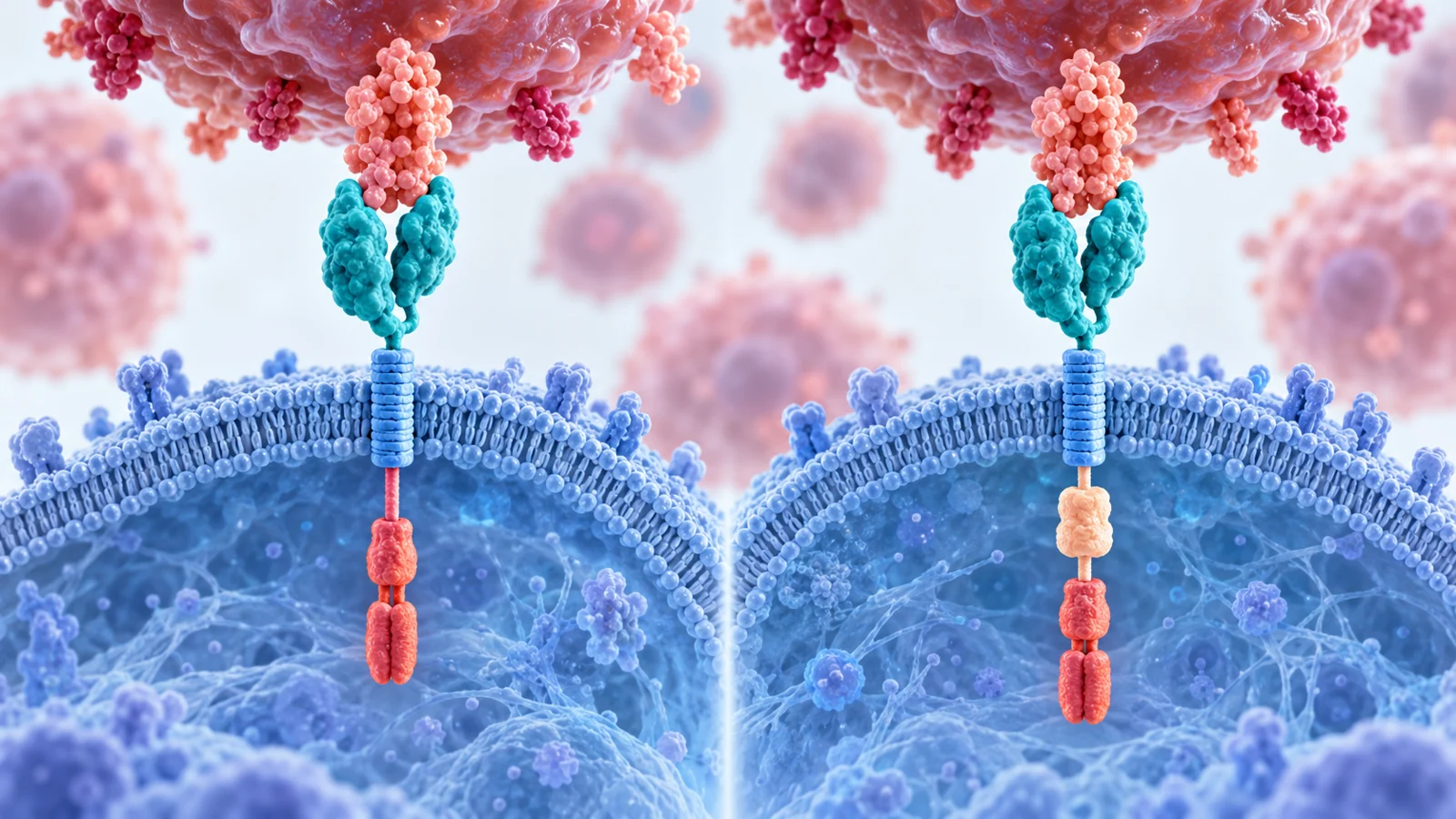
A chimeric antigen receptor, or CAR, is an engineered receptor that gives an immune cell a new way to recognize a target and connect that recognition to activation. Its outside portion binds the target. A membrane-spanning section holds the receptor in place, while internal signaling components tell the cell how to respond.
The seven receptors used the same anti-CD19 recognition element, but varied in their membrane anchors and internal signaling machinery. CAR1 used a CD8 membrane anchor and a CD3ζ signaling domain. CAR3 kept those components and added OX40, a co-stimulatory module intended to influence activation and persistence. Other designs used FcεRIγ, CD28, 4-1BB or a shortened CD3ζ signaling arrangement in different combinations.
That structure let the researchers compare the consequences of receptor architecture while holding much of the surrounding system steady. They used cord-blood-derived natural killer cells from three donors, adjusted the packaged retroviruses to the same measured titer and exposed the cells to the same multiplicity of infection. The resulting CAR expression rates were also broadly comparable. These controls cannot erase all biological variation, but they make differences between the designs easier to interpret than a comparison built from unrelated cell sources or unequal delivery conditions.
The ranking depended on how many targets each cell faced
In the first laboratory test, the engineered cells were mixed with Nalm-6 cells, a human B-cell acute lymphoblastic leukemia line. The researchers varied the effector-to-target ratio, meaning the number of immune cells available for each leukemia cell. A ratio of 0.2:1, for example, placed roughly one engineered immune cell against five target cells, while 1.6:1 supplied more immune cells than targets.
All seven CAR-NK groups killed more leukemia cells than the unmodified and control-cell groups. CAR1 stood out most clearly when engineered cells were relatively scarce. Its advantage was significant at the lower tested ratios and remained visible at the highest ratio, although the gap narrowed as more effector cells were added. At 1.6:1, CAR1, CAR2, CAR3 and CAR4 formed a stronger-performing group, while CAR5, CAR6 and CAR7 were comparatively weaker. CAR5, which paired a CD28 membrane anchor with an FcεRIγ signaling domain, showed the weakest specific cytotoxicity in this assay.
The ranking changed less dramatically when the researchers asked whether the cells could keep responding to repeated exposure. In a serial-killing experiment, fresh leukemia targets were added for three consecutive rounds, with each round lasting 12 hours at a 1:1 ratio. All seven engineered-cell types maintained robust killing across the three rounds. The control NK-cell groups lost killing ability more noticeably over the same repeated challenge.
That finding matters because a low-cell-number encounter and a repeated-target encounter test different capabilities. CAR1’s advantage was most apparent when the available attackers were limited. The three-round result showed that even designs with lower single-assay cytotoxicity could continue killing under the conditions tested. It did not turn every construct into an equivalent candidate, but it prevented one short exposure measurement from carrying the entire interpretation.
Mouse results separated control from persistence
The researchers then moved from cell cultures to mice carrying human leukemia cells. They injected luciferase-labelled Nalm-6 cells into immune-deficient animals and assessed tumor engraftment. On day 0, one day after leukemia-cell injection and on the same day as the engraftment assessment, the irradiated mice received thawed CD19 CAR-NK cells or control NK cells by intravenous injection. The animals also received repeated interleukin-2 support every two days through day 14, and tumor progression was monitored by bioluminescent imaging.
The treatment groups did not perform identically. CAR1 produced the strongest anti-tumor effect in the comparison, and CAR1 through CAR4 were associated with better survival than the weaker-performing CAR5, CAR6 and CAR7 groups. These results placed the first-generation CAR1 design at the top for tumor control in this particular leukemia xenograft system.
The blood measurements added a different dimension. Human NK cells and CAR-positive NK cells could be detected in the circulation on day 7, but circulating human-cell levels declined substantially by day 14 across the groups. At day 14, the percentage of CAR-NK cells measured in peripheral blood was highest in the CAR3 group and lowest in the CAR5 group. CAR3 therefore supplied evidence of a relative persistence advantage under the study’s conditions, not evidence of permanent residence in the body or durable remission.
The two results can coexist. A receptor that drives strong early killing is not automatically the design that leaves the most detectable cells in circulation later. The study’s value is partly in showing why those outcomes should be measured separately rather than compressed into one ranking.
A strong design still has to make enough cells
Receptor performance also affected the manufacturing-like stage before testing. The researchers activated and expanded the cord-blood NK cells, introduced the receptors with a retroviral system and then cryopreserved the engineered cells. Across the seven groups, most designs expanded within a broadly similar range. CAR4 was the exception: it showed weaker expansion, reaching a lower cell output than CAR6 in the reported comparison.
This is more than a laboratory footnote. A design that kills well but expands poorly may be harder to turn into a practical cell product, because useful activity depends on producing enough cells with consistent properties. The result also shows why adding signaling machinery is not automatically an upgrade. CAR4 included both OX40 and FcεRIγ, yet its expansion capacity was weaker than the other designs in this system.
The experiments used cryopreserved material in ways that mirrored different questions. For the animal work, thawed cells were washed and infused soon afterward. For the short laboratory killing assay, another portion was thawed, allowed to recover for 48 to 72 hours, and then sorted for CAR-positive NK cells before testing. Those are controlled experimental choices, but they are not the same as demonstrating a validated clinical product with a defined shelf life, routine availability or known performance after repeated storage and transport.
Exhaustion markers added a second layer of uncertainty
After repeated contact with leukemia targets, the researchers examined activation receptors and exhaustion-associated markers. The engineered cells continued to show the characteristic killing behavior described in the serial assay, while markers including TIGIT, TIM-3 and PD-1 generally increased after prolonged target engagement. CAR7 showed the highest exhaustion-marker expression in the comparison. CAR2 and CAR4 showed lower PD-1 expression than some of the other groups.
Marker expression and functional failure are related questions, not interchangeable measurements. The cells’ continued killing across three rounds means that increased exhaustion-associated markers did not, under those assay conditions, amount to an immediate loss of cytotoxic activity. At the same time, the marker pattern raised a possible next direction for the authors: combining CAR-NK cells with immune checkpoint inhibitors that target such receptors. That combination was proposed as an extension to investigate, not demonstrated as a treatment benefit by this study.
The boundaries of the comparison are specific. It used cord-blood NK cells from three donors, a single CD19-positive leukemia model for the central assays, retroviral engineering and a mouse treatment schedule that included irradiation and repeated interleukin-2. The findings support configuration-specific differences among these seven constructs in this setting. They do not establish a universally optimal receptor, patient benefit, acceptable clinical safety or superiority to CAR-T treatment. Nor does relative CAR3 persistence in mouse blood establish whole-body distribution or lasting persistence in people.
What this could mean for ready-to-use leukaemia cell therapies.
The longer-term possibility is a banked supply of engineered natural killer cells that can be thawed when needed, recognize CD19-positive leukemia and retain enough activity to help control tumors. Patients would be the eventual beneficiaries if a design can preserve effective function after storage, expand reliably and produce sufficiently durable tumor control with acceptable safety in people.
The June 2024 study does not establish that capability. It identifies a useful engineering tension instead: CAR1 delivered the clearest killing advantage in the tested leukemia models, while CAR3 gave the strongest persistence signal in mouse blood and CAR4 revealed a production constraint. Resolving how those properties combine in a usable, durable and safe cell therapy would determine whether the comparison becomes more than a laboratory guide to receptor design.
Key Sources
- Primary source: Comparison of seven CD19 CAR designs in engineering NK cells for enhancing anti-tumour activity.
DOI or Journal Page · Peer-Reviewed Paper · 2024-06-03