
Evidence date · 2025-04-01 · Research note 3 of 3
1 2 3
See current Track status →
Since the previous research note · Earlier expectation not tested
Track continuity
Since the previous research note: How receptor design changes what engineered natural killer cells can do against leukemia
Previous expectation: Banked engineered natural killer cells might offer ready-to-use leukaemia treatment if their activity survives storage and translates into durable, acceptably safe tumour control.
What this study adds: This review connects non-viral receptor delivery and stable modification with cell-source, manufacturing and storage constraints. Its supplied evidence does not test whether the earlier receptor designs deliver the forecast banked-treatment capability.
What changed in this study
Cancer immunotherapy is not only a question of finding a receptor that recognises a tumour. The cells carrying that receptor must also be made in sufficient numbers, retain their useful functions, survive the journey into the body and be available at the time a patient needs treatment.
Natural killer cells, or NK cells, offer an appealing starting point. They are immune cells with built-in killing capabilities, so they can attack abnormal cells without first being sensitised to a particular tumour antigen. Researchers can add a chimeric antigen receptor, or CAR, to give them another route for recognising a chosen target on cancer cells. The result is a CAR-NK cell with both an added targeting system and the natural machinery of an NK cell.
A major attraction is that the cells need not necessarily come from the patient receiving them. That creates the possibility of preparing batches in advance rather than collecting and modifying a patient’s own cells for every treatment. But getting closer to that possibility involves more than removing a viral carrier. The delivery method affects how long the receptor lasts, whether DNA is integrated, how the cells behave during manufacture and whether the final product can be stored.
Why natural killer cells are attractive starting material
CAR-T cells rely heavily on their engineered receptor to identify a target. NK cells can use the CAR pathway while retaining other ways of recognising and damaging abnormal cells. Their natural cytotoxicity receptors can contribute to killing even when the target is not defined by the CAR, and an Fc receptor on NK cells can support antibody-dependent cell-mediated cytotoxicity.
The cell source also changes the manufacturing problem. Autologous T-cell collection can be difficult when previous treatment has left a patient with few suitable T cells. CAR-NK approaches may instead use cells from a donor, a cell line or an induced pluripotent stem-cell route, depending on the design. The goal is not simply a different immune-cell identity. It is a supply model in which a tested cellular product might be prepared before an individual treatment appointment.
Clinical observations discussed in the April 1, 2025 review help explain why CAR-NK therapy has attracted attention, including a cord-blood-derived, HLA-mismatched anti-CD19 CAR-NK trial in which the 11 treated patients did not experience cytokine release syndrome or neurotoxicity. Those observations belong to the broader CAR-NK field. They do not validate every non-viral engineering method described in the same review, and they do not show that a stored, non-viral product is already an established treatment.
The first choice is what reaches the cell
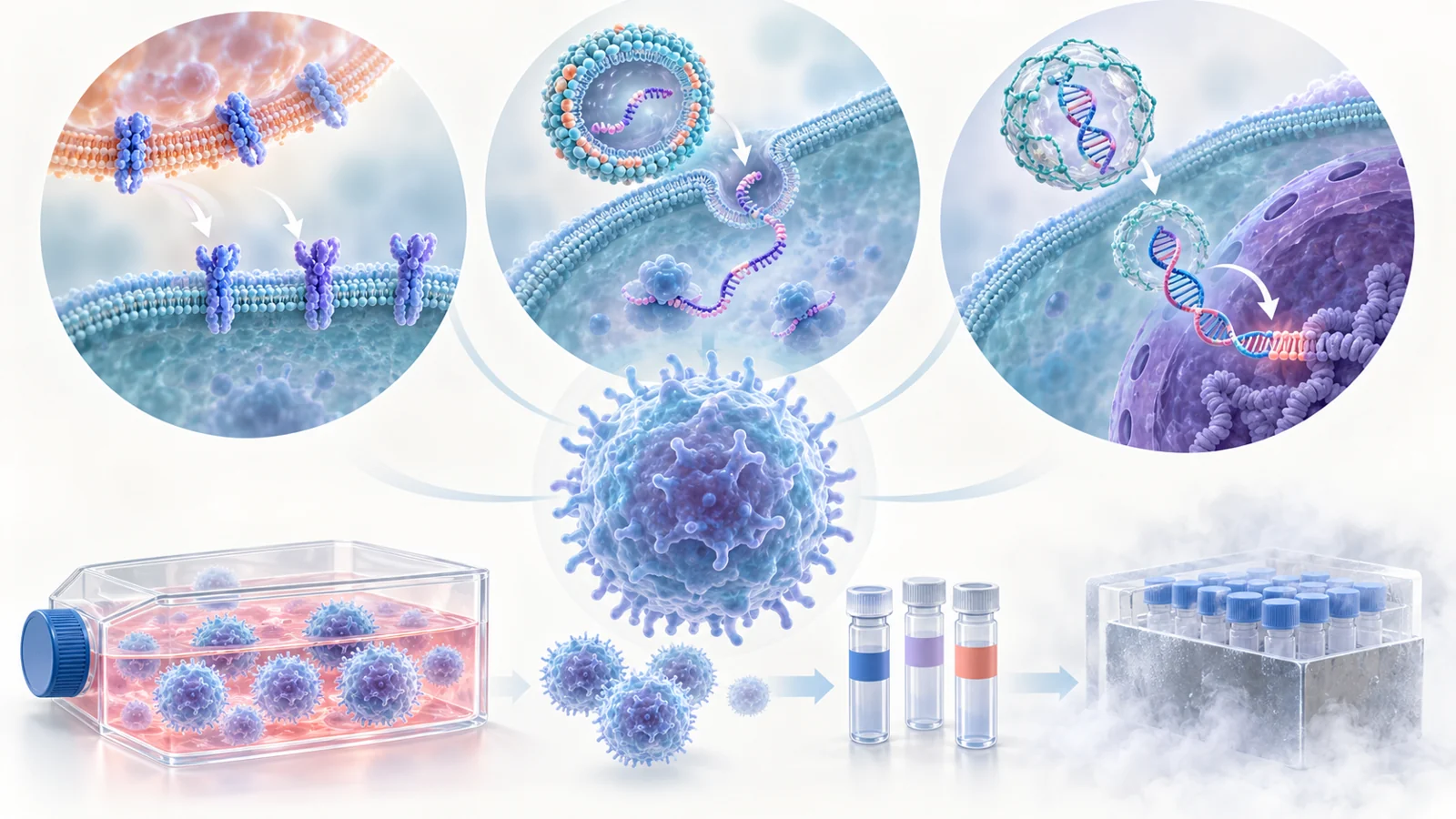
One non-viral route does not behave like another. Trogocytosis transfers pieces of cell membrane and the proteins embedded in them when cells make contact. In the review’s examples, engineered donor cells carried an anti-CD19 CAR that NK cells acquired through contact. The process is closer to handing over a finished surface protein than to giving a cell genetic instructions for making one.
That can make trogocytosis fast and conceptually direct, but the transferred material may be temporary. In one set of observations described by the review, CAR expression reached about 80% of NK cells after co-incubation with live antigen-presenting cells, compared with about 50% when nonviable donor cells were used. Those figures describe particular experimental arrangements, not a general performance ranking.
Trogocytosis also shows why delivery is not automatically beneficial. NK cells can acquire inhibitory molecules such as PD-1 from leukaemic cells. They may also take up tumour antigens. Acquiring tumour antigens can lead to repeated CAR activation, fratricide (NK cells killing one another) and exhaustion. Transfer from a tumour cell can also reduce antigen density on that target, potentially helping the tumour evade recognition. The same cell-contact process therefore raises questions about what else moves between the cells and how long the transferred material remains useful.
Temporary instructions can be useful without being permanent
Electroporation uses electrical pulses to help cargo enter cells. When the cargo is messenger RNA, the cell can use that temporary instruction to produce a CAR without requiring the message to become a permanent part of the genome. The review describes mRNA electroporation as a rapid approach that can preserve viability, phenotype and cytotoxic function in particular studies while producing high CAR expression for a limited period.
The working window matters. In the examples summarised by the review, high expression after mRNA electroporation could last roughly three to seven days, and some preparations required reinfusion within seven days because the CAR was transient. A temporary receptor may be useful when a short burst of engineered activity is the intended design, but it creates a scheduling and dosing problem if therapeutic activity requires a longer period.
Lipid nanoparticles, or LNPs, offer another way to deliver mRNA. The lipid carrier packages the message and helps it enter the NK cell; it does not turn the message into a permanently integrated DNA sequence. The review describes LNP studies in expanded primary NK cells in which BCMA-CAR mRNA produced expression in 95% of cells and CD19-CAR mRNA in 78%. Those percentages come from different constructs and preparations, so they cannot be read as a head-to-head leaderboard. They show that lipid delivery can produce substantial receptor expression in selected experiments while leaving the question of duration and downstream treatment performance open.
Stable DNA changes open a longer route
Transposons address a different problem. They are DNA systems that can move a gene cassette into the cell’s genome, using a transposase to insert and, in some systems, later mobilise the cargo. Sleeping Beauty, PiggyBac and Tol2 are among the transposon families discussed in the review. Their appeal is the prospect of stable gene expression without using a viral vector.
Stable insertion changes the engineering trade-off. It may reduce the need to repeatedly deliver a short-lived receptor, but it also makes the location and pattern of genomic insertion important. Genetic modification can create genotoxicity concerns, and the absence of a virus does not remove those concerns. The review notes that PiggyBac insertion patterns resemble those of some retroviral systems and describes lymphoma cases in two patients who received CAR-T therapy using non-viral PiggyBac vectors. These observations are a warning about the safety questions surrounding stable genetic engineering; they do not establish the frequency or cause of malignancy in CAR-NK recipients.
CRISPR-Cas9 has a different role from a transposon. CRISPR is a gene-editing tool that can disrupt or alter a chosen gene, while a transposon is a delivery and insertion system for genetic cargo. The two can be combined. The review describes a primary-NK approach using transposon engineering and CRISPR-Cas9 that generated CLL-1 CAR-NK cells with antigen-specific activity against CLL-1-positive AML cell lines and primary AML populations.
The review also discusses a CAR-insertion strategy demonstrated in T cells, in which CRISPR editing placed a CD19 CAR cassette under the control of an endogenous T-cell receptor promoter. That example is relevant as a possible engineering model, not as direct evidence that the same result has been achieved in CAR-NK therapy. A method that works in one immune-cell type still has to be adapted and tested in the cells intended for treatment.
A modified cell is not yet a usable treatment
A common source of confusion is treating receptor expression as the same thing as therapeutic success. The fraction of cells displaying a CAR is one manufacturing or laboratory endpoint. It does not tell us how strongly those cells kill a tumour target, how long they remain functional, how they behave in a patient or whether patients live longer.
The reviewed examples make the comparison especially difficult. They use different NK-cell sources, receptor targets, cargoes, delivery systems and measurement times. One study may report the proportion of cells expressing a receptor after electroporation, while another measures expression after LNP delivery. A third may assess killing against a particular cell line. Even high expression percentages cannot be combined into a common technology score when the cell preparations and endpoints differ.
The same discipline applies to broader clinical observations. A CAR-NK trial can provide information about the behaviour and tolerability of a particular cellular product, but it does not automatically prove that a non-viral delivery method produced the result. To judge whether an engineered cell is becoming a treatment, readers need a chain of evidence connecting modification to retained function, tumour control, patient outcomes and acceptable safety.
Receptor delivery does not solve the tumour environment
Once engineered cells enter a tumour, they face a separate obstacle. The tumour microenvironment can contain cellular and soluble signals that suppress immune-cell activity. The review highlights soluble NKG2D ligands that can reduce NKG2D expression on NK cells, along with other soluble factors that weaken NK-cell antitumour actions. During ex vivo expansion, NK cells may also acquire checkpoint receptors that compromise their potency.
This is why adding a cancer-recognition receptor and removing an inhibitory pathway are not the same intervention. A CAR can improve recognition of a selected antigen, while gene editing may try to preserve function under suppressive conditions. The review describes CRISPR-Cas9 work aimed at disrupting inhibitory signalling genes such as ADAM17 and PD-1, and it discusses targets connected with IL-15 signalling, NKG2A, TIGIT and CD96. These are strategies for changing the cell’s response state, not simply for giving it another address label.
The possibility of editing exhausted or inhibited NK cells is promising, but the engineering objective remains distinct from proving clinical benefit. A cell that shows stronger activity in an experimental setting still has to function in the complex environment of a human tumour and remain suitable for manufacture and infusion.
From cell source to a dose that can be stored
The practical sequence begins before gene delivery. Donor-derived NK cells vary in how well they expand and how much functional capacity they retain. Each batch must be checked, which can delay treatment. NK-92 cells can be expanded to large doses and have been studied as a possible off-the-shelf source, but their status as a transformed cell line creates concerns about genetic stability. They must be irradiated for clinical use to limit their lifetime activity, adding another constraint to the product.
Induced pluripotent stem cells offer a different scale opportunity. They can be expanded and differentiated into more homogeneous NK-cell populations, potentially reducing some of the variability associated with individual donors. CAR-engineered iPSC-NK cells have shown the ability to target human tumours in the studies reviewed. At the same time, prolonged culture raises unresolved concerns about genetic instability, and iPSC-derived products may carry tumorigenicity risks that require careful control.
After expansion and batch validation comes storage. Freshly expanded cells cannot always be prepared at exactly the moment a patient is ready for infusion. Cryopreservation could allow quality testing, logistics and clinical scheduling to be coordinated. The freezing medium matters because conventional dimethyl sulfoxide, or DMSO, can affect cell biology and has been associated with changes in immune-cell markers, reduced function and toxicity. The review discusses efforts to refine freezing media, including nanoparticle-mediated intracellular protection and DMSO-free approaches.
A cell that survives freezing is not automatically a cell that remains clinically useful after thawing. The product must retain the relevant phenotype, cytotoxic activity and manufacturing quality, and those properties must translate into durable tumour control with acceptable safety in people. In the April 2025 perspective of the review, storage is therefore part of the treatment technology rather than an afterthought.
What banked NK-cell treatments could mean for patients
The long-term promise is a cancer-targeting immune-cell dose manufactured and stored before an individual patient needs it. Reliable banked CAR-NK products could reduce dependence on collecting and engineering each patient’s own cells, while allowing infusion to fit the timing of clinical care. That could make treatment logistics simpler and, potentially, improve access or reduce costs.
Those benefits remain conditional. They depend on dependable large-scale production, validated quality control, retained function after thawing and durable tumour control with acceptable safety in people. Non-viral delivery creates several routes toward a ready-to-use cell therapy, from temporary protein or mRNA delivery to stable genetic modification, but it does not by itself prove that the final product will work as a stored treatment. The opportunity identified by this April 2025 review is a manufacturing and clinical possibility: immune cells could be engineered ahead of time and brought to patients on schedule if the remaining biological and technical bottlenecks can be solved.
Key Sources
- Primary source: Revolutionising Cancer Immunotherapy: Advancements and Prospects in Non-Viral CAR-NK Cell Engineering.
DOI or Journal Page · Review or Meta-Analysis · 2025-04-01