
Evidence date · 2024-06-20 · Research note 2 of 2
1 2
See current Track status →
Since the previous research note · Earlier expectation not tested
Track continuity
Since the previous research note: Could targeting abnormal brain cells reduce seizures in mice?
Previous expectation: Selectively removing pathological cells might eventually help children with focal cortical dysplasia control seizures while reducing the need for extensive brain surgery.
What this study adds: This study examined systemic senolytic pretreatment in aged mice facing chemically induced status epilepticus and found reduced acute seizure severity and improved survival. It did not test focal-lesion targeting, pediatric disease or an alternative to surgery.
What changed in this study
An aging brain becomes more vulnerable to seizures, but the biological reasons are not fully understood. A study published on June 20, 2024, tested whether targeting senescent cells before a seizure insult could change that vulnerability in aged mice.
Senescent cells have entered a persistent state in which they stop dividing and resist normal removal. They can also release inflammatory signals. Dasatinib and quercetin, used together in this study, are senolytic drugs intended to eliminate some senescent cells. The treatment improved the aged mice’s response to an experimentally induced episode of prolonged seizure activity. It also improved spatial memory before the insult. Afterward, however, the treated survivors did not show a detectable memory advantage, and the experiment did not establish whether the treatment prevented later epilepsy.
A months-long test before a controlled seizure challenge
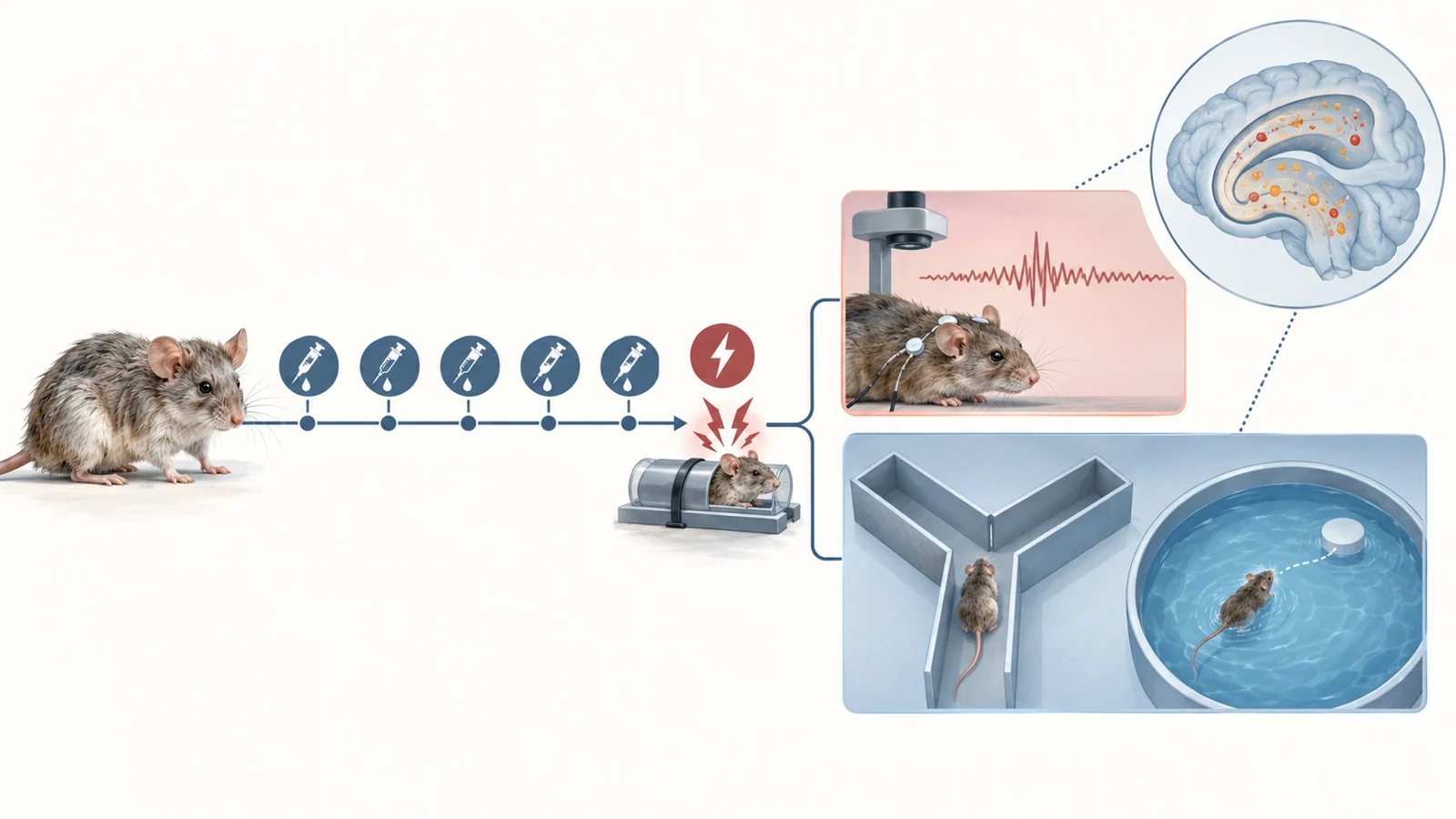
The researchers compared aged C57BL/6J mice with and without the drug combination and included young mice as an age comparison. The aged animals were 18 months old when seizure susceptibility was tested. Beginning at 14 months, aged mice received weekly injections of dasatinib and quercetin, or a vehicle preparation containing neither drug, for 16 weeks. Treatment continued after the seizure experiment.
The researchers then used pilocarpine to induce status epilepticus. In this model, status epilepticus means prolonged seizure activity that does not stop on its own. The animals were monitored for behavioral seizure signs and for how long they remained in the acute challenge before seizure activity was reduced with diazepam. The study measured whether mice reached status epilepticus, how severe their observed seizure behaviors became and how long they survived during the challenge. Observers collecting and analyzing the data were blinded to treatment and age.
This design tested prevention by pretreatment. It did not test a regimen first given during or after a seizure. It also created a deliberately specific comparison: an aged mouse exposed to a chemical seizure challenge after months of treatment, rather than a person receiving a clinically established preventive therapy.
The treated aged mice were slower to reach status epilepticus
Among the aged mice, 83% of those given dasatinib and quercetin reached status epilepticus, compared with 100% of the vehicle-treated aged mice. The onset was also later in the treated group. The reported latency was 72 minutes after pilocarpine for treated aged mice and 30 minutes for aged mice given the vehicle.
Behavioral seizure scores showed a similar shift in the acute response. The median score was 4 in treated aged mice and 5 in vehicle-treated aged mice. These scores reflected observable seizure behaviors, not a direct measurement of every electrical event in the brain. The young comparison group had a lower median score and was less likely to reach status epilepticus, showing that treatment moved the aged animals toward greater resilience without making their response identical to that of young mice.
Survival during the challenge also improved with pretreatment. Reported survival duration was longer in the treated aged group than in the vehicle-treated aged group, and the treated aged mice did not differ significantly from the young mice on that measure. The pattern suggests that the combination shifted the severity and timing of the acute response. It did not prevent every treated aged mouse from entering status epilepticus, and the challenge remained a chemically induced laboratory event.
Memory improved before the insult, then the picture changed
The researchers assessed spatial memory at two different points with two different navigation tasks. Before seizure induction, after four months of treatment, the aged mice given dasatinib and quercetin learned the Barnes Maze more quickly than the vehicle-treated aged mice. In the probe test, which assessed memory for the escape location after training, the treated mice took a reported 51 seconds to find the escape platform, compared with 71 seconds for the vehicle group.
The Barnes Maze uses a dry circular platform with an escape location, while the later Morris Water Maze assesses navigation in water. Both tasks examine spatial learning and memory, but using different tests helped the researchers avoid carryover effects from repeatedly testing the same task. The timing also matters. The first assessment measured age-associated memory function before the seizure insult; it did not show that the treatment had already protected the animals from epilepsy-related injury.
The second assessment took place eight weeks after status epilepticus, while treatment continued. At this point, the researchers tested surviving animals in the Morris Water Maze. The mice improved with training, but there was no detectable treatment advantage in either the learning analysis or the probe trial. No spatial-memory advantage was detected among treated survivors in this later assessment.
The fact that the later test involved survivors is an important interpretive consideration. The study does not establish that survival differences caused the similar memory results, or that the treatment failed across every form of cognition. It shows a narrower result: the regimen improved the measured spatial-memory performance before the insult, while no treatment difference was detected in the post-insult water-maze assessment of surviving animals.
The cell markers add biological context
The study also examined markers associated with cellular senescence in the hippocampus. Senescence is not simply aging in the broadest sense. It refers to a persistent cell-cycle arrest accompanied by changes in cell behavior, including the release of inflammatory signaling molecules. Because several features of inflammatory signaling are also associated with epilepsy, the researchers asked whether the seizure sequence and the treatment were accompanied by changes in senescence-related measurements.
The aged mice showed increased p16 expression compared with young mice, and status epilepticus raised it further in the aged vehicle group. Dasatinib and quercetin reduced p16 after the seizure experiment toward levels seen in normally aged controls, but the measurement remained different from the young group. The p21 pattern was similar in broad outline: it increased with age, rose further after status epilepticus in aged vehicle-treated mice, and was reduced by treatment toward normal aging levels without reaching the young-animal level.
Senescence-associated beta-galactosidase followed a different pattern. Its expression did not differ between young mice and aged controls without status epilepticus, but was elevated in aged vehicle-treated mice after status epilepticus. Treatment reduced the measurement, although it remained higher than in the aged controls without status epilepticus and the young comparison group.
These findings show that the combination was associated with lower measurements of several senescence-related markers after the experimental sequence. They do not demonstrate complete restoration to a youthful state, and they do not identify the exact cellular event that produced the seizure benefit. The treatment was systemic and can affect tissues throughout the body. The study therefore cannot by itself establish that selective removal of one brain-cell population caused the acute protection.
Acute protection leaves major questions open
The most important unresolved question concerns what happened after the acute challenge. In the pilocarpine model, spontaneous recurrent seizures are expected to develop after status epilepticus, but this study did not evaluate whether senolytic treatment prevented those seizures. As a result, the findings concern vulnerability, severity and survival during an induced episode, not established prevention of chronic epilepsy.
The timing of treatment creates another boundary. The aged mice received the combination for months before the insult and continued it afterward. The study does not show whether starting dasatinib and quercetin during or after status epilepticus would improve outcomes. Nor does the combination design reveal whether dasatinib, quercetin or their interaction was responsible for the observed changes.
The mouse results also cannot establish a safe or effective preventive regimen for older people. Human brains, seizure causes and medication risks are not represented by this experiment. Even within the animal study, the later memory results caution against treating better acute survival as a guarantee of preserved cognition. The biological marker changes make senescence a plausible area for further investigation, but they do not prove that the markers themselves are the direct cause of seizure susceptibility.
What this could mean for seizure prevention in older adults
The study raises the possibility of a preventive strategy that addresses an aging-related biological process before severe seizures occur. If the acute effects are reproduced, the mechanism is clarified and a safe approach can be developed for people, reducing senescence-associated vulnerability could eventually mean fewer dangerous seizure episodes or less severe acute consequences for older adults.
That potential benefit remains conditional. The experiment did not demonstrate preserved memory after status epilepticus, prevention of chronic epilepsy or a treatment suitable for human use. Its contribution is more focused: it suggests that changing the aged biological environment before a seizure insult may alter how severely the brain responds.
Key Sources
- Primary source: Prophylactic senolytic treatment in aged mice reduces seizure severity and improves survival from Status Epilepticus.
DOI or Journal Page · Peer-Reviewed Paper · 2024-06-20