
Evidence date · 2021-01-08 · Research note 1 of 2
1 2
See current Track status →
Combining treatments that block two immune brakes can improve the effects of cancer immunotherapy, but the added benefit can come with immune-related side effects that limit how much anti-CTLA-4 antibody patients can receive. A 2021 study introduced MEDI5752, a single antibody designed to block both the PD-1 and CTLA-4 pathways while directing more of its CTLA-4 activity toward activated T cells that carry PD-1.
The design raises a useful question: could one molecule coordinate two forms of immune-brake blockade differently from two separate antibodies? The researchers reported findings from cell experiments and tests in a living organism (in vivo) that distinguish MEDI5752 from conventional combinations. They also described partial responses in two patients with advanced solid tumors. Those observations make the design worth understanding, while leaving its clinical benefit and safety unresolved.
Why direct two immune brakes with one antibody
PD-1 and CTLA-4 are receptors that help restrain immune activity. Blocking their pathways can help immune cells attack cancer, which is why combining PD-1 blockade with CTLA-4 inhibition is attractive. The tradeoff is that stronger immune activity can also produce immune-related adverse events, and these side effects can constrain the dose of anti-CTLA-4 treatment.
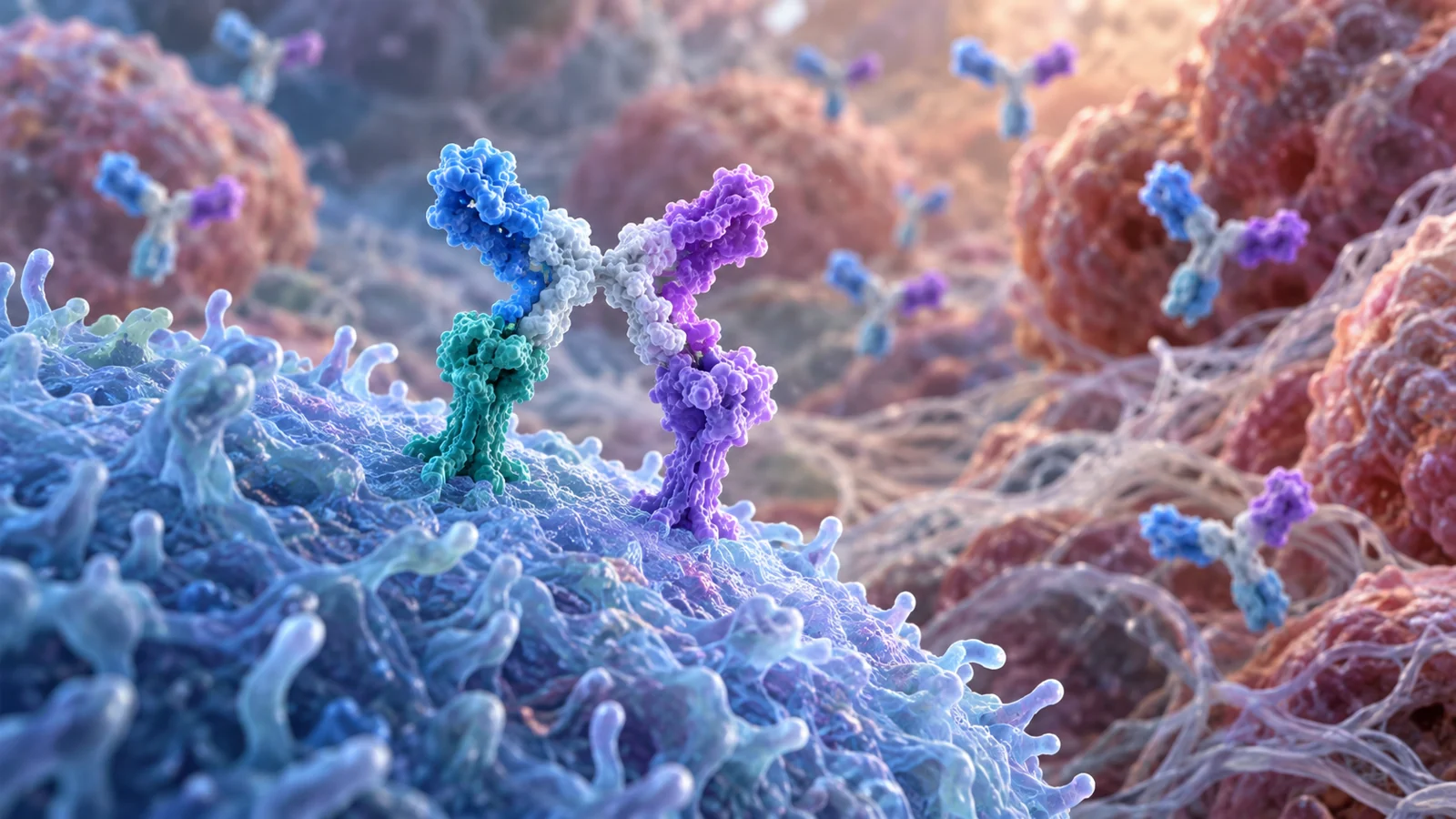
MEDI5752 was engineered as a monovalent bispecific antibody: one antibody molecule built to bind targets in both pathways, with a single binding site for CTLA-4. Its design aimed to suppress PD-1 while favoring CTLA-4 blockade on PD-1-positive activated T cells. These are T cells showing PD-1 on their surface, a feature the researchers used to direct the molecule’s activity toward a particular activated cell population.
The proposed advantage is selective placement of CTLA-4 blockade, rather than simply combining two established antibody treatments. The study tested whether the design produced that selectivity and what other effects followed.
A cell-selective effect appeared in the experiments
The researchers reported that MEDI5752 saturated CTLA-4 more strongly on PD-1-positive T cells than on T cells without PD-1. They also found that a lower dose was needed to elicit IL-2 secretion. IL-2 is a signaling protein made by immune cells; here, its release served as a measured response to treatment.
Together, these cellular findings support the intended mechanism: MEDI5752 could focus CTLA-4 blockade on PD-1-positive T cells and prompt the measured IL-2 response at a lower dose. They do not show that patients can safely receive a lower dose, or that this cell preference reduces immune-related side effects in people. The findings concern selectivity and a laboratory measure of immune activity.
The antibody also changed PD-1 on the cell surface
MEDI5752 was reported to cause rapid internalization and degradation of PD-1. In plain terms, after the antibody engages the pathway, PD-1 is taken into the cell and broken down. This gives the molecule a mechanism beyond occupying targets: it was associated with removal of PD-1 itself.
The authors contrasted this behavior with conventional PD-1 and CTLA-4 antibodies. A pair of separate antibodies can block both pathways, but the reported PD-1 internalization and degradation distinguish MEDI5752’s effects on the receptor. This is a mechanistic observation, separate from whether the molecule ultimately improves outcomes or tolerability for patients.
Tumor accumulation accompanied stronger in vivo activity
The study also reported that MEDI5752 preferentially localized and accumulated in tumors. In an in vivo comparison, it showed enhanced activity relative to a combination of separate antibodies targeting PD-1 and CTLA-4. This adds a distribution finding to the cell-selectivity result: the antibody was reported to build up preferentially in tumor tissue, alongside the stronger activity in that comparison.
The supplied evidence does not identify the in vivo model or provide enough detail to translate that comparison into a clinical advantage. Tumor accumulation and enhanced activity in this setting are findings about where the molecule went and how it performed in the reported comparison, not evidence that it works better in patients.
Two patient responses offer an early human observation
The paper reports partial responses in two patients with advanced solid tumors after treatment with MEDI5752. That is a human observation accompanying the experimental findings, and it shows that responses were seen in patients treated with the antibody.
Two responses cannot establish how often treatment works, how long responses last, or whether MEDI5752 benefits patients more than separate PD-1 and CTLA-4 antibodies. The evidence provided also does not establish fewer immune-related adverse events. Without clinical denominators or comparative safety results, the patient observations cannot settle either efficacy or tolerability.
What a more targeted cancer antibody could change
If MEDI5752’s cell selectivity leads to reproducible clinical benefit and acceptable safety in broader human evidence, it could offer a way to combine two forms of immune-brake blockade while directing CTLA-4 inhibition more toward activated PD-1-positive T cells. That could make the benefit of dual blockade achievable with a more tolerable dose or safety profile for people with advanced cancer. The 2021 findings establish a design rationale and early observations; whether that potential becomes a useful treatment option remains conditional on evidence from people beyond these two reported responses.
Key Sources
- Primary source: Design and Efficacy of a Monovalent Bispecific PD-1/CTLA4 Antibody That Enhances CTLA4 Blockade on PD-1 + Activated T Cells.
DOI or Journal Page · Peer-Reviewed Paper · 2021-01-08