
Evidence date · 2025-02-13 · Research note 3 of 3
1 2 3
See current Track status →
Since the previous research note · Earlier expectation not tested
Track continuity
Since the previous research note: Can removing cells that have permanently stopped dividing help fight infection?
Previous expectation: Senolytic treatment might help older adults recover from infections with less inflammatory injury while preserving lasting immune protection.
What this study adds: This February 2025 paper reports an eight-week randomized human study of a plant extract in adults aged 40–59, with no significant overall immune-cell endpoint benefit and a narrower male subgroup finding. These cellular observations do not test infection recovery, tissue repair or durable protective memory.
What changed in this study
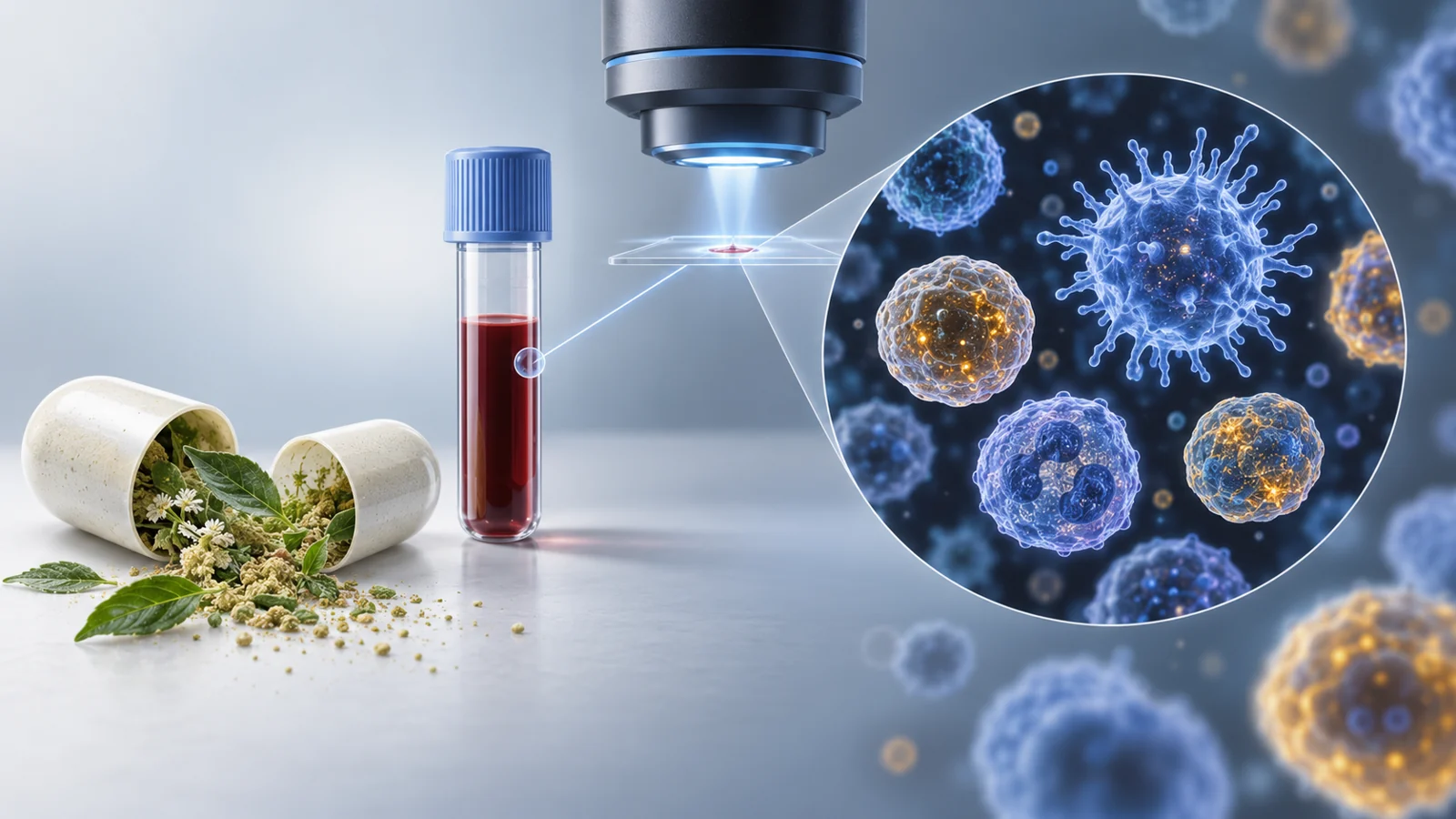
A February 2025 randomized trial tested whether an extract of Agrimonia pilosa Ledeb. containing agrimols could reduce a marker associated with aging immune cells. The main comparison did not show a statistically significant advantage over placebo after eight weeks. A finding in male participants makes the result worth examining more closely, but it does not turn the overall trial into evidence that the extract improves immune health.
What the Japanese trial actually tested
The study screened 635 people and selected 110 Japanese adults aged 40–59 whose blood showed relatively high proportions of CD8+ T cells with high senescence-associated β-galactosidase, or SA-βGal, activity. These participants were randomly assigned to receive either the extract or a matching placebo. The capsules looked alike, and the participants, administrators and evaluators remained blinded until the analysis population had been fixed.
The test product was one capsule per day containing 50 mg of Agrimonia pilosa extract, including 0.2 mg of agrimols, for eight consecutive weeks. That is a description of the study exposure, not a recommended supplement dose. An extract prepared and tested in this way should not automatically be treated as equivalent to every product made from the plant.
Of the 110 people randomized, 108 completed the study schedule and supplied the primary and secondary endpoint data used in the full analysis set. The safety set contained 109 participants. The primary endpoint was the change from baseline in the proportion of CD8+ T cells with high SA-βGal expression at week eight.
The result was not a simple decline in the extract group. The proportion of high-SA-βGal CD8+ T cells fell in both groups, and the difference between the extract and placebo groups was not statistically significant. The overall secondary measures likewise did not show a statistically significant treatment advantage. A change within people who took the extract is therefore not enough on its own. The relevant question is whether that change exceeded what also occurred with the placebo.
Why the marker matters and what it cannot show
SA-βGal is an enzyme-activity marker associated with cellular senescence. In this study, the researchers used fluorescence to distinguish cell populations with lower and higher signal, then classified the higher-signal population as high-SA-βGal. The measurement offers a way to track the proportion of immune cells carrying a marker associated with senescence in the sampled blood.
It does not directly show that the extract selectively killed senescent cells. A lower proportion can reflect several biological or measurement-related changes, and the result does not establish an increase in the absolute number of naïve T cells. The trial therefore measured a change in the composition of a blood-cell population, not a demonstrated rejuvenation of the immune system.
The paper also reported exploratory measurements of p16, p21, p53 and Sirt1 gene expression in peripheral blood mononuclear cells. Those measurements did not show movement linked to the high-SA-βGal CD8+ T-cell findings. The researchers did not assess a broad set of other senescence-related features, including additional markers, inflammatory SASP factors, oxidative-stress measures or cell-cycle markers in the relevant CD8+ T-cell population. The proposed senolytic mechanism consequently remains unresolved.
What the male subgroup adds
The most notable signal appeared in the male subgroup. Among men, the proportion of high-SA-βGal CD8+ T cells was lower in the extract group than in the placebo group at eight weeks, with a reported p value of 0.044. Men receiving the extract also had a higher proportion of naïve CD8+ T cells and a lower proportion of effector-memory CD8+ T cells than men receiving placebo. These observations point in a direction that could be consistent with a shift in the measured T-cell mix, but they remain observations within a subgroup.
The corresponding significant findings were not observed in women. That pattern does not by itself prove that the extract works differently in men and women. A significant result in one subgroup and a nonsignificant result in another are not the same as a formally demonstrated treatment-by-sex difference. The study’s sample-size calculation was based on the overall comparison, not on proving a separate effect in each sex. Possible influences from sex hormones were raised as unresolved explanations, not established causes.
The male result is useful as a question for further research because it aligns with the related naïve-cell and effector-memory observations. It is not enough to establish that men are confirmed responders, that the cells were selectively removed, or that the biological change would improve health outside the measured blood markers.
Safety and the limits of an eight-week exposure
All reported adverse events were mild and resolved during the study. The principal investigator judged them unrelated to the trial supplements, and no side effects were judged to have occurred. That finding is reassuring for the monitored research period, but it does not answer the question of long-term safety.
The participants were a selected group of middle-aged Japanese adults, not a broad sample of people with age-related immune decline. The study focused on adults under 60, so it did not establish efficacy in people aged 60 and above. It also did not determine whether the intervention would affect aging-related diseases, infection outcomes, tissue repair, protective immune memory or lifespan. Those are clinically meaningful outcomes, but they were outside this experiment.
The same caution applies to the product itself. An eight-week trial of one defined extract cannot establish that other Agrimonia preparations have the same composition, biological activity or safety profile. A monitored study exposure is also not a basis for recommending a supplement to individuals with different ages, health conditions or medications.
What this could change
For people experiencing age-related immune decline, the long-term attraction of this approach is concrete: an oral treatment might eventually help remove or reduce harmful senescent immune cells while preserving useful immune function. That possibility would matter medically only if researchers confirm selective biological action, show benefits in meaningful measures of immune performance, and establish acceptable safety in the population intended to use it.
This trial is an early human step toward that capability, not a demonstration that the capability already exists. The overall comparison was neutral, the male finding needs confirmation, and the connection between a blood-cell marker and better health remains untested. If larger and better-resolved studies eventually show that the extract produces a reproducible, selective and clinically useful effect, it could become a candidate for an oral strategy against immune aging. The present result keeps that possibility open without claiming that it has been achieved.
Key Sources
- Primary source: Preliminary Data on the Senolytic Effects of <i>Agrimonia pilosa</i> Ledeb. Extract Containing Agrimols for Immunosenescence in Middle-Aged Humans: A Randomized, Double-Blind, Placebo-Controlled, Parallel-Group Comparison Study.
DOI or Journal Page · Clinical Trial · 2025-02-13