
Evidence date · 2025-05-27 · Research note 2 of 3
1 2 3
See current Track status →
Since the previous research note · Earlier expectation not tested
Track continuity
Since the previous research note: How a self-healing electrolyte performed with a high-voltage cathode
Previous expectation: Self-healing interface protection and high-voltage compatibility might enable lithium-metal batteries with a nickel-rich cathode to retain useful capacity through repeated charging.
What this study adds: The May 2025 study proposes a zwitterionic electrolyte for anode-free batteries and computationally examines charged-group functions and degradation against copper and lithium surfaces. This provides a distinct molecular-design contribution without testing the earlier forecast's practical high-voltage configuration.
What changed in this study
A battery material with two difficult jobs
Anode-free lithium-metal batteries are attractive because their design does not begin with a preloaded lithium-metal surface. But the lithium must still form reliably on a copper current collector, and later deposition takes place against lithium metal. Poor cycling performance and an unstable solid electrolyte interphase, or SEI, remain central challenges.
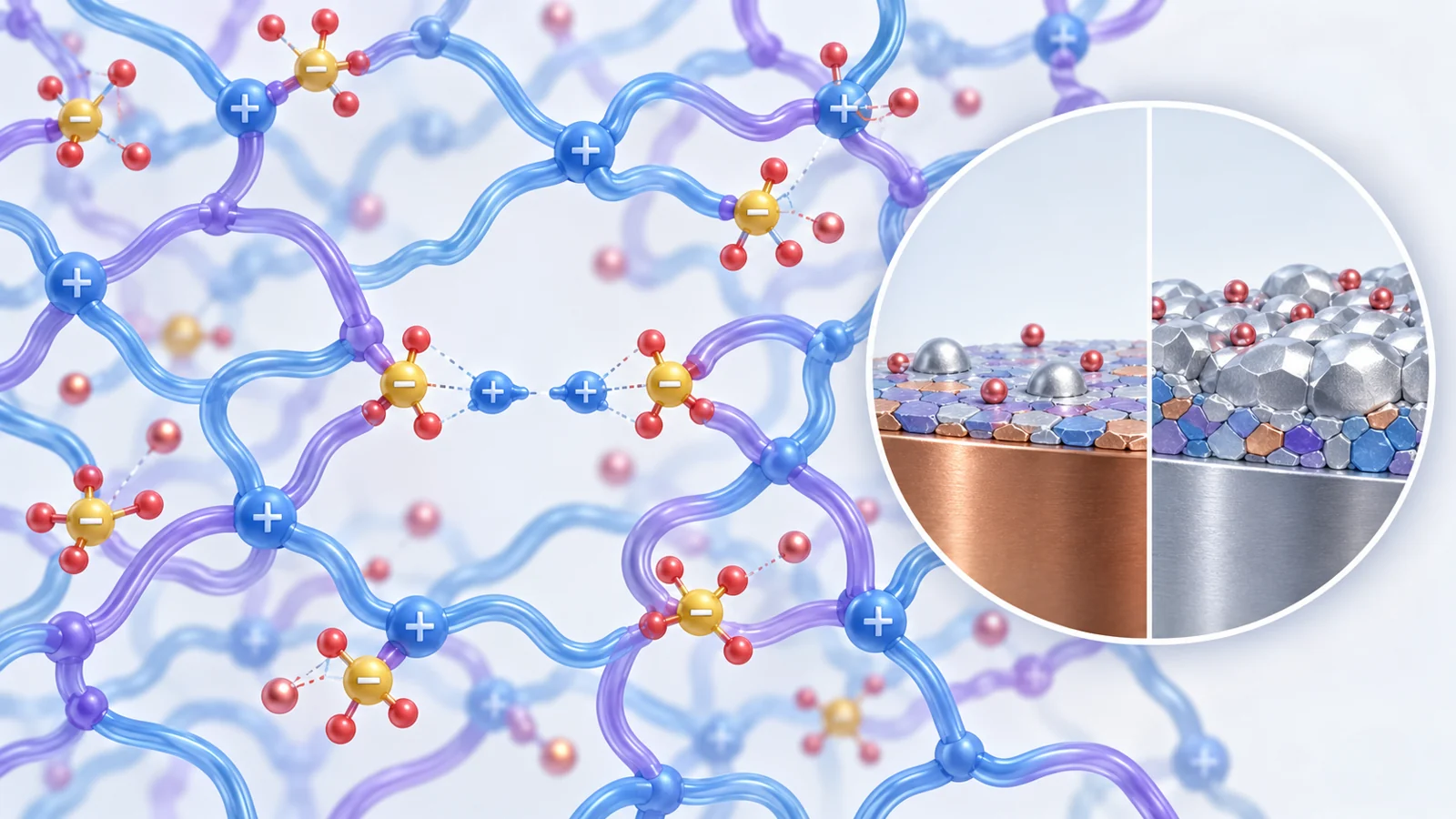
A new study published on May 27, 2025, examines whether one polymer electrolyte could address several of these problems at once. The authors propose P(SBMA-co-BA):LiTFSI, a zwitterionic self-healing solid polymer electrolyte, and evaluate its suitability for anode-free lithium-metal batteries with density functional theory and ab initio molecular dynamics simulations.
The central idea is easy to state but difficult to achieve: the material should repair damage while continuing to carry lithium ions. The study also follows what happens as the electrolyte encounters two different surfaces, because the chemistry that matters during lithium’s first formation on copper may not be identical to the chemistry involved during extensive plating against lithium metal.
Why the charged groups matter
“Zwitterionic” means that the material contains both positively and negatively charged groups. In this proposed polymer, the sulfonate group, written as RSO3−, is associated with lithium-ion transport. The positively charged NR4+ group is important for a different reason. Electrostatic attraction between the oppositely charged groups is what the authors associate with self-healing after the material is damaged.
Those roles should not be collapsed into one vague claim about a smart electrolyte. The sulfonate-containing chemistry is linked to carrying Li+ ions, while the attraction between charged groups is linked to restoring the polymer’s structure. A material that could do both would be useful precisely because an electrolyte must remain ion-conducting even as it experiences mechanical or interfacial disruption.
The computational approach lets the researchers examine these molecular relationships at a level that is difficult to see from a cell-level cycling curve alone. Atomic charge distributions also help identify which parts of the electrolyte participate in the interphase that develops at an electrode surface.
Following lithium from copper to a growing metal surface
The study examines electrolyte degradation in two stages. First, it considers the copper current collector while lithium is beginning to nucleate, meaning that the first lithium deposits are forming there. Later, it examines the lithium metal surface during more extensive plating.
This sequence matters because an anode-free battery depends on the initial lithium deposition event and then on the behavior of the growing lithium surface. Degradation at either stage could alter the interphase and affect how lithium continues to move. By looking at both copper and lithium, the study connects the original polymer chemistry to the changing surfaces that the electrolyte must face.
The authors describe the resulting SEI as an organic–inorganic hybrid with favorable flexibility and stability. They also associate a long-chain sulfonate-containing compound with rapid lithium-ion conduction and more uniform lithium-metal plating. These are conclusions about the modeled material and its modeled interfaces, not measurements of a working battery’s cycle life.
What the simulations establish and what remains open
The supplied evidence supports a molecular design proposal: P(SBMA-co-BA):LiTFSI has charged groups with distinct functions, and computational analysis indicates how those functions may contribute to transport, self-healing and interphase formation. It does not provide a numerical healing efficiency, conductivity value, deposition metric or improvement in retained capacity.
The abstract also mentions that the identified SEI components are typically compared with X-ray photoelectron spectroscopy data. That wording describes a customary comparison; it does not establish that experimental X-ray photoelectron spectroscopy validation was performed in this study. The evidence supplied here therefore supports the computational interpretation while leaving cell-level validation unresolved.
A working battery would need to show that the proposed repair and transport behavior survives repeated operation and produces a measurable cycling benefit. Manufacturing scalability, product readiness and safety benefits also remain outside what this evidence establishes.
What this could mean for battery lifespan
If the charged polymer can repair interfacial damage, continue carrying lithium ions and help form a flexible, stable interphase on both copper and lithium surfaces, anode-free lithium-metal batteries could have a better chance of retaining useful performance through repeated charging. For users, the potential payoff would be longer useful battery operation rather than a benefit demonstrated already.
That prospect remains conditional from the May 2025 perspective. The molecular design is a reason to test the material in working cells, not a measurement of how long those cells will last. The important advance is the attempt to make self-healing, ion transport and interphase control part of one electrolyte design.
Key Sources
- Primary source: Multifunctional Zwitterionic Self-Healing Polymer Electrolytes for Anode-Free Lithium-Metal Batteries: a Computational Perspective.
DOI or Journal Page · Peer-Reviewed Paper · 2025-05-27