
Evidence date · 2026-07-14 · Research note 3 of 3
1 2 3
See current Track status →
Since the previous research note · Partly supported
Track continuity
Since the previous research note: How charged groups could help a simulated battery electrolyte heal and carry lithium
Previous expectation: Combining interfacial repair, lithium-ion transport and stable surface layers could help anode-free batteries retain useful performance through repeated charging.
What this study adds: A different polymer design now combines experimental high-voltage cycling with lithium-metal and silicon–carbon pouch demonstrations and measurements consistent with preserved electrode contact. These results support the broader combined-design direction but do not test the earlier charged polymer or its anode-free configuration.
What changed in this study
A battery electrolyte is the material that carries lithium ions between the negative and positive electrodes. In a solid-state battery, that material must do more than conduct ions. It must also remain in close contact with electrodes that expand and contract as the battery charges and discharges.
Small gaps or cracks at that boundary can interrupt ion transport and concentrate current in uneven ways. A July 14, 2026 study reports a polymer electrolyte designed to respond to that mechanical damage while also forming protective chemical layers at the electrode surfaces. The researchers tested the material in lithium-metal cells, high-voltage lithium cobalt oxide cells, and two pouch-cell formats.
The result is useful as a prototype demonstration of several linked design choices. It is not evidence that one self-healing mechanism alone explains every improvement, nor does it turn a laboratory cell into a ready-made consumer battery. The important question is more specific: can a polymer that repairs small defects help a working battery maintain usable contact while its electrodes change shape and operate at higher voltage?
The interface is where the battery keeps changing shape
Electrode expansion and contraction can place mechanical stress on the solid material between the electrodes. In a rigid inorganic electrolyte, that stress may contribute to cracking. In a polymer electrolyte, flexibility can help, but flexibility by itself does not guarantee that a damaged interface will recover its contact or remain chemically stable during repeated cycling.
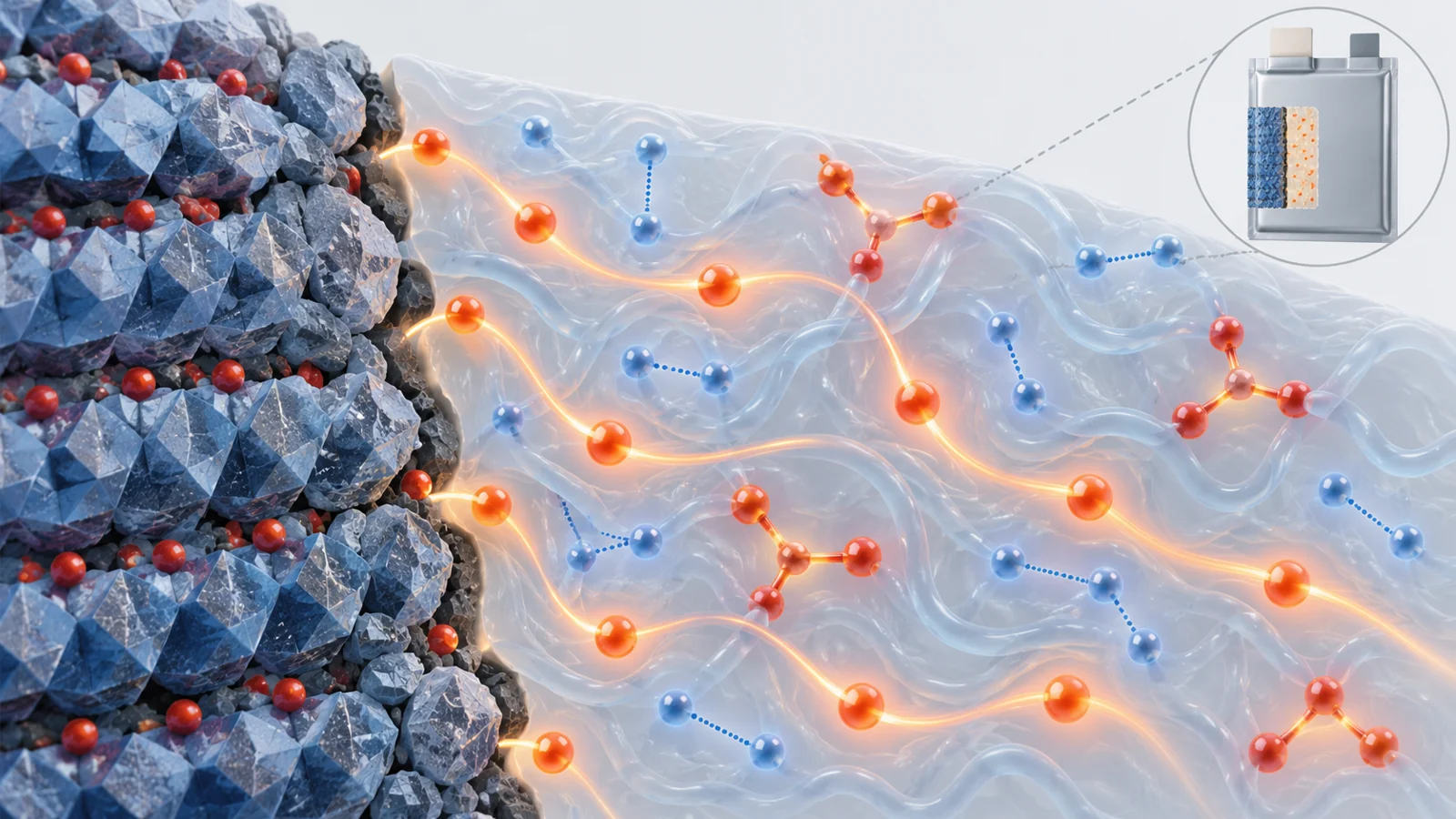
The study’s self-healing polymer electrolyte, called B-F-SHPE in the paper, uses two reversible bond types. Boronic ester bonds form exchangeable covalent cross-links. They provide a stronger, more durable part of the network while still allowing bonds to rearrange when the material is damaged. Urethane groups form hydrogen bonds that reorganize more rapidly and can dissipate mechanical energy.
Those bonds perform complementary jobs. The fast hydrogen-bond network can respond quickly to small disturbances, while the boronic ester links help the polymer retain a coherent structure and exchange damaged connections over time. The authors report room-temperature self-repair of the polymer material and describe the combined structure as a gradient dynamic network. The practical idea is not that the entire battery becomes permanently indestructible. It is that the material can repeatedly reorganize at vulnerable boundaries instead of treating every microscopic defect as a one-way failure.
The formulation also changes how ions move and how the electrodes are chemically protected. At 25°C, its reported ionic conductivity was about 1.6 × 10⁻³ S cm−1. That number measures ion transport through the electrolyte; it is not a battery capacity, a voltage, or a cycle-life result. The authors also measured a higher lithium-ion transference number for the combined formulation than for the boron-only and fluorine-only comparison materials.
Boron- and fluorine-containing groups have a second role. During cycling, the electrolyte helps form boron- and fluorine-enriched interfacial layers on the electrodes. On the lithium cobalt oxide cathode, the reported surface layer was thin and uniform, with signals associated with Li–F and B–O components. These layers are part of the chemical stabilization story. They should not be confused with the reversible bonds that give the polymer its mechanical self-repair behavior.
A wider stability window is not the same as cycling at 5.2 volts
The combined polymer had a reported electrochemical stability window of 5.2 V, compared with 4.8 V for the fluorine-only formulation and 4.5 V for the boron-only formulation. A stability-window measurement asks how far the electrolyte can be driven in an electrochemical test before unwanted reactions become significant. It does not mean that a complete rechargeable battery was cycled at 5.2 V.
The battery tests were separate and used their own voltage limits. In one lithium cobalt oxide–lithium-metal test, the cell was charged to a 4.5 V cutoff and retained 80.2% of its capacity after 550 cycles. The initial capacity in that test was 166.7 mAh g−1, and the cycling used a 0.5 C charge rate and a 1 C discharge rate.
A separate test pushed the charging cutoff to 4.6 V. Under that condition, the cell delivered 216 mAh g−1 at 0.5 C and retained 90% of its capacity after 300 cycles. These two results point in the same direction, but they are not one combined performance claim. The voltage, retention, cycle count, and operating conditions belong to different measurements.
The comparison formulations also help show what the combined design added within the reported experiments. At the 4.5 V cutoff, the boron-only and fluorine-only cells faded more quickly, with the comparison cells losing performance after roughly 150 and 250 cycles, respectively. That contrast is consistent with a benefit from combining the dynamic network with the boron- and fluorine-containing chemistry. It does not isolate self-healing as the sole cause. Ionic conductivity, interfacial resistance, lithium deposition, and surface-layer composition changed together.
Pouch cells show how the design behaves beyond a coin cell
The study moved from small laboratory cells to two pouch-cell demonstrations with different negative electrodes. An LCO|SHPE|Li pouch cell used a lithium-metal negative electrode and had a reported capacity of 1.2 Ah. It cycled for 200 cycles. A separate LCO|SHPE|Si-C pouch cell used a silicon–carbon negative electrode, had a reported capacity of 2.5 Ah, and cycled for 400 cycles.
Those results matter because the electrode identity and cell format are part of the evidence. The 1.2 Ah lithium-metal result cannot be treated as the same experiment as the 2.5 Ah silicon–carbon result, and neither should be merged with the 4.5 or 4.6 V coin-cell measurements to create a single headline number. Together, they show that the polymer design was tested in more than one laboratory pouch configuration.
The authors also tracked the pouch-cell interface with in situ ultrasonic imaging. Ultrasound can reveal changes in how a signal passes through a layered cell, making it a way to observe evolving contact without opening the pouch. Through more than 50 cycles, the combined formulation maintained a relatively strong transmission signal. Its reported peak-to-peak amplitude declined from 2.28 to 1.81 V, while the fluorine-only comparison fell from 1.95 to 0.39 V and developed larger attenuated regions.
Post-cycling microscopy supported the same interpretation from a different angle. LCO particles cycled with the fluorine-only electrolyte showed severe intergranular microcracks extending from the particle interiors toward their surfaces. The LCO particles cycled with the combined formulation remained structurally intact in the reported images. The ultrasound and microscopy do not prove that every part of the battery stayed unchanged, but they provide physical evidence consistent with better-preserved electrode–electrolyte contact in the tested pouch cells.
The safety result is a bounded laboratory observation
The study also reports nail-penetration testing. The LCO|B-F-SHPE|Li pouch cell did not experience a severe short circuit during the reported test, while a liquid-electrolyte comparison cell underwent violent thermal runaway with smoke and swelling. In that specific experiment, the polymer-based cell avoided the most obvious failure response seen in the comparison.
That is a meaningful abuse-test observation, but its scope is narrow. One nail-penetration result does not establish universal puncture safety, safety certification, or protection under every fault condition. It also does not quantify how a future commercial pack would behave, where cell design, packaging, manufacturing variation, monitoring, and system-level controls would matter.
The polymer was converted from a liquid precursor into a non-flowing solid after polymerization. That material state is relevant to the prototype’s architecture, but it does not by itself establish that the electrolyte was solvent-free. Likewise, the reported cycling and imaging results show what happened in the tested configurations; they do not establish a consumer service life or prove that the same performance will appear at commercial scale.
The July 2026 evidence therefore supports a careful progression claim. A polymer electrolyte can combine rapid and more durable reversible bonding with ion transport, protective surface chemistry, and reported high-voltage cell operation. The remaining question is whether those functions remain reliable when the design is reproduced across larger, more variable, and application-relevant batteries.
What self-healing interfaces could mean for battery life
Higher-voltage rechargeable batteries could retain useful capacity for longer if their internal interfaces can accommodate the repeated expansion, contraction, and chemical stress of cycling. The study points toward that possibility by pairing dynamic mechanical repair with ion transport and protective electrode surface layers, then demonstrating the combination in lithium-metal and silicon–carbon pouch prototypes.
For battery users, the potential benefit would be longer useful service before capacity loss makes a device or vehicle less practical. That outcome remains conditional on the combined stabilization working reproducibly in application-relevant cells and on the material being manufacturable in dependable formats. The July 2026 results make the interface a concrete engineering target; they do not yet turn a self-healing polymer into a guarantee of longer consumer battery life.
Key Sources
- Primary source: Interfacial Self-Healing Polymer Electrolytes With Gradient Covalent-Noncovalent Dynamic Bonds for 4.6 V-Class Lithium Metal Batteries.
DOI or Journal Page · Peer-Reviewed Paper · 2026-07-14