
Evidence date · 2022-03-19 · Research note 1 of 3
1 2 3
See current Track status →
A lithium-metal battery depends on its electrolyte, the material that carries lithium ions between the electrodes. For these batteries to combine a lithium-metal anode with a nickel-rich cathode, the electrolyte must handle two different problems at once. It must limit uneven lithium growth at the anode interface, while also remaining compatible with high-voltage operation at the cathode.
A study published on March 19, 2022, tested a polymer electrolyte designed around both requirements. The reported result connects a proposed self-repair process at the lithium interface with cycling data from a high-voltage nickel-rich cathode. It is a useful research milestone, but its figures describe this particular experimental system rather than a finished battery product.
Why the electrolyte has two jobs
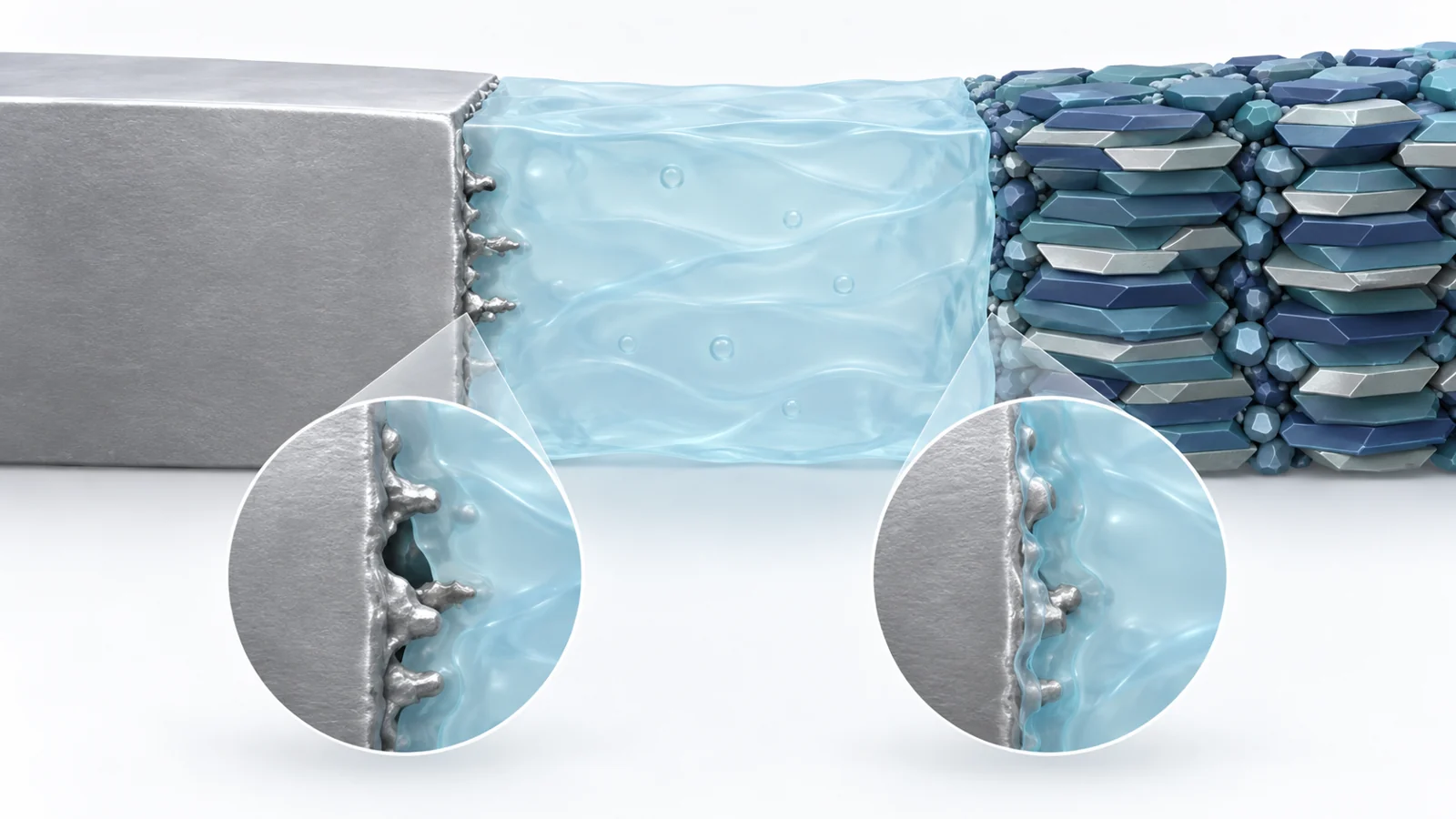
Dendrites are branching growths of lithium that can develop at an electrode surface. In a lithium-metal battery, small defects or gaps at the lithium–electrolyte interface can become sites where growth proceeds unevenly. The authors developed a polymer electrolyte intended to respond to damage as it forms, rather than treating the interface as permanently unchanged.
The material was made by in situ copolymerization of two monomers, UPyMA and EGMEA. Their chemical names are less important here than the design idea: the resulting electrolyte was intended to repair dendrite-induced defects, cracks, and voids spontaneously at the lithium interface. In the authors’ account, this repair helps inhibit further dendrite growth.
The study also used a kinetic Monte Carlo simulation to visualize suppressed growth and associated electrochemical behavior. That simulation is a representation of the proposed growth process, separate from the reported battery-cycling measurements. It helps show how the modeled behavior relates to the interface mechanism, but it is not itself a measurement of a commercial cell.
What the cycling figures actually measure
With the self-healing electrolyte and a LiNi0.8Mn0.1Co0.1O2, or NMC811, nickel-rich cathode, the reported system operated under 4.7 V. The abstract gives a specific capacity of approximately 228.8 mAh g−1 and capacity retention of 80.4% over 500 cycles.
These numbers answer different questions. Specific capacity expresses how much charge was measured per unit mass in the reported system. Capacity retention describes how much of the relevant starting capacity remained after repeated cycling. A high value for one does not automatically imply a high value for the other. Here, the approximately 228.8 mAh g−1 figure indicates the capacity reached in the stated measurement, while 80.4% after 500 cycles indicates how much capacity was preserved across that test.
The authors associate the performance with a combination of properties, including high ionic conductivity, a wide electrochemical window, and good interfacial stability. The supplied abstract therefore supports the reported result as a property combination; it does not justify assigning the entire cycling outcome exclusively to self-healing.
Where the result should be kept in perspective
The reported cycling performance shows that this electrolyte design supported a demanding laboratory test involving lithium metal and an NMC811 cathode under 4.7 V. It does not establish universal elimination of dendrites or demonstrated safety across practical operating conditions. The simulation and the cycling result also address different parts of the scientific case: one visualizes modeled behavior, while the other reports measured capacity and its retention in the tested system.
The available evidence does not provide a basis here for numerical claims about whole-cell energy density, commercial lifetime, manufacturing scale, cost, or performance in a particular product. Detailed cycling conditions, electrode loading, replication, comparator performance, and the specific-capacity mass basis are not established in the supplied abstract. Those limits matter because a promising material result still has to remain stable across the wider conditions required for practical cells.
What self-healing electrolytes could enable.
If the interface protection and high-voltage compatibility hold up in practical cells, this approach could help make lithium-metal batteries that combine a lithium anode with a nickel-rich cathode while retaining useful capacity through repeated charging. For battery users, the longer-term possibility is more energy in a given battery mass and longer useful operation, provided safety is validated alongside the electrochemical performance.
That is a conditional prospect from the March 2022 research result, not a measured product benefit. The study supplies evidence that a self-healing polymer electrolyte can be tested in this high-voltage configuration and can deliver the reported cycling figures. Whether the same balance survives scale-up, broader operating conditions, and safety validation remains part of the practical challenge.
Key Sources
- Primary source: Self-Healing Polymer Electrolyte for Dendrite-Free Li Metal Batteries with Ultra-High-Voltage Ni-Rich Layered Cathodes.
DOI or Journal Page · Peer-Reviewed Paper · 2022-03-19