
Evidence date · 2024-06-11 · Research note 2 of 3
1 2 3
See current Track status →
Since the previous research note · Earlier expectation not tested
Track continuity
Since the previous research note: Why did body size seem to matter differently during cancer immunotherapy?
Previous expectation: Validated body composition and nutritional changes might improve estimates of survival and side effects beyond starting BMI.
What this study adds: This melanoma-focused review brings together checkpoint-treatment associations and explains why muscle mass and changing weight may matter. It calls for longitudinal assessment but does not itself test the earlier forecast's prospective predictive condition.
What changed in this study
A 2024 review of earlier research brings together a counterintuitive pattern: higher body mass index (BMI), a measure of weight relative to height, has been associated with thicker melanoma at diagnosis and, among patients treated with immune checkpoint inhibitors, with better survival. The same broad feature can therefore point toward more concerning tumor growth and a more favorable response to a particular treatment.
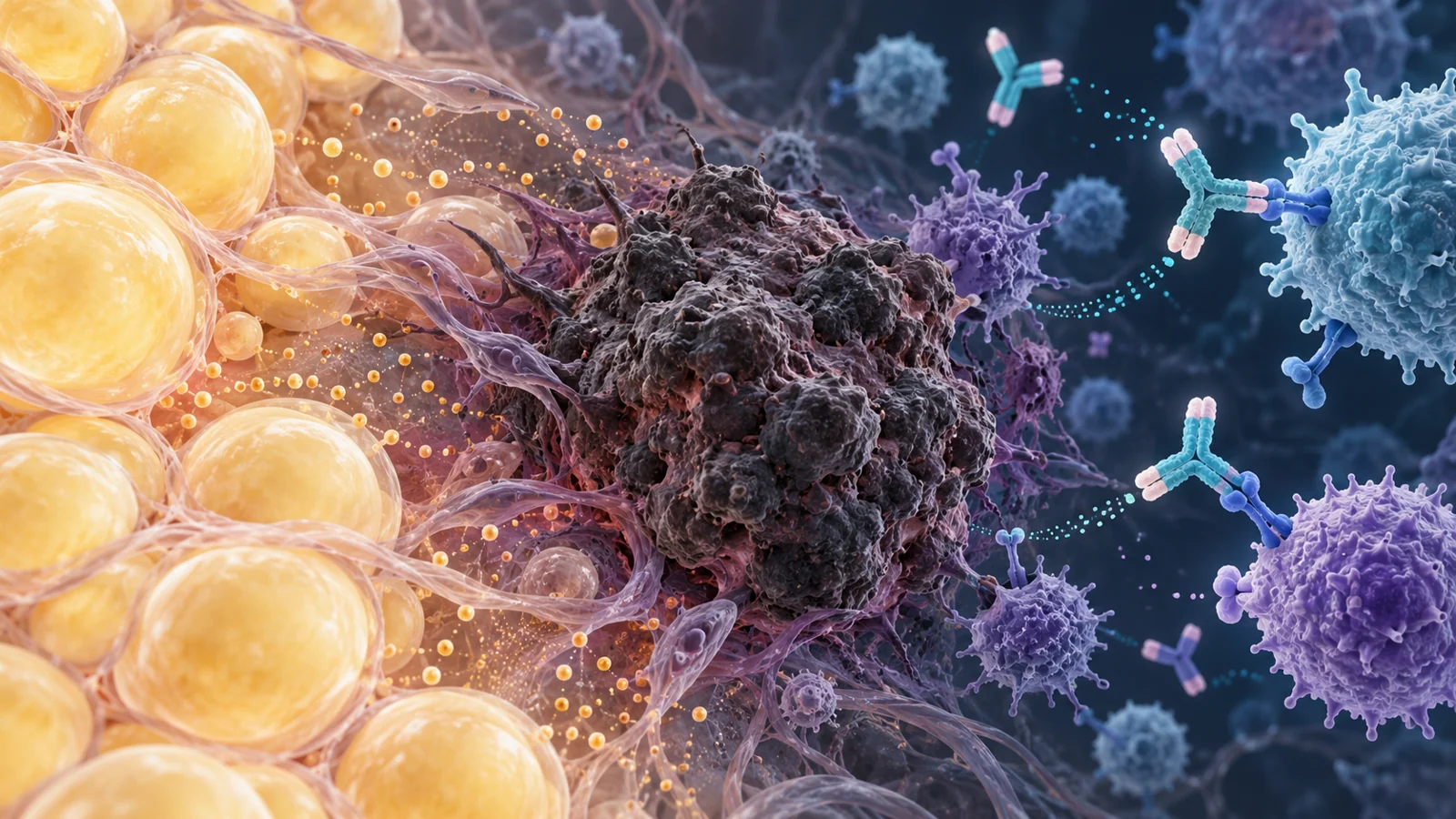
That pattern is an association across studies, not evidence that excess body fat protects against melanoma or that gaining weight improves treatment. The review’s central contribution is to show why the two observations might coexist: fat tissue can send signals that support tumor growth, while obesity-related changes in immune cells may also affect how checkpoint treatment works.
One measure points toward two different outcomes
Melanoma begins in pigment-producing skin cells and can spread quickly. One feature used to assess a primary tumor is Breslow thickness: how deeply it extends into the skin. The review describes studies linking higher BMI with greater thickness, which is generally a more concerning feature. This is a finding about melanoma biology and presentation, not a measure of how a later treatment will work.
The treatment pattern comes from a different set of observations. Across studies of people receiving immune checkpoint inhibitors (ICIs), the review found higher BMI associated with better overall survival and progression-free survival. Overall survival counts survival over time; progression-free survival tracks the time before disease progresses. In one subgroup analysis, BMI above 25 kg/m² was associated with significantly better overall survival. Another analysis suggested a plateau: the reported survival advantage did not differ significantly between overweight and obese groups, with little additional advantage above BMI 30 kg/m².
The pattern was not uniform. The review also describes melanoma studies that found varied or no clear prognostic advantage from obesity. The thresholds are reported comparisons within prior research, not a validated rule for deciding which treatment an individual should receive.
Checkpoint treatment may interact with a changed immune landscape
Some cancers can use immune checkpoint proteins to restrain immune cells that might otherwise attack them. Checkpoint inhibitors block proteins such as PD-1 or its partner PD-L1, releasing some of those brakes and helping immune cells act against the tumor.
Obesity can alter immune-cell behavior, including the number and function of T cells bearing PD-1. The review discusses a proposed explanation: if obesity leaves more of these cells in a dysfunctional, restrained state, blocking PD-1 may make that immune change particularly relevant to treatment. In that account, a feature of immune dysfunction could also create a target for checkpoint drugs.
This is a biological hypothesis that helps explain the clinical association; it does not show that the same process caused better outcomes in each patient. The review also notes pathways that could work against treatment response, including changes in fat metabolism and oxidative stress that may help melanoma cells survive. The immune effects of obesity are therefore not a single switch from weaker to stronger protection.
Fat can also support a melanoma-friendly environment
Fat tissue affects the surroundings of a tumor as well as the immune system. It releases signaling molecules called adipokines. The review highlights leptin and resistin among signals associated with melanoma-cell growth and changes to the tumor microenvironment, the local mix of cells and molecules around a tumor. Obesity-related inflammation and metabolic disruption may add to conditions that favor progression.
Nearby fat cells can also change as melanoma develops. In studies discussed by the review, tumor cells alter adjacent adipocytes, turning them into cancer-associated adipocytes. These cells release fatty acids that can feed tumor metabolism and signals associated with melanoma-cell movement. Other reported changes to the surrounding tissue may support invasion and spread.
These tumor-facing pathways help explain why the survival association during immunotherapy does not mean fat itself is protective. Different processes can operate at once: some may support tumor growth, while others could change how an immune treatment interacts with the body.
The same BMI can describe different bodies
BMI compresses weight and height into one number. It does not distinguish fat from skeletal muscle, measure where fat is distributed, or describe how body composition is changing. Two people in the same BMI category may therefore have different amounts of muscle and fat, differences the review identifies as relevant to melanoma outcomes and immunotherapy response.
Muscle loss, or sarcopenia, is one reason the number can mislead. The review describes links between lower indicators of muscle mass and poorer survival, suggesting that muscle may help explain some differences otherwise attributed to BMI. The same BMI measured once also cannot show whether someone’s weight has been stable, rising, or falling. The review points to weight gain and progressive wasting before or during treatment as changes that could matter to prognosis and immune function.
For interpreting the research, a starting BMI and a weight trajectory answer different questions. A snapshot can group people by size; it cannot by itself tell what their body composition is or how that composition is changing during illness and treatment.
Survival is not the whole health picture
The association may also vary with sex and treatment. The review describes a reported survival benefit among obese men receiving immune and targeted therapies, while other included studies found differing results. It discusses sex hormones as one possible influence, but the evidence does not reduce the differences to a single explanation. BMI’s relationship with melanoma outcomes may depend on who is being studied and which treatment they receive.
Some studies also linked higher BMI with more immune-related adverse events during PD-1 or PD-L1 treatment. These are unwanted effects that occur when treatment activates immune activity against healthy tissue. Their higher incidence was reported alongside better survival outcomes in some research, but side effects remain harms in their own right. The review also notes that cardiovascular and cerebrovascular conditions associated with higher BMI may contribute to non-cancer mortality, which can change the overall health picture even when cancer outcomes look more favorable.
How the review assembled its evidence
The review, published on June 11, 2024, searched PubMed and Embase on May 11, 2023, then ran an additional search on October 22, 2023. Its eligibility criteria allowed trials, cohort and cross-sectional studies, and reviews. The authors report that one investigator screened the studies and that data extraction was completed by one reviewer.
The synthesis brings together findings that do not all agree, across different treatments and patient groups. Its conclusions are useful for identifying recurring associations and possible biological explanations, but the review does not establish that obesity caused a better response or that its proposed immune mechanisms explain an individual outcome. It also does not validate a BMI threshold or body-composition measure for choosing treatment. Those limits matter because a pattern across groups is not a reliable forecast for a particular person.
How body measures could shape melanoma immunotherapy care
If future research confirms which body-composition and weight changes matter for specific treatments, clinicians could eventually estimate treatment outcomes more precisely than a starting BMI allows. That could help researchers design trials around meaningful patient differences and, in time, help care teams discuss likely benefits and health risks with more individual context. The path to that capability depends on tracking change over time and confirming the associations across sex, treatment types, muscle mass, and other health conditions.
Key Sources
- Primary source: The Effect of Body Mass Index on Melanoma Biology, Immunotherapy Efficacy, and Clinical Outcomes: A Narrative Review.
DOI or Journal Page · Review or Meta-Analysis · 2024-06-11