
Evidence date · 2021-03-05 · Research note 1 of 3
1 2 3
See current Track status →
Higher body mass index (BMI), a measure based on weight and height, accompanied longer survival in some cancer immunotherapy reports. Other studies found little or no relationship. In a systematic review published March 5, 2021, all three kidney cancer reports associated higher BMI with better survival, while results in lung and melanoma cohorts varied by study and outcome. Across the solid tumors examined, the review could not support a clearly positive survival association overall.
The review focused on immune-checkpoint inhibitors, treatments that act on proteins controlling how immune cells respond to cancer. One such protein, PD-L1, was measured in some of the lung studies. Its comparisons show why survival, tumor response, and treatment side effects need to be considered separately: a BMI association with one outcome did not necessarily extend to the others.
Kidney, lung, and melanoma studies told different stories
The kidney cancer findings pointed in a consistent direction, but the reported outcomes were not identical. In an Italian cohort of 313 people with renal cell carcinoma treated with nivolumab, higher BMI was associated with longer overall survival. It was not associated with a difference in tumor response or disease control. A second study included BMI in a broader score with a blood-cell ratio and information about the number and sites of metastases. The score was associated with better survival, though it could not show how much BMI contributed on its own. A third report found longer progression-free survival (time before cancer worsens or death) among obese patients who had already experienced clinical benefit from treatment; its overall-survival finding was only a trend.
Lung cancer reports were more divided. A pooled analysis of people with non-small cell lung cancer from four atezolizumab trials found longer overall survival among obese patients, with a stronger association in those whose tumors had high PD-L1 expression. A large pembrolizumab study also linked higher BMI with better tumor response, progression-free survival, and overall survival in patients with high PD-L1 expression. By contrast, a Japanese anti-PD-1 cohort linked BMI to response and disease control but not to survival. Two smaller nivolumab reports found no clear link between BMI and outcomes. One linked low under-skin fat to poorer survival; the evidence for pre-treatment weight loss was less certain.
Melanoma results varied as well. One study linked higher BMI to tumor response with ipilimumab, but not to progression-free survival; its overall-survival result was uncertain. Another multicenter report suggested a favorable survival association among men receiving anti-PD-1 or anti-PD-L1 treatment, but its reported survival estimates were statistically uncertain. Meanwhile, two of the largest melanoma studies, together covering 704 patients, found no association between BMI and disease control, progression-free survival, or overall survival. The same measure could therefore appear relevant to one outcome in one cohort and uninformative in another.
The biological explanation could point both ways
Researchers had reasons to ask whether body fat might affect checkpoint treatment. Fat tissue is linked with chronic low-grade inflammation, which could influence the immune response. The review also discusses leptin, a signal produced by fat tissue, and other changes that may contribute to an immune-suppressive environment and to T-cell exhaustion, when immune cells become less able to sustain their activity. These effects offer competing possibilities: inflammation might coincide with stronger activity during checkpoint treatment, while immune dysfunction could hinder the response.
Those ideas help explain why BMI attracted attention, but they do not identify the cause of the survival patterns in the patient cohorts. The review describes proposed biology and preclinical findings; it does not establish that excess fat produced the observed clinical outcomes.
One BMI reading can hide different bodies and changing conditions
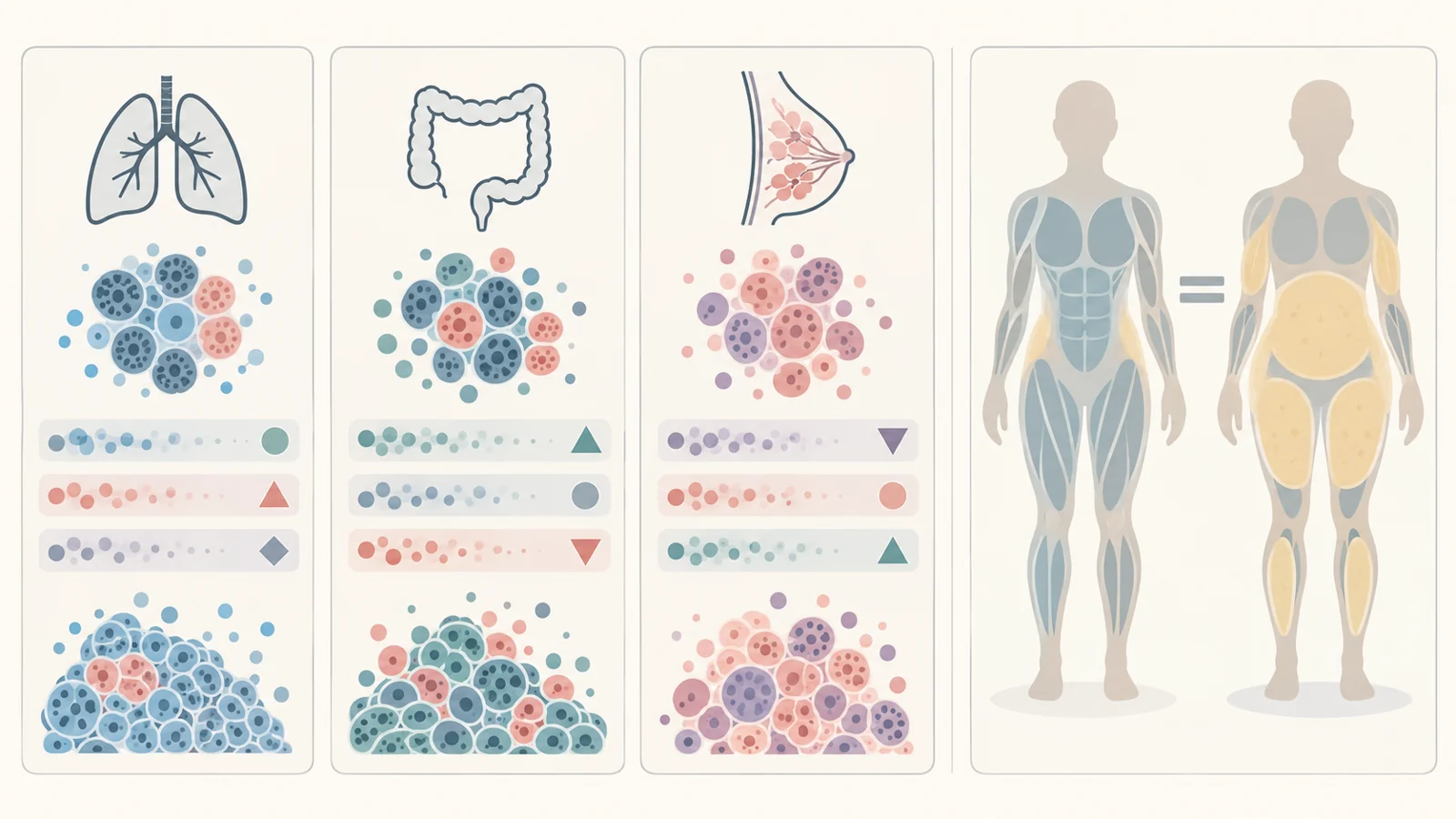
BMI compresses weight and height into one number. It cannot show how much of a person’s weight comes from muscle, other lean tissue, or fat, or whether fat is mainly under the skin or deeper in the body. Two people with the same BMI can therefore have different body compositions, which may matter when interpreting cancer outcomes.
The lung studies that considered weight loss or under-skin fat alongside BMI illustrate the difference between a weight-for-height measure and a fuller picture of nutritional condition. A single measurement before treatment also cannot capture what changes during therapy. The authors raise the possibility that immune response could shift over time, including a period of early responsiveness followed by resistance as T-cell exhaustion progresses. That is a proposed explanation, not a timeline demonstrated by these studies. Repeated measurements could answer questions that a baseline BMI alone cannot.
Toxicity findings were steadier than survival findings
The studies that reported immune-related adverse events generally found similar overall rates across BMI groups. In one melanoma report, these events occurred in 31% of normal-weight patients, 33% of overweight patients, and 36% of obese patients. A pooled lung cancer analysis recorded rates of 26%, 29%, and 32%, respectively, without a significant overall difference across groups.
The pattern was not identical for every side effect. That pooled analysis reported more skin-related adverse events among overweight patients, and two other multicenter reports found higher overall adverse-event incidence among obese patients. Even so, the review’s overall assessment was that rates were broadly comparable. BMI did not provide a consistent summary of either survival or toxicity across the reports.
Why the studies resisted a single answer
The review searched five databases on December 7, 2020. Most studies looked back at existing patient records, with one pooled analysis of participants from phase 2 and 3 trials. Studies differed in cancer types, treatments, statistical methods, and the BMI categories they used. Some treated BMI as a continuous measure; others divided patients into groups, using different cutoffs for overweight and obesity. Two multicenter reports may also have included overlapping patients.
These differences made a single combined estimate difficult to interpret, so the authors described results by cancer type instead. The mix of study designs and definitions helps explain why the review could not establish a reliable, positive survival relationship for baseline BMI across cancers. Its findings do not identify a BMI threshold for selecting checkpoint treatment or show that gaining weight would improve outcomes.
How better body measures could guide immunotherapy care
If prospective studies show that body composition and changes in nutritional condition add reliable information beyond a starting BMI, oncology researchers could group patients more precisely and build more useful estimates of survival and side effects during immunotherapy. That could give care teams a better basis for discussing prognosis and side-effect risk with patients, provided those measures are validated for individual care.
Key Sources
- Primary source: Impact of BMI on Survival Outcomes of Immunotherapy in Solid Tumors: A Systematic Review.
DOI or Journal Page · Review or Meta-Analysis · 2021-03-05