
Evidence date · 2025-01-10 · Research note 3 of 3
1 2 3
See current Track status →
Since the previous research note · Partly supported
Track continuity
Since the previous research note: Why body size can relate to both melanoma growth and immune treatment response
Previous expectation: Body-composition measures might eventually give a more individual view of immunotherapy outcomes than starting body mass index alone.
What this study adds: A synthesis of 17 studies found that some CT-derived fat measures were associated with survival and progression outcomes, while other measures were not. It supports interest in body composition without establishing a better individual forecast.
What changed in this study
The so-called obesity paradox in cancer immunotherapy describes reports that patients with obesity sometimes have better survival during treatment with immune checkpoint inhibitors (ICIs), an immune-based cancer treatment. A systematic review asked a more specific question: do measurements of fat in different places on a CT scan show the same relationship with patient outcomes?
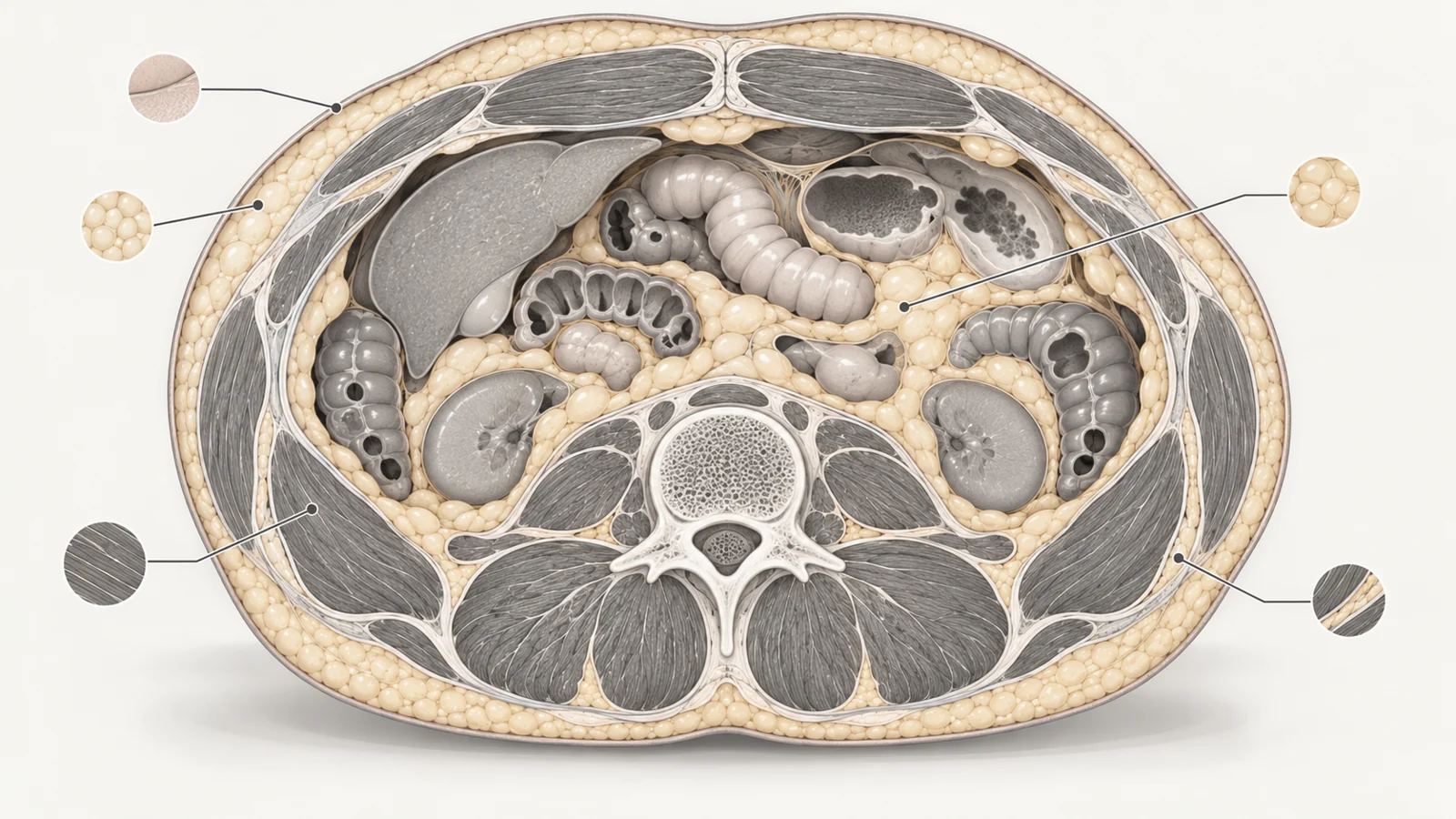
Fat just beneath the skin is called subcutaneous fat. Fat around internal organs is visceral fat, and fat between muscle groups is intermuscular fat. The review pooled studies of these CT measurements and their links to overall survival (time to death) and progression-free survival (time until cancer progresses or death).
Fat beneath the skin and fat around organs tracked both outcomes
A higher subcutaneous fat area (SFA) was associated with better overall survival (OS) and progression-free survival (PFS). The pooled hazard ratio (HR) was 0.61 for OS (95% confidence interval [CI] 0.46–0.81) and 0.65 for PFS (0.50–0.85).
A higher visceral fat index (VFI), a measure of fat around internal organs, was also associated with both outcomes. Its HR was 0.68 for OS (95% CI 0.56–0.83) and 0.79 for PFS (0.67–0.92). In this analysis, the associations for both measures appeared across survival and progression outcomes.
The other measurements gave a less consistent picture
A second measure of fat beneath the skin, the subcutaneous fat index (SFI), was associated with better OS (HR 0.64, 95% CI 0.48–0.86). Its association with PFS was not statistically clear (HR 0.78, 95% CI 0.59–1.03); that interval includes 1.0, the value indicating no relative difference in the estimate.
For fat between muscle groups, measured as the intermuscular fat index (IFI), the analysis found no significant association with either OS (HR 0.94, 95% CI 0.56–1.60) or PFS (HR 1.00, 95% CI 0.62–1.62). The results therefore varied by both the location measured and the outcome considered.
Pooled hazard ratios describe relative event rates
The authors included 2,118 patients across 17 studies. They searched PubMed, Embase, Web of Science, and the Cochrane Library through May 2024.
A hazard ratio compares the rate at which an event occurs over follow-up; it is not a percentage of patients who will survive. For example, an HR of 0.61 corresponds to an estimated 39% lower event hazard in the higher-SFA groups than in their comparison groups. It does not mean that 39% more patients survived, or give an individual patient’s chance of benefiting from treatment.
The pattern still needs prospective testing
These pooled results are prognostic associations. They do not show that having more body fat causes better outcomes or identify a biological explanation. The results summarized in the abstract do not provide a direct predictive comparison with body-mass index (BMI), a patient-level prediction accuracy, or a CT threshold ready to guide care. The abstract also leaves unclear how consistent results were across studies, whether their measurement cutoffs were comparable, and how fully analyses accounted for other prognostic factors.
The authors call for larger prospective cohorts to test whether the associations hold up. Immune-related adverse events were named as a secondary outcome, but the abstract provides no quantitative result for them; these survival findings therefore do not answer a safety question.
How CT fat measurements could sharpen treatment forecasts
Validated CT fat measures could eventually help cancer teams estimate survival and progression outlooks for people receiving checkpoint treatment. They could also help researchers account for body composition when comparing trial outcomes. That capability depends on prospective replication, usable measurement rules, and evidence that the measures add meaningful predictive value in relevant patient groups.
Key Sources
- Primary source: Explanation of the obesity paradox of immunotherapy in cancer patients using CT-derived adipose composition parameters: A systematic review and meta-analysis.
DOI or Journal Page · Review or Meta-Analysis · 2025-01-10