
Evidence date · 2023-08-20 · Research note 2 of 3
1 2 3
See current Track status →
Since the previous research note · Changed direction
Track continuity
Since the previous research note: What a patent review shows about OX40 cancer drug development
Previous expectation: OX40 agonists could add a cancer treatment option if clinical testing showed meaningful benefit with acceptable safety.
What this study adds: The 2023 review describes limited benefit from early OX40 treatment alone or with checkpoint inhibitors despite strong animal results. It examines antigen signals, scheduling, drug potency, and different partners as possible routes forward.
What changed in this study
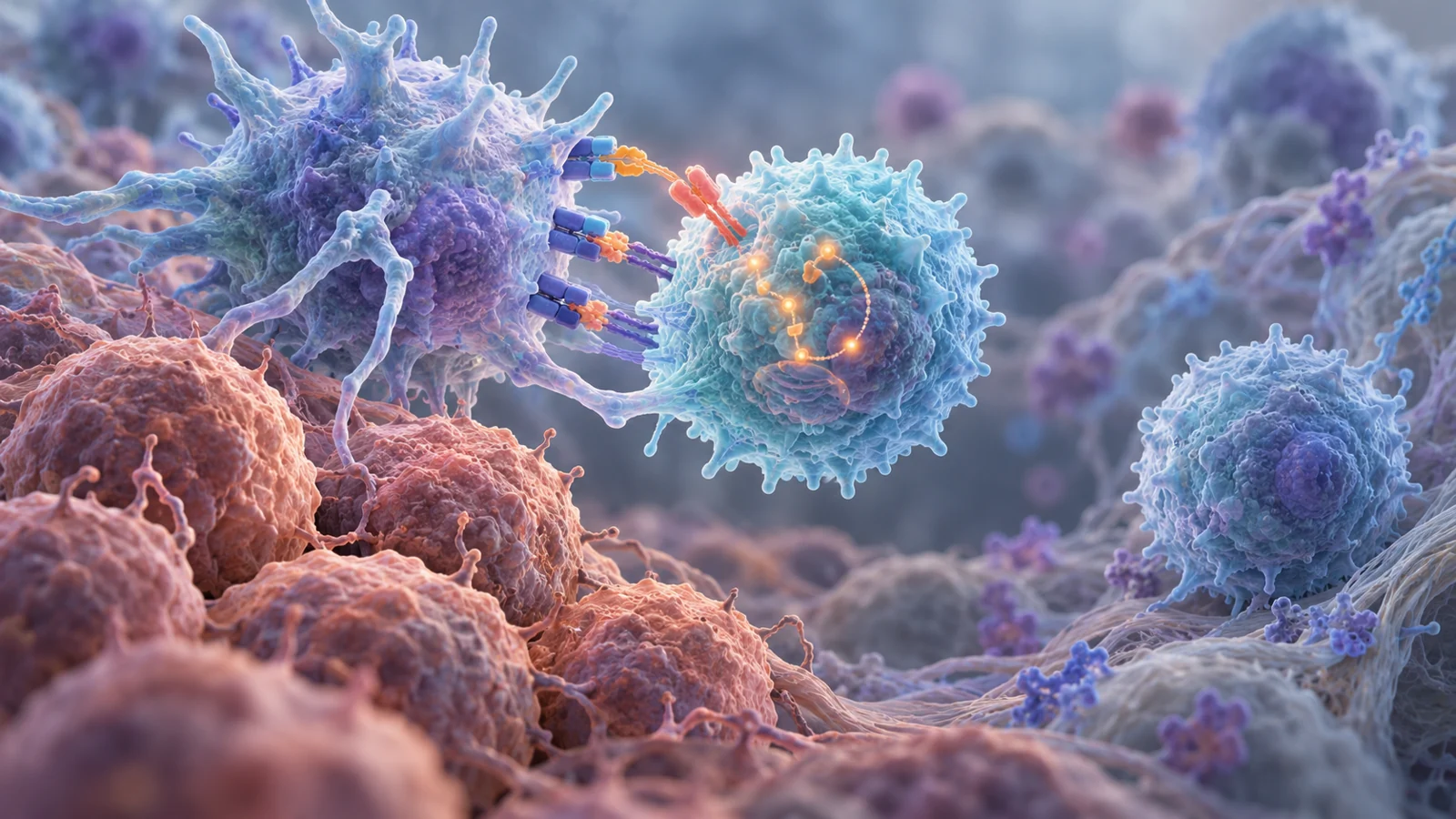
OX40 agonists—drugs designed to activate the OX40 receptor on immune cells—produced stronger antitumor responses in many mouse models. Yet early studies in people with advanced cancers found limited benefit, including when OX40 drugs were paired with checkpoint inhibitors. A 2023 review of this work asks a more specific question than whether the immune system can be stimulated: are the right T cells ready to respond, and are the timing, drug design and treatment partners suited to them?
The gap matters because an immune boost does not act on every T cell in the same way at every moment. OX40 helps activated T cells multiply, perform immune functions and persist. But the receptor’s levels rise after a T cell recognizes an antigen—a molecular feature that helps the immune system identify a target—and receives additional signals. The review discusses several ways this conditional biology could shape treatment, while emphasizing that the evidence does not identify one explanation for the limited clinical results.
The clinical combinations had little added benefit
T cells need more than one kind of instruction. They first recognize a target, then receive costimulatory signals that support activation and survival. OX40 is one receptor that can provide such a costimulatory boost. In preclinical models, activating it has strengthened T-cell activity, including proliferation and production of molecules involved in attacking tumors. Effects on regulatory T cells, which can restrain immune responses, have varied with the model and surrounding immune conditions.
Checkpoint inhibitors work differently. They block inhibitory pathways that can hold immune cells back. The idea behind combining them with an OX40 agonist was to release a brake while also adding a stimulatory push. But early clinical trials pairing OX40 drugs with CTLA-4 or PD-1/PD-L1 checkpoint inhibitors generally showed little or no added benefit beyond checkpoint treatment alone. Some OX40 drugs increased T-cell activity in patients’ blood, but that activity did not translate into a clear additional clinical effect in the reported studies.
A separate combination paired OX40 with another T-cell agonist, 4-1BB, which stimulates immune-cell activity through a different receptor. In a cohort of 57 people with advanced cancers, the treatment was described as safe and well tolerated, with clinical responses in a small subset. The study did not compare the combination randomly against another treatment, so those responses cannot establish that adding the two agonists improved outcomes. Blood-cell activity and a small number of responses are useful observations, but they answer different questions from whether a combination works better for patients.
The boost depends on when T cells are ready
OX40 expression is regulated partly by what happens after a T cell recognizes its target. In the reviewed research, antigen recognition helps start the process, and signals from cytokines—proteins that help coordinate immune activity—can increase OX40 expression further. This means the drug’s target may be more available on some activated, target-recognizing T cells than on others. A strong agonist cannot by itself guarantee that enough tumor-specific T cells are in a responsive state.
Treatment order may also matter, although mouse studies disagree. In some tumor models, giving OX40 stimulation before checkpoint blockade delayed tumor growth and improved survival; giving both at the same time did not produce the same result. Other mouse studies found strong effects from concurrent treatment. The review notes that differences among tumor models may help explain the conflicting findings, but the best sequence for patients remains unresolved.
There is also a practical tradeoff behind the schedules tested in people. Many trials gave OX40 on the same recurring cycle as checkpoint treatment, often every two to four weeks. Coordinating infusions can make treatment more convenient and reduce extra visits. Yet preclinical work cited in the review suggests OX40 may work better when doses are clustered around the time of vaccination rather than spaced weeks apart. A schedule designed around clinic convenience may not match the short-lived immune events the treatment is meant to support; whether a different schedule would improve patient outcomes is an open question.
Vaccines and radiation could supply a target
In preclinical models discussed by the review, some target-specific T cells became poorly responsive after prolonged antigen exposure. In models of this state, OX40 stimulation alone was not enough to restore their response; providing an external source of antigen through vaccination was needed to supply the initial recognition signal. That points to a different combination strategy: help the immune system encounter tumor-associated targets, then give the activated T cells an OX40 boost.
Many preclinical studies reviewed found stronger tumor control when OX40 agonists were paired with vaccination. Some added other immune-modulating treatments as well. These results span different tumor models, and the review says clinical translation has been hindered by the shortage of therapeutic cancer vaccines ready for early-phase testing. The animal results therefore offer a biological rationale for combining vaccination and OX40 stimulation, not evidence that this approach improves outcomes in people.
Radiation may also release tumor antigens as tumor cells die, making them available for immune recognition. In animal studies, OX40 treatment after radiation improved antitumor effects compared with radiation alone, particularly when given within 48 hours. The timing echoes the vaccine idea: OX40 stimulation may be most useful when target recognition is being initiated or reinforced. The review discusses clinical investigations of OX40 with radiation and other partners, but the evidence summarized here does not establish a successful patient combination.
A stronger drug and a better partner are separate questions
An OX40 drug’s potency is not the same issue as which treatment it is paired with or when it is given. Traditional OX40 antibodies may differ in how strongly they activate the receptor. Newer designs aim to strengthen that activity or bring OX40 stimulation physically together with checkpoint blockade. Examples discussed in the review include a multimeric OX40 agonist and a fusion protein that combines PD-1 blockade with OX40 ligand, the molecule that engages OX40.
These designs offer a rationale for improving the strength or coordination of the immune signal. They do not yet answer whether stronger signaling will produce better tumor control in patients, or whether it will be safe and useful in combination. Even with a more potent drug, the responding T cells may still need target recognition, suitable timing and a treatment partner that addresses a relevant barrier.
Promising combinations are hard to translate
The review describes many preclinical partners beyond checkpoint inhibitors, including immune stimulators and approaches intended to reduce immune suppression. In animal models, combinations can be built to prime tumor-specific T cells, support their expansion and address several obstacles at once. But a regimen with many components can be difficult to test and deliver. It may increase the possibility of adverse effects, require complicated schedules and involve drugs that have not each been established for use in that combination.
There are research barriers, too. The authors note that companies may be reluctant to pair two investigational agents in an early clinical trial, even after each has completed initial safety testing. That can leave a promising biological pairing in preclinical research without a straightforward route into a patient study. A simpler combination may be easier to test, but it still has to match the biology that made the original animal result possible.
How OX40 could expand treatment options for advanced cancer
If researchers can match OX40 stimulation to the moment tumor-specific T cells receive their targets—and pair it with an agonist whose activity is strong enough for that setting—the approach could eventually add another way to support immune attack against cancer. That possibility depends on translating the timing and antigen lessons from models into combinations that can be tested safely and practically in people. The 2023 review describes a set of plausible routes toward that goal, not a clinically proven OX40 treatment.
Key Sources
- Primary source: Challenges and opportunities in the development of combination immunotherapy with OX40 agonists.
DOI or Journal Page · Review or Meta-Analysis · 2023-08-20