
Research Signal – Source date 2025-12-02
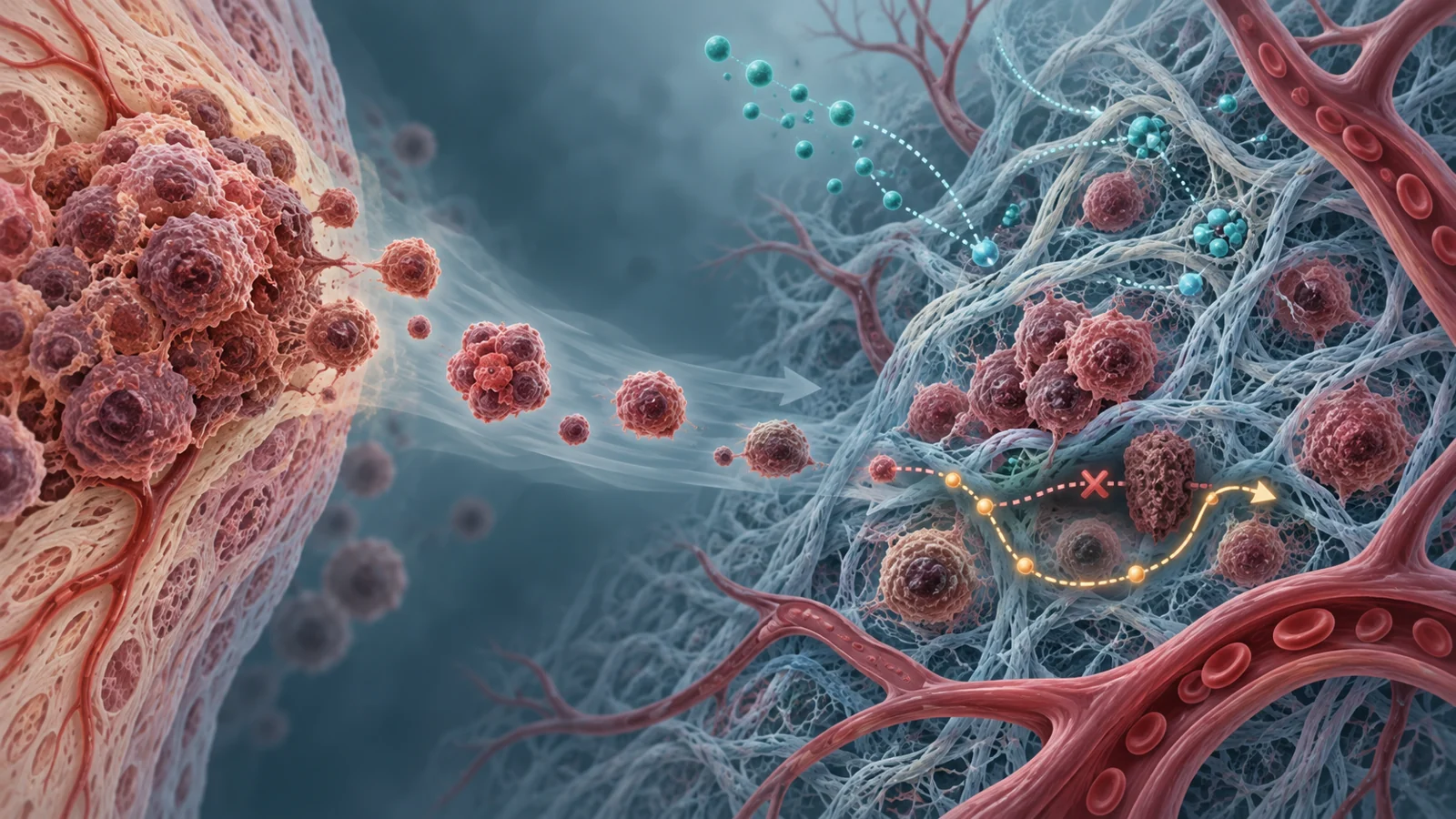
A treatment can shrink a primary tumor and still leave a harder problem: cancer cells that have already traveled elsewhere. Those distant lesions may differ from the original tumor and from one another. They can also occupy tissues where physical barriers limit drug delivery. A therapy aimed at one route of spread may therefore face both changing cancer cells and a changing environment.
A narrative review published December 2, 2025, brings together research on how metastases form and approaches proposed to disrupt that process. It spans mechanistic studies, preclinical strategies and clinical approaches at different stages. It is a synthesis of that varied work, not a trial showing that one combined treatment controls metastatic cancer.
Cancer cells can change how they move
Some invading cancer cells move individually. In mesenchymal migration, an elongated cell attaches strongly to the surrounding extracellular matrix (ECM), the mesh of proteins and other material around cells, and uses enzymes such as matrix metalloproteinases (MMPs) to break through it. Amoeboid cells take a different route: they deform and squeeze through existing gaps, relying more on internal contraction and less on attachment or matrix breakdown.
Other cancer cells move collectively, traveling in groups while keeping connections between neighboring cells. A group may better withstand environmental stress than a lone cell. The review describes cancer cells as capable of switching movement modes in response to changes around them, including matrix stiffness or treatment. Blocking a process needed for one mode could leave another available.
Cells also occupy states between clearly epithelial and mesenchymal forms. These intermediate states combine traits associated with both. The review warns that broadly suppressing epithelial-to-mesenchymal transition (EMT) could have an unintended consequence: disseminated cells may shift toward a more epithelial state, which can support the formation of a secondary tumor. The practical challenge is not simply to stop a cell from moving; its movement and identity can change along the way.
Distant organs shape where cells settle
Metastases do not appear randomly. Blood flow and the structure of an organ can affect where circulating tumor cells arrive and leave the bloodstream. Yet anatomy alone does not account for the patterns. Cancer types often favor particular destinations: breast cancer commonly spreads to bone, lung, brain or liver, while prostate cancer primarily spreads to bone, according to the review.
Chemical signals and local conditions can help guide those patterns. The review describes chemokine signaling as one influence: the CXCL12/CXCR4 axis is associated with movement toward organs including bone marrow, lungs and liver. Before cancer cells arrive, factors released by a primary tumor can also alter distant tissue. Such pre-metastatic niches may feature remodeled matrix, more permeable blood vessels and recruited bone-marrow-derived cells, creating conditions that support incoming cells.
These processes make the destination part of the disease. A therapy developed around the primary tumor may not fully account for the signals, immune landscape or supporting tissue at a metastatic site.
Reaching the target is a separate challenge
Even when a drug has a plausible molecular target, the surrounding tissue can make it difficult to reach cancer cells. In some tumors, collagen and hyaluronan accumulate in a dense matrix, and fibroblasts help remodel that matrix. The resulting pressure can impede drug delivery. The remodeled matrix can also strengthen signals that help cancer cells survive and grow.
Metastatic organs add their own barriers. The blood–brain barrier restricts the entry of many agents; bone tissue can supply survival signals that support resistance. Large drugs may also have difficulty moving through tumor tissue. Delivery, then, is not a single hurdle solved by identifying the right target: access can differ by tumor and by organ.
The review discusses several ways researchers are trying to address that problem. A clinical example is PEGylated liposomal doxorubicin used with trastuzumab for HER2-positive breast cancer. Bone-targeting nanoparticles and intranasal carriers aimed at brain delivery are described as under preclinical or translational investigation. These examples differ in maturity and purpose; they do not establish reliable delivery to every metastatic site or a general survival benefit.
Blood-vessel blockade can invite workarounds
Tumors can promote blood-vessel growth through VEGF signaling, making VEGF or its receptors targets for treatment. The review describes clinical use of anti-VEGF strategies, while also explaining why responses may not last. Tumors can activate other pro-growth signals or sustain blood supply through routes that do not depend on the blocked VEGF pathway, including vessel co-option and vasculogenic mimicry.
The intervention can also change the conditions it is meant to control. Reducing vessels may increase hypoxia, or low oxygen, which can stabilize HIF-1α and promote survival and angiogenic signals. Hypoxia can also favor an immune-suppressive environment and matrix changes that restrict drug penetration. Meanwhile, normal blood vessels depend on VEGF signaling too, so treatment can cause effects such as high blood pressure, protein in urine, bleeding or impaired wound healing. Those harms can narrow the dose a patient can tolerate.
The review describes combinations with chemotherapy or immune checkpoint blockade, dual targeting of angiogenic signals and treatment schedules designed around temporary changes in vessel function as strategies being pursued. These proposals reflect attempts to manage bypass and treatment tradeoffs; the synthesis does not show that one regimen provides durable control across cancer types.
A tumor snapshot may miss the differences that matter
A biopsy or scan offers a view of disease at a particular place and time. But metastatic lesions may differ from the primary tumor in gene activity, immune cells and surrounding stroma, and they can differ from each other. A treatment selected from the original tumor’s biology may not fit every distant lesion. Standard imaging and biopsy can also miss some of that variation.
The review points to liquid biopsy, multi-omics and single-cell analysis as ways to study disease across sites and over time. Liquid biopsy examines material shed into body fluids; multi-omics combines types of molecular measurements, while single-cell methods can distinguish differences among individual cells. These tools could help researchers identify markers of metastatic behavior or treatment response. Their promise depends on validating markers and showing that measurements can guide decisions effectively for individual patients.
The review also discusses gene editing as a research tool and calls attention to the limits of preclinical models. A model that fails to capture the diversity of human metastatic disease can make a promising intervention look more ready than it is. Better ways to measure variation will matter only if they connect reliably to treatment choices and patient outcomes.
What treating metastases directly could change
If metastasis-specific markers can be validated and paired with treatments that account for both tumor-cell plasticity and the conditions at each destination, clinicians could eventually adapt care as metastatic disease changes, instead of relying on a single picture of the primary tumor. That could make it more feasible to match treatment to the biology and delivery barriers of particular lesions. The route to that capability remains conditional: the approaches surveyed here vary in maturity, and translating them into dependable patient benefit will require stronger models and clinical validation.
Key Sources
- Primary source: Deciphering molecular pathways driving cancer invasion and metastasis: advances and therapeutic prospects.
DOI or Journal Page · Review or Meta-Analysis · 2025-12-02
Keep exploring