
Evidence date · 2026-05-07 · Research note 2 of 3
1 2 3
See current Track status →
Since the previous research note · Partly supported
Track continuity
Since the previous research note: How viruses could link lung cancer cell destruction with an immune response
Previous expectation: A cancer-targeting virus could add a lung cancer treatment that combines tumor-cell destruction with an immune response, provided it delivers safe and meaningful clinical benefit.
What this study adds: The May 2026 review brings vaccinia-specific model evidence and early clinical observations of tumor infection and immune activity to that rationale. Its synthesis still describes infrequent lung cancer responses and unresolved delivery barriers, so the patient-benefit condition remains unmet.
What changed in this study
A virus that infects a tumor and activates immune cells sounds like it could do more than destroy the cancer cells it reaches. But does that activity translate into meaningful control of lung cancer, including disease at sites the virus may not reach directly?
A review published on May 7, 2026, brings together preclinical studies and early clinical observations of vaccinia virus, or VV, in lung cancer therapy. Its evidence supports a biological rationale: some vaccinia constructs can combine tumor-cell destruction with immune stimulation. It also shows why that rationale is not yet the same as a demonstrated treatment benefit. Different vaccinia platforms perform different jobs, animal models isolate different parts of the mechanism, and early human studies have generally measured safety, tumor infection or immune activity more clearly than durable tumor control.
Two vaccinia strategies answer different questions
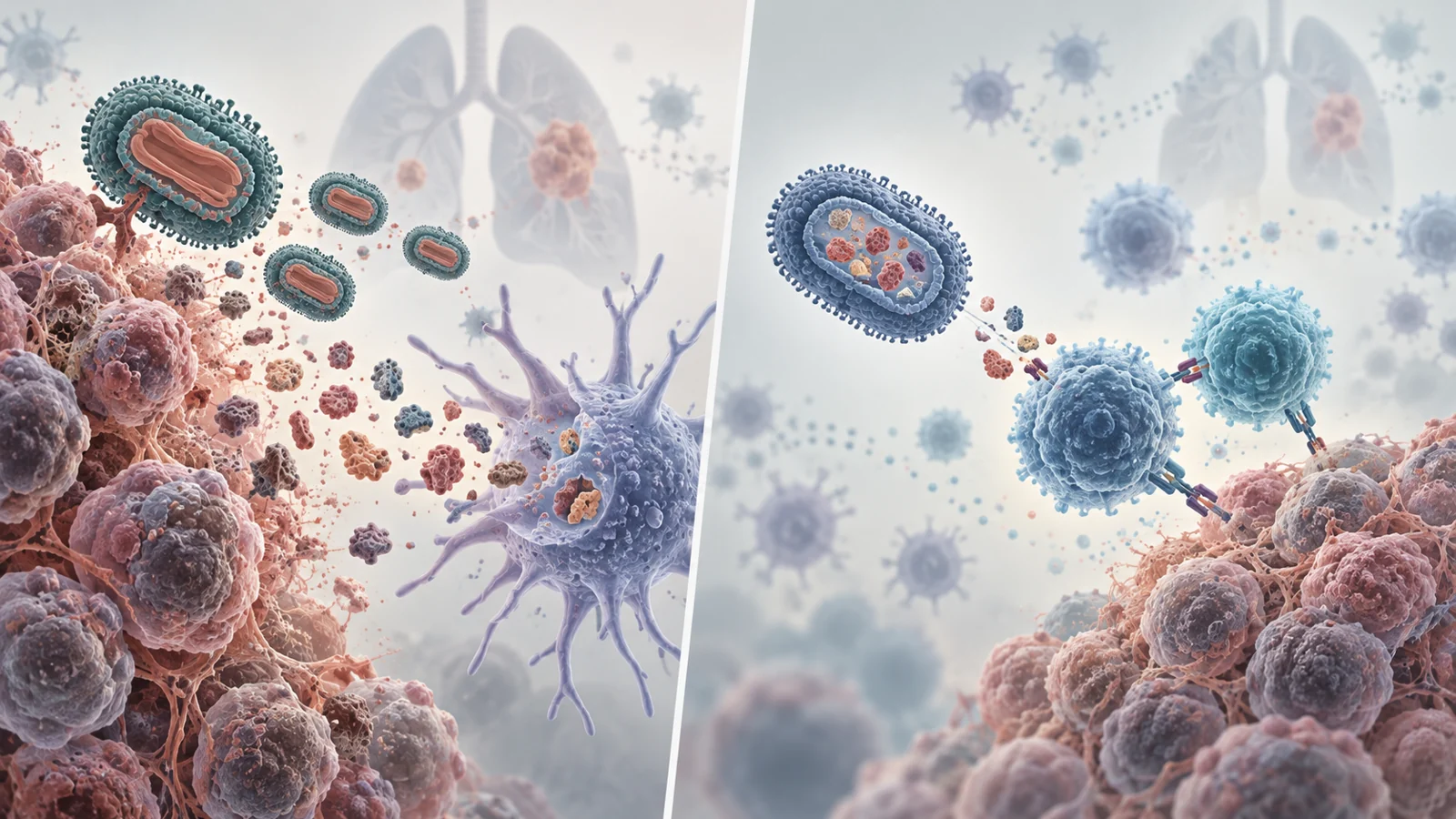
The phrase “vaccinia therapy” covers more than one approach. Replication-competent oncolytic vaccinia viruses are designed to multiply in tumor tissue, damage or kill infected cancer cells, and provoke an immune response as the tumor breaks down. Non-replicating Modified Vaccinia Ankara, or MVA, vectors work mainly as vaccine platforms. They can present tumor-associated material and stimulate tumor-directed T-cell responses without relying on viral multiplication inside the cancer.
That difference matters when interpreting results. A study showing that a replication-competent virus reaches a tumor and produces local oncolysis is testing a different therapeutic proposition from an MVA study designed to strengthen T-cell recognition. Immune activation from one platform cannot be treated as evidence that the other will produce the same tumor effect. Likewise, tolerability or biological activity observed in a mixed group of patients does not establish the efficacy of every engineered vaccinia construct.
Vaccinia also carries an unusual historical advantage. The virus has extensive human-use experience through smallpox eradication, and antiviral countermeasures are available. That background can make the platform more familiar from a regulatory and clinical-development perspective. It does not transfer a blanket safety guarantee to a cancer virus with a different genome, dose, route, transgenes or treatment combination. Each engineered product still has to be evaluated in its own setting.
From tumor damage to a wider immune response
The proposed chain begins when a replication-competent vaccinia virus preferentially multiplies in malignant tissue and causes tumor-cell lysis. The selectivity is conditional, not absolute. Cancer cells often have features that favor viral replication, such as rapid proliferation, altered oncogenic signaling, disrupted cell-death control or weakened antiviral defenses. Those features can create a replication bias toward tumors, but they do not mean that only cancer cells can ever be infected.
When tumor cells are damaged, they can release antigens and danger signals. These materials can help activate dendritic cells, which process and present information to T cells. The resulting tumor-directed T-cell response may extend the effect beyond the cells directly destroyed by the virus, creating a form of immune surveillance against other tumor cells.
Engineering is intended to make this sequence more effective or more directed. Vaccinia has a large double-stranded DNA genome, reported in the review as roughly 190 kilobases, with capacity for substantial foreign DNA. That allows researchers to combine therapeutic elements such as cytokines, tumor antigens, costimulatory molecules or reporter genes in one vector. One experimental example is a VV.CXCL11 construct designed to recruit antigen-specific T cells into tumors. The example illustrates how a virus can be altered to influence the immune environment, not just its ability to replicate.
The size of an engineered toolkit does not eliminate the biological tradeoffs. A virus must remain active long enough to affect the tumor, while the immune response must become strong enough to help control disease. The magnitude and character of the response vary with the viral strain, the tumor and the host immune system. A mechanism observed in one experimental setting therefore cannot be assumed to operate identically across human lung cancers.
Why the mouse model changes the mechanism
The review’s comparison of two lung-cancer models shows why the same broad label, “antitumor activity,” can conceal different causal pathways. In immunodeficient mice bearing TC-1 tumors, VV.mIFNβ acted mainly through direct oncolysis. The virus replicated robustly, and local interferon-beta production accompanied tumor control. Because the animals lacked a fully functioning adaptive immune response, the experiment emphasized what the virus could do inside the tumor itself.
In immune-competent mice bearing LKRM2 tumors, the balance shifted. Viral spread was limited, yet CD8-positive T cells were central to controlling tumor growth. This setting highlighted an adaptive immune mechanism rather than simply showing how much cancer tissue the virus could infect. The tumor models and immune environments were different, so the comparison should not be read as a single universal sequence that every vaccinia treatment follows. It shows how host context can change which part of the therapy carries the effect.
The immune system can also be both helper and obstacle. Strong antiviral defenses may clear the virus before it has spread through enough tumor tissue or delivered its engineered functions. If the virus is allowed to persist and replicate without generating a useful antitumor response, direct destruction alone may not control disease. The review describes timing as an important design problem: an early antiviral response can limit oncolysis, while insufficient immune activation can leave the treatment dependent on a narrow local effect.
One proposed solution is to control when different viral functions become prominent, shifting from an oncolytic phase toward an immunostimulatory phase. The form of cell death also matters: the review links apoptosis, necroptosis and pyroptosis to differences in the magnitude of immune activation. These findings help explain why a construct that performs well in one tumor model may not produce the same balance of viral spread and immune activation elsewhere.
Clinical signals stop short of proven benefit
Human evidence answers a different set of questions from the mouse experiments. Early studies of vaccinia-based immunotherapy in lung malignancies have included both MVA vaccine vectors and replication-competent oncolytic viruses. Many enrolled people with heterogeneous solid tumors, with patients who had lung cancer often forming only a subset rather than a prospectively defined primary group. The results therefore provide useful information about tolerability, viral trafficking and immune activity, but limited evidence about lung-cancer efficacy specifically.
Across these early-phase studies, the review describes generally acceptable safety and measurable biological activity. Reported adverse effects were mostly mild, including temporary flu-like symptoms or reactions at the injection site, while serious toxicities were uncommon in the studies summarized. The historical familiarity of vaccinia may support development, but these observations should not be generalized to every construct, dose, combination or patient population.
The clinical signals also need to be kept in separate categories. Tumor infection or trafficking shows that a platform can reach at least some tumor sites. Cytokine induction, increased tumor-infiltrating lymphocytes or antigen-specific T-cell responses show that the immune system is responding. Disease stabilization indicates that growth may have been held for a period in the reported setting. None of those findings, on its own, establishes tumor regression, longer survival or durable control of lung cancer.
In the review’s synthesis, objective responses in lung-cancer cohorts were infrequent, and durable regressions were rare. Most trials were early and were not designed to establish a lasting antitumor benefit in a defined non-small cell lung cancer population. The current clinical picture is therefore one of biological activity with an unresolved patient-benefit question, rather than an established vaccinia treatment for lung cancer.
Reaching a tumor is only part of systemic treatment
A therapy intended to work throughout the body must solve more than the problem of infecting one accessible tumor. Lung cancer can involve multiple sites, and the review points to limited viral penetration into metastatic niches as a major delivery challenge. A virus may show activity where it is administered or where it can enter efficiently while failing to maintain useful exposure elsewhere.
The host can make systemic delivery harder. Pre-existing immunity and neutralizing antibodies may remove or block the virus before it reaches distant tumors. At the same time, the immune system needs to remain capable of recognizing tumor material and sustaining an antitumor response. The practical goal is not simply to evade immunity indefinitely. It is to preserve enough viral activity for delivery and immune priming, then generate a response capable of acting beyond the initially infected site.
Tumor heterogeneity adds another layer. The review identifies differences among tumors and the complexity of their immune environments as barriers to reproducible effects across patients. An immunosuppressive tumor environment can also limit the immune response that viral activity is intended to generate.
For these reasons, delivery strategy is part of the treatment itself. The review describes progress as requiring both better virus design and better ways to reach difficult tumor ecosystems. Rational combinations with checkpoint inhibitors are a development goal because immune activation may need support, but the supplied evidence does not establish a preferred regimen or confirm that such combinations provide durable benefit in lung cancer.
What vaccinia could change for lung cancer patients
Vaccinia could eventually add a treatment capable of coupling direct tumor destruction with immune control that reaches beyond the initially infected cancer cells. That possibility would be especially important for people whose lung cancer resists targeted therapy or checkpoint blockade, where a local viral effect alone may not be enough.
The capability remains conditional. It depends on delivering the chosen construct safely to relevant tumor sites, managing neutralizing immunity, preserving a useful balance between viral spread and antiviral defense, and producing reproducible clinical benefit across biologically diverse patients. If those problems are solved, vaccinia could become part of a multimodal strategy that links local oncolysis with longer-lasting immune surveillance. As of the review’s May 2026 publication perspective, that is a development prospect, not an established patient outcome.
Key Sources
- Primary source: Vaccinia virus for lung cancer therapy: preclinical progress and prospects as a systemic immunotherapy platform.
DOI or Journal Page · Review or Meta-Analysis · 2026-05-07