
Research Signal – Source date 2022-03-01
A cancer trial can ask patients directly how they feel and function through questionnaires. These patient-reported outcomes offer information that comes from the people receiving treatment, rather than only from clinical measurements. But how should those answers be interpreted when patients know which treatment they were assigned?
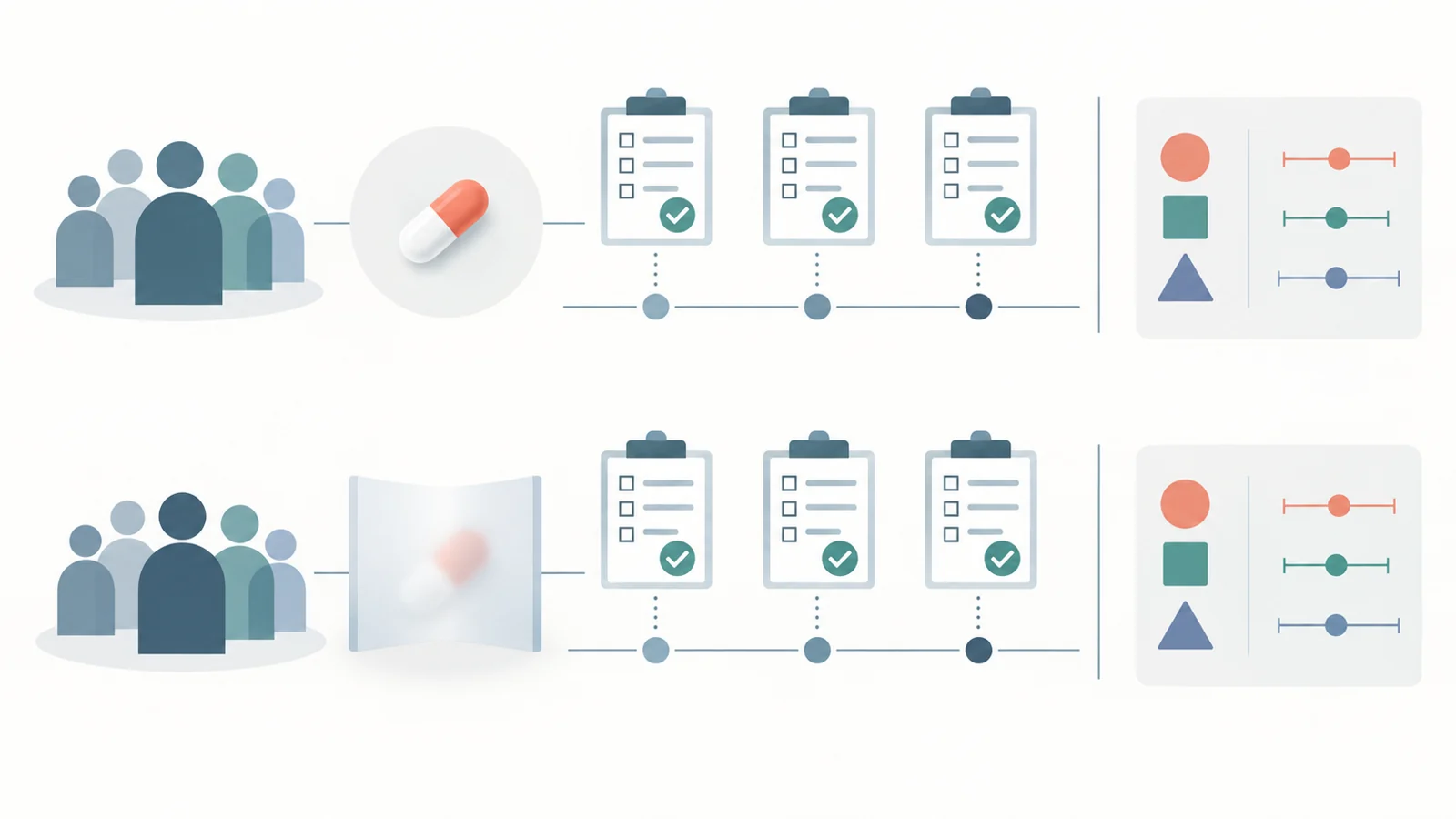
An open-label trial discloses treatment assignment, while a blinded trial conceals it. The difference raises a practical question: could knowing the treatment affect whether patients complete questionnaires or how they score their experiences? A systematic review published on March 1, 2022, compared the available evidence from randomized immunotherapy trials in advanced or metastatic cancer.
Why the trial design matters to questionnaire data
Patient-reported outcomes are useful only when patients both provide the information and when the resulting scores can be interpreted in context. Completion is one part of that process. A questionnaire that is not completed cannot contribute a patient’s perspective at that time point. The score itself is another part: it describes what patients reported about their experience.
The review examined whether the first part, the second part, or both appeared different in open-label and blinded studies. The question was not whether patients’ expectations definitely changed their answers. Rather, it was whether the way treatment assignment was handled was associated with observable differences in the patient-reported data.
How the review compared the evidence
The authors searched PubMed/MEDLINE, the Cochrane Library and EMBASE for indexed literature published from January 2009 through May 2019. They retained 23 randomized clinical trials of immuno-oncology therapies in advanced cancer that reported patient-reported outcomes. Of these, 15 were open-label and eight were blinded.
The review then used descriptive analyses to compare questionnaire completion rates and patient-reported outcome scores at baseline and over time. This structure is important when interpreting the result. The individual trials randomized patients to cancer treatments, but the review did not randomly assign trials to be open-label or blinded. Its comparison was between groups of existing trials with those different designs.
What the starting results showed
At baseline, questionnaire completion looked similar between treatment arms within both types of study. The reported absolute mean difference between arms was 2.8% in open-label studies and 2.2% in blinded studies. The authors observed no difference in completion attributable to trial design at this starting point.
The baseline scores told a similar story in a separate analysis. The review found no clinically significant difference between treatment arms in patient-reported outcome scores. These findings suggest that the first set of questionnaires did not show a clear design-related imbalance in either participation or reported scores.
Starting-point balance is useful, but it answers a narrower question than whether treatment disclosure affects reports throughout a trial. A similar beginning does not, by itself, show that the two designs produce equivalent scores as treatment continues. The review therefore also considered what could be learned from changes over time.
Why follow-up effects stayed unresolved
The authors could not identify an effect on patient-reported outcome scores over time. The reason given was not a finding that disclosure had no effect. The review contained too few studies for that question, and the studies differed in their questionnaires and tumor types. Those differences made it difficult to separate a possible influence of trial design from differences in what was measured and in the cancers being studied.
The authors pointed toward more comparable ways to investigate the issue. Future analyses could focus on specific cancer types, reducing one source of variation. Ideally, researchers could also compare individual data from two similar randomized trials that used different blinding designs. Such a comparison would make it easier to examine whether treatment disclosure is related to changes in patients’ reported experiences while keeping other features of the studies more alike.
The evidence therefore gives a defined baseline result but not a complete answer about follow-up. It supports careful interpretation of questionnaire completion and starting scores without treating those findings as proof that knowledge of treatment cannot influence later answers.
What this could mean for cancer treatment decisions
Patients’ descriptions of how they feel and function can be valuable when clinicians and patients weigh cancer treatments. Better evidence about how open-label and blinded designs influence questionnaire results could make those reported experiences more useful in that process. That benefit remains conditional: more comparable follow-up evidence would first need to establish how treatment disclosure affects patient-reported scores. This review did not demonstrate improved treatment decisions or patient outcomes.
Key Sources
- Primary source: Impact of open-label versus blinded study design on patient-reported outcomes data in randomized clinical trials of immunotherapy in advanced or metastatic cancer patients: a systematic review.
DOI or Journal Page · Review or Meta-Analysis · 2022-03-01
Keep exploring