
Research Signal – Source date 2021-11-23
A cream can make skin look less red or more elastic. But does that mean it has removed senescent cells, or slowed the cellular changes associated with aging? The answer depends on which result was measured and where.
A review published on November 23, 2021, examined that question through research on skin aging, cellular senescence and natural polyphenols. Polyphenols are a broad group of plant compounds found in foods and beverages such as fruits, vegetables, seeds, spices, red wine, coffee and cocoa. The review connected laboratory studies in skin cells with observations from cosmetic preparations, while also showing why those kinds of evidence cannot be treated as interchangeable.
Why a skin cell can age without disappearing
Cellular senescence is a persistent loss of the ability to divide while the cell remains metabolically active. It is not simply a dead cell left in the tissue. Senescence can arise through several forms of cellular stress, including telomere dysfunction, DNA damage and mitochondrial problems. The review also makes clear that senescence is being considered as one contributor to skin aging, not as its sole established cause.
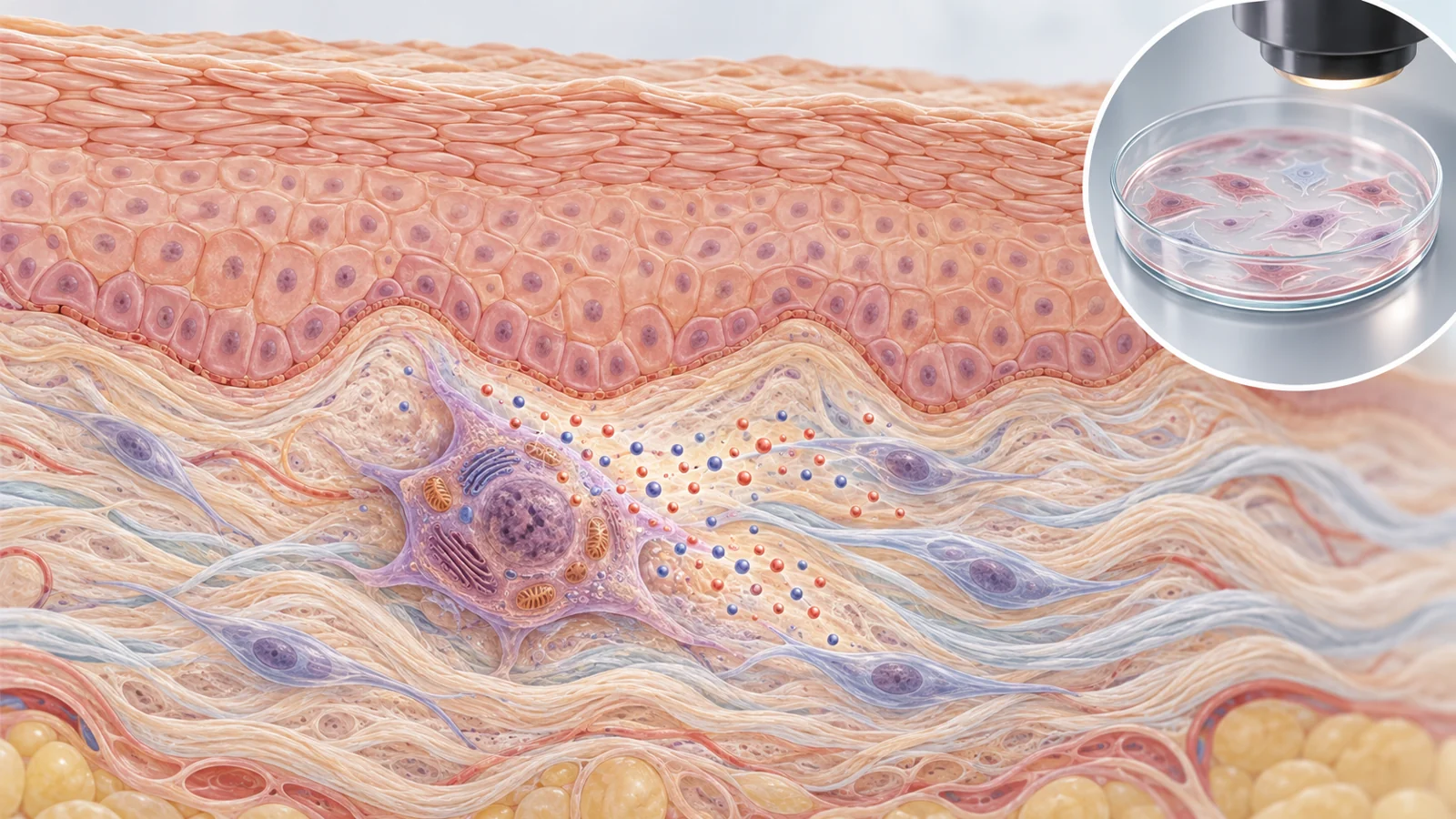
The skin contains several cell types with different jobs. Keratinocytes make up much of the epidermis, the outer layer that forms the body’s first barrier. Fibroblasts are prominent in the dermis beneath it, where they help produce the collagenous and elastic fibers that support tissue structure. Senescent cells can appear in both settings, and their influence may extend beyond the individual cell.
Senescent keratinocytes and fibroblasts remain active enough to release cytokines, other signaling molecules and enzymes that modify the surrounding matrix. These secretions can alter the local environment and affect neighboring cells. Senescent melanocytes may also display markers associated with the state and influence the behavior of basal keratinocytes. The biological concern is therefore not only that an older cell has stopped dividing, but that its continuing activity may reshape the tissue around it.
The review describes this altered secretory pattern as the senescence-associated secretory phenotype, or SASP. It can include inflammatory signals, chemokines, proteinases and growth factors. Their effects may reach beyond the original cell, helping explain how a cellular change could be connected to broader changes in skin integrity and function.
What the laboratory studies actually measured
The review summarizes experiments in different skin-cell types and models, so the intervention and the readout matter. One cited experiment treated pre-senescent neonatal human dermal fibroblasts over time with either hydroxytyrosol or oleuropein aglycone, compounds derived from extra-virgin olive oil. At the concentrations described in the review, the treatment reduced the number of cells positive for SA-β-Gal and reduced expression of the senescence-associated protein p16INK4A.
Those measurements are useful indicators of a senescence-associated state. They are not, by themselves, a demonstration that an ingredient selectively found and killed established senescent cells. The cells in this example were pre-senescent fibroblasts, and the reported result concerns changes in measured senescence-associated readouts after chronic treatment. It is more precise to describe the observation as a possible prevention or delay of senescence-related features in that cell model.
A separate line of work examined how polyphenols affect senescence-associated secretions. The review describes apigenin as interacting with NF-κB-related activity and being associated with reduced secretion of SASP factors. It also discusses grape seed proanthocyanidins in human epidermal keratinocytes exposed to ultraviolet radiation, where the reported laboratory observations included reduced oxidative stress and lower activation of MAPK and NF-κB activity.
These examples involve different cells, treatments and outcomes. Reducing a marker associated with senescence is not the same biological action as changing the signals released by a senescent cell. Neither observation automatically shows that a topical product or a polyphenol-rich diet would reproduce the same effect in intact human skin. Cell-culture exposure can isolate a mechanism for study, but it does not recreate every feature of a living tissue.
Senescence can protect as well as disrupt
A lower senescence signal may sound unambiguously beneficial, yet senescence has useful roles. Permanent growth arrest can help restrain cells that might otherwise become tumorigenic. Senescence-associated secretions can assist immune clearance of potentially dangerous cells, and they also participate in wound healing. The same broad biological program can therefore support protection in one context and contribute to chronic tissue deterioration in another.
This matters for how future treatments would need to work. A useful intervention would have to limit harmful senescence-related changes without simply disabling every process connected with senescence. Preserving the skin’s ability to repair damage, maintain its barrier and respond to abnormal cells would be part of the biological challenge. The review describes this tension as an open area for investigation; it does not show that the compounds discussed caused clinical harm.
The review also emphasizes that a universal marker of senescence is still lacking. Researchers therefore use combinations of cellular features and molecular readouts, each of which captures only part of a complex state. A change in one measurement can be informative without serving as a complete answer about what happened to the tissue.
What the cream study showed and what it left open
The review describes a double-blind, placebo-controlled study involving 44 women aged 40 to 65 who had redness on their cheeks. Participants used a cream containing 2% alpine rose extract on the face and neck twice daily for 28 days. The reported outcomes were a significant reduction in skin redness and an increase in elasticity.
The same alpine rose extract had also been described as having senolytic activity in senescent fibroblasts in vitro. That laboratory observation gives the ingredient a possible cellular rationale, but it does not connect the human results to senescent-cell clearance on its own. The clinical study measured visible and physical properties of skin, while the cell experiment addressed activity in a laboratory model.
The review explicitly notes that senescence biomarkers were not monitored in this study or in the other cosmetic studies discussed in that section. As a result, the reported improvements in redness and elasticity cannot be used to establish that senescent cells were removed, that their accumulation slowed, or that a particular anti-senescence pathway caused the change. They are observations about appearance and elasticity, not a direct measurement of the proposed cellular mechanism.
That separation also prevents a broader leap from the review’s findings to consumer advice. The cited cell experiments do not establish that eating polyphenol-rich foods reproduces the effects of a specific cream or cell-culture exposure. Nor does the review provide a general safety claim, a durable clinical benefit or a recommendation for a particular formulation.
What this could mean for aging skin
From the 2021 perspective, the practical opportunity was not simply to erase older cells. It was to develop treatments that limit harmful senescence-related changes while allowing skin to retain useful repair, protective and structural functions. If the proposed cellular effects of polyphenols can be reproduced in living skin, linked to meaningful benefits in tissue function and shown not to disrupt helpful responses, they could eventually help older people’s skin preserve more of its protective and structural capacity.
That possible advance would be different from making skin look less red or more elastic after a 28-day cosmetic study. It would require the cellular mechanism, the tissue-level outcome and the skin’s useful biological responses to align. The review presents that as a future possibility, not as a result already demonstrated in people.
Key Sources
- Primary source: Skin Aging, Cellular Senescence and Natural Polyphenols.
DOI or Journal Page · Review or Meta-Analysis · 2021-11-23
Keep exploring