
Research Signal – Source date 2022-03-13
A protein called α-Klotho helps regulate mineral balance and participates in signals that protect tissues from physiological stress. Its levels tend to decline with ageing and disease, which has made it a target of geroscience research. A study published on March 13, 2022, reports that removing senescent cells increased α-Klotho in several mouse settings and was followed by a rise in urinary α-Klotho in 20 people with idiopathic pulmonary fibrosis (IPF).
The finding is intriguing because it links two lines of research that are often discussed separately. Senolytics are drugs intended to clear senescent cells, while α-Klotho is a protein associated with kidney, brain, and broader tissue biology. But the human result was a change in a urine measurement after an uncontrolled treatment sequence. It is not evidence that the participants were rejuvenated, that their organs were protected, or that the urinary change itself improved their disease. The value of the paper lies in showing a plausible biological connection and a practical way to investigate it.
Senescent cells can influence their neighbors
Cellular senescence is a state in which a cell has essentially stopped dividing and has undergone broad changes in its metabolism and behavior. Some senescent cells release a mixture known as the senescence-associated secretory phenotype, or SASP. The mixture can include inflammatory signals and other molecules that alter the surrounding tissue.
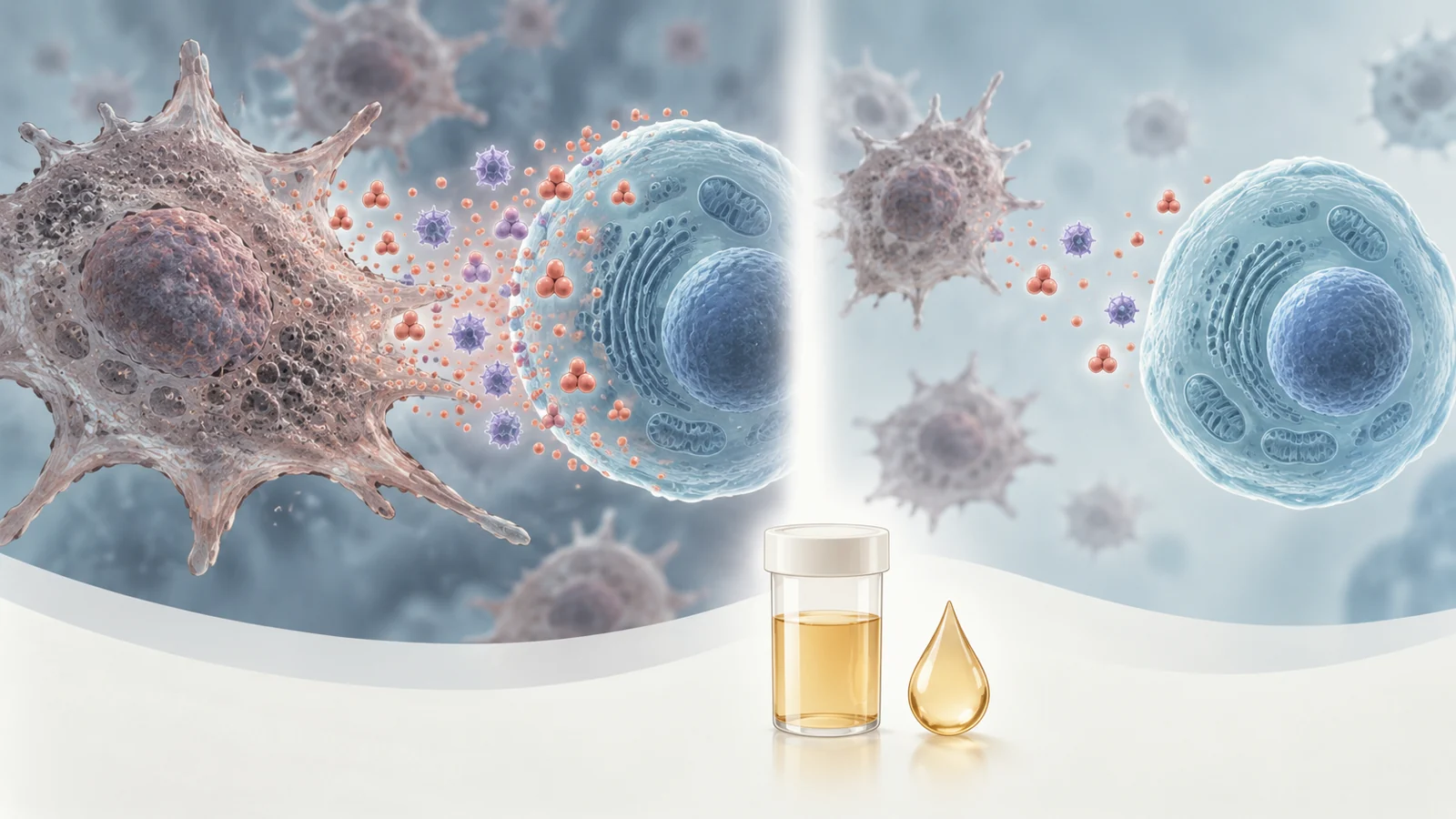
The researchers first tested whether those secretions could affect α-Klotho in otherwise nonsenescent human cells. They used conditioned medium, the liquid collected from cell cultures, from senescent or nonsenescent cells. Three types of human primary cells were examined. Exposure to medium from senescent cells lowered α-Klotho expression in each tested cell type.
The team then blocked individual SASP-related signals. Neutralizing activin A partly reduced the effect in two of the tested cell types, while blocking interleukin-1α partly reduced it in the third. Adding recombinant activin A or interleukin-1α could also lower α-Klotho expression in the corresponding nonsenescent cells.
That pattern supports a secretion-mediated mechanism: senescent cells may help create an environment in which neighboring cells make less α-Klotho. It does not reduce the whole process to one universal molecule. The partial, cell-dependent rescue leaves room for several signals acting together, as well as for other differences between tissues.
The mouse experiments tested cause, not just coincidence
A decline in α-Klotho and an accumulation of senescent cells could simply occur at the same time during ageing. The mouse experiments were designed to ask whether changing the senescent-cell burden changed α-Klotho as well.
In one experiment, researchers transplanted senescent cells into young mice. Compared with mice receiving nonsenescent cells or vehicle, the animals given senescent cells had lower α-Klotho in urine and in examined brain regions, including the cerebellum and choroid plexus. This intervention placed a senescent-cell burden into an otherwise young setting and produced a measurable reduction in the protein.
The investigators then used several ways to remove or target senescent cells. In genetically engineered INK-ATTAC mice, a drug activated a suicide mechanism in cells with high expression of p16, a marker expressed by many—but not all—senescent cells. Removing those cells increased α-Klotho in the kidney, urine, and brain of old mice. The study also tested orally administered senolytics in naturally aged mice, mice made obese by diet, and mice that had received senescent-cell transplants.
Dasatinib plus quercetin, commonly abbreviated D+Q, increased urinary α-Klotho in aged and diet-induced obese mice and increased kidney α-Klotho in old mice. Fisetin also increased urinary α-Klotho in aged mice and in mice that had received senescent cells. The exact tissue and response varied by experiment, but the direction of the findings was consistent with the idea that a high senescent-cell burden can suppress α-Klotho and that reducing that burden can relieve some of the suppression.
An informative part of the design was what did not respond. D+Q and fisetin did not increase α-Klotho in the examined nonsenescent human cell cultures. The genetic and drug-based interventions also did not increase kidney or urinary α-Klotho in young mice with a low apparent senescent-cell burden. That context makes a direct drug effect on every α-Klotho-producing cell less likely, although it does not settle every detail of the mechanism.
A small human signal appeared in urine
The human analysis came from a previous study, not from a newly randomized trial designed specifically to test α-Klotho. It involved 20 patients with IPF in a single-arm, open-label study. Participants took oral dasatinib plus quercetin for three consecutive days during each of three weeks, for nine treatment days in total. Urine was collected before treatment and five days after the last dose.
The reported mean creatinine-normalized urinary α-Klotho was approximately 34% higher after treatment than at baseline. The measurements were reported relative to urinary creatinine so that the amount of α-Klotho could be interpreted in relation to how concentrated or dilute a urine sample was. The authors also found inverse relationships between urinary α-Klotho and urinary SASP factors in this group.
The result is a useful human observation, but the study design matters. There was no untreated comparison group, no random assignment, and no way from this before-and-after analysis to separate a treatment effect from changes related to time, the underlying illness, sample conditions, or other factors. The analysis also cannot show that senescent-cell clearance caused the urinary rise, or that the rise caused any improvement in physical function. The earlier study reported changes in physical performance after D+Q, but the urinary analysis does not establish a causal chain between those observations.
Nor does a urine measurement tell us that α-Klotho increased in the brain, kidney tissue, blood, or lungs. It cannot show that pulmonary fibrosis was reversed. The reported sampling point also does not establish how long the change lasted or whether the treatment had a favorable long-term balance of benefits and risks.
What a urine test can and cannot tell us
α-Klotho is produced in several tissues, including the distal kidney tubule and parts of the brain, and soluble α-Klotho is present in urine. A urine sample is attractive in a clinical study because it can be collected less invasively than blood and may integrate production over the hours represented by a first-morning sample. Creatinine normalization adds another useful control by accounting for differences in urine concentration, which helps prevent a more diluted or concentrated sample from being mistaken for a biological change.
Those practical advantages do not turn urinary α-Klotho into a direct window on every tissue. The amount detected by an immunoassay can reflect what reaches urine, how the sample is concentrated, and how the measured protein is presented to the assay. The authors discuss discrepancies between urinary and plasma α-Klotho in other conditions as a reminder that the two compartments do not always tell the same story.
For the same reason, urinary α-Klotho is not established by this study as a validated surrogate for clinical benefit or as a universal quantitative measure of senescent-cell burden. It may become a convenient way to follow biological activity during senolytic trials, especially if changes in urine track other evidence of treatment response. That possibility needs to be tested rather than assumed.
From removing cells to restoring protection
The proposed therapeutic chain is straightforward in outline. Senescent cells accumulate and release signals that can suppress α-Klotho in nearby cells. An intermittent oral senolytic could reduce the cells producing those signals, allowing endogenous α-Klotho production to recover in the appropriate biological settings. If that restored protein then improved tissue resilience, patients with diseases involving senescence and reduced α-Klotho might gain a more practical route to endogenous protection than repeated injections of recombinant protein or related peptides.
The patient-facing benefit remains conditional at every important step. A future treatment would need to clear the relevant senescent cells safely, raise α-Klotho in meaningful tissues rather than only in urine, and produce a durable clinical improvement that outweighs its risks. The March 2022 study does not establish those outcomes. It shows why the question is testable: the cell experiments identify a plausible suppressive route, the mouse interventions connect senescent-cell removal with protein recovery, and the exploratory human measurement suggests that an oral regimen can be studied with a relatively accessible biological readout.
The paper also leaves the precise mechanism open. Senolytics might reduce harmful bystander signaling, remove cells that themselves produce little α-Klotho, or do both. Distinguishing those possibilities will matter because a rise in a urine biomarker is most useful when it corresponds to a real change in tissue biology and, ultimately, to better health for the people receiving treatment.
What this could change
A reliable, safe way to restore a patient’s own α-Klotho through intermittent oral treatment could make senolytic therapy more practical for diseases in which senescent cells and declining tissue protection overlap. Urinary α-Klotho might help clinicians follow whether the biological pathway is responding without repeated invasive sampling. That capability would become meaningful only if controlled human studies show that the rise reflects beneficial tissue effects and leads to improved patient outcomes. For now, the study supplies an experimental bridge from senescent-cell secretions to mouse biology and an early human urine signal—not proof of general rejuvenation or a treatment ready for routine use.
Key Sources
- Primary source: Orally-active, clinically-translatable senolytics restore α-Klotho in mice and humans.
DOI or Journal Page · Peer-Reviewed Paper · 2022-03-13
Keep exploring