
Research Signal – Source date 2024-02-01
A cell can stop dividing and still affect the tissue around it. It can remain metabolically active, release inflammatory molecules and alter the behavior of neighboring cells. This combination helps explain why researchers are interested in cellular senescence as a contributor to age-related disease—and why simply counting cells tells only part of the story.
A research synthesis published on February 1, 2024, brings together several ways of intervening. Some treatments aim to kill senescent cells. Others aim to change what those cells release. A further approach equips immune cells to recognize and clear them. The publication draws on cell and tissue experiments, animal models and human clinical observations; it does not report one new experiment testing all these approaches together.
The distinction that matters for health runs through those examples. A treatment can change a molecular marker associated with senescence without establishing that an organ works better. An improvement in physical function answers a different question, and its meaning depends on whether it occurred in a mouse experiment or in patients with a particular disease.
Why a cell that stops dividing still matters
Senescence is a cellular response to stress or damage, including damage to DNA. It can arise regardless of a person’s age. The cell activates mechanisms that arrest its division, but it does not necessarily die or become inactive. Senescence also differs from quiescence, a resting state from which cells can resume dividing.
The February publication describes senescent cells as continuing to use energy and produce signaling molecules. Their secretions can include inflammatory cytokines and chemokines, molecules that influence other cells and recruit immune activity. Collectively, these secretions are called the senescence-associated secretory phenotype, or SASP.
When such activity persists, its effects can extend beyond the original cell. Secretions can promote senescence in neighboring cells and contribute to inflammation and tissue dysfunction. The resulting biological problem is therefore larger than a population of cells that no longer reproduces. It includes the environment those cells help create.
Yet senescence also has useful roles. Arresting the division of damaged cells helps suppress cancer, and senescent cells can contribute to wound healing and development. The publication describes differences among senescent cells, including a subset whose secretions support tissue regeneration. Persistence, cell type and tissue context all matter when deciding which activity could be harmful and which could be useful.
That is the biological tension behind treatment. Removing a persistent source of inflammatory signals may help a tissue, while indiscriminately disrupting senescence could interfere with protective processes.
Killing a cell and changing its secretions are different actions
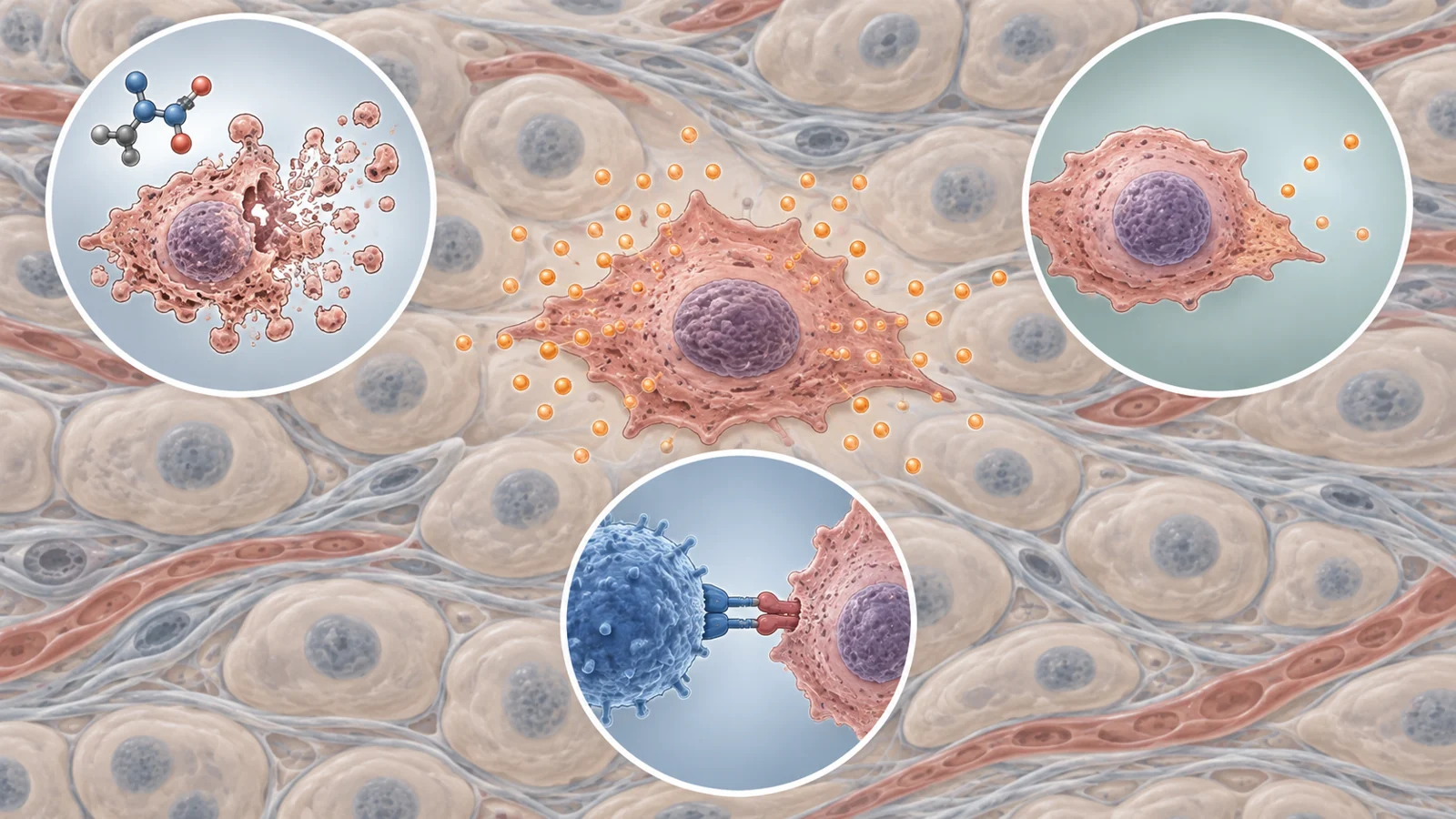
Senescent cells can resist apoptosis, the regulated process through which cells undergo programmed death. They maintain survival mechanisms that allow them to persist despite damage. Senolytics are drugs intended to exploit vulnerabilities in those mechanisms and induce senescent-cell death.
The synthesis discusses dasatinib combined with quercetin as one example. The rationale for this combination concerns the survival pathways used by particular senescent cells. Its intended action is cell elimination; the relevant experimental questions include whether the treatment reduces the targeted cell population and what happens to the tissue afterward.
Senomorphics take a different approach. They modify senescent behavior, especially secretory activity, without requiring the cell to die. Interfering with a pathway that helps drive inflammatory secretions could reduce a cell’s effects on its surroundings even while that cell remains present.
Rapamycin is discussed in this category because it acts on mTOR, a regulator of cellular activity connected to the senescent phenotype. Other examples act on pathways involved in inflammatory signaling. These mechanisms help explain why a lower level of secreted inflammatory molecules cannot, on its own, tell us that senescent cells have been removed.
The two approaches therefore require different interpretations of a result. Reduced secretion may be the intended outcome of a senomorphic treatment. For a senolytic, researchers are trying to establish cell clearance and its consequences. A similar change in a tissue measurement can arise from different biological actions.
What changed in tissue, mice and patients
The dasatinib–quercetin examples make the gap between mechanism and health outcome concrete. They span several experimental settings, each with a different endpoint.
In an experiment using human abdominal fat tissue outside the body, treatment reduced senescence-associated measurements, including p16 and an enzyme activity commonly used to identify senescent cells. The researchers also observed reduced senescence-associated secretions in the surrounding culture medium. These findings describe responses in treated human tissue. They do not measure how a person feels, moves or functions after treatment.
The publication also describes observations in patients with diabetic kidney disease who received the combination. Subsequent samples showed reductions in senescence-associated markers and secretions in fat and skin. This brings the evidence into people, but the endpoint still matters. A change in sampled tissue can support biological activity without establishing that kidney function has recovered or that a benefit will persist.
The distinction is especially important because a marker is an indicator of a biological state. A lower marker measurement is not itself a measurement of organ performance. Interpreting it requires attention to what was sampled and what the treatment was intended to change.
A mouse experiment addressed physical function more directly. Young mice received transplanted senescent cells, which produced later deterioration in walking speed, hanging endurance and grip strength in vehicle-treated animals. Giving dasatinib plus quercetin around the time of transplantation mitigated those changes. This connects an intervention to functional outcomes in that experimental model, rather than only to molecular measurements.
The synthesis separately reports improved physical function in patients with idiopathic pulmonary fibrosis, a progressive lung disease associated with senescence. That is a human functional observation, distinct from the tissue-marker findings. It does not, by itself, establish reversal of lung fibrosis, durable disease modification or benefit in otherwise healthy older adults.
These examples cannot be combined into a single result in which lower markers automatically lead to stronger muscles or healthier organs. The tissue experiment, the transplantation model and the patient observations address different questions. Together, they explain the interest in senescence-directed treatment while leaving the connection between biological activity and lasting clinical benefit to be established for each use.
Giving immune cells a recognition target
Drug treatment is only one way to approach senescent-cell clearance. The immune system already participates in this process. Signals released by senescent cells can recruit immune cells, including macrophages, natural killer cells and T cells.
That surveillance can fail. The publication describes ways senescent cells evade immune activity, including increased expression of signals that inhibit clearance. It also notes that the immune system’s ability to remove them declines with age. Engineering recognition offers a possible way to address this problem.
CAR T cells are T cells modified to carry an artificial receptor that recognizes a selected target. In the work discussed here, researchers investigated uPAR, a protein found on the surface of cells in several senescence models. The engineered receptor gives the T cell a means of recognizing cells bearing that protein and directing its activity toward them.
The synthesis describes treatment with uPAR-directed CAR T cells in a mouse model of liver fibrosis, reporting benefit in that setting. This extends the therapeutic idea beyond delivering a compound that alters an internal survival pathway. The intervention supplies a living immune cell with a chosen recognition mechanism.
The same account also illustrates how treatment intensity can change the outcome. Excessive doses produced an inflammatory reaction resembling cytokine release syndrome, whereas the publication describes tolerability under other tested conditions. The liver-fibrosis result establishes a preclinical example; it does not establish an effective or safe regimen for treating human aging.
The limits sit inside the biology
Senescent cells do not all rely on the same survival mechanisms. Some use different pathways, and some have overlapping ways to resist death. A drug directed at one pathway may therefore eliminate only a subset. This heterogeneity helps explain why activity in one tissue cannot be assumed to transfer to every other tissue or disease.
Recognition presents a related problem for immune approaches. uPAR has biological roles beyond senescence, including involvement in wound healing and cancer. Finding a target associated with senescent cells is different from finding a target exclusive to the cells a treatment should remove.
The clinical challenge brings these issues together. A useful intervention would need to affect disease-relevant cells while limiting effects on other cells and preserving beneficial senescence, including its roles in repair and tumor suppression. Dose and timing belong to that problem, alongside target choice. The adverse effects described in the engineered-cell mouse work make clear that a promising mechanism does not settle the question of tolerable treatment.
The February 2024 synthesis identifies safe, specific targeting and standardized approaches to treatment as unresolved needs. Its varied examples do not establish which strategy is superior, nor do they demonstrate extended human lifespan or broadly healthier aging in people without the diseases studied. Those are larger claims than changes in tissue markers or functional observations in particular settings can support.
What this could change
If researchers can establish disease-relevant targeting and tolerable treatment in humans, senescence-directed therapies could offer a way to preserve organ function by reducing one contributor to tissue dysfunction. In liver fibrosis, for example, successfully controlling a harmful senescent-cell population could reduce its contribution to the processes that impair the organ. The mouse work supplies a reason to investigate that possibility.
A clinically useful treatment might remove those cells or reduce the secretions through which they affect their neighbors. If that biological change leads to sustained preservation of organ function, the downstream benefit could be less disability from particular age-related diseases and more years of independent life. That is the consequential promise behind this research: turning an effect on cells into a measurable improvement in what people can do.
Key Sources
- Primary source: Senotherapeutics to Counteract Senescent Cells Are Prominent Topics in the Context of Anti-Ageing Strategies.
DOI or Journal Page · Peer-Reviewed Paper · 2024-02-01
Keep exploring