
Research Signal – Source date 2022-08-01
A cell can stop dividing and still influence the tissue around it. It remains alive, consumes energy, and may release molecules that alter neighboring cells. That combination helps explain why senescent cells—cells that have entered a stable halt in division after damage or stress—became targets for treatments aimed at aging-related disease.
An August 1, 2022 review in the Journal of Clinical Investigation brings together the biology behind this approach, experiments that removed selected cells in mice, and early attempts to treat people. The human findings address two different questions: can treatment improve physical performance, and can it change the measured burden of senescent cells? Those answers need to be connected before researchers can explain reliably how a treatment helps.
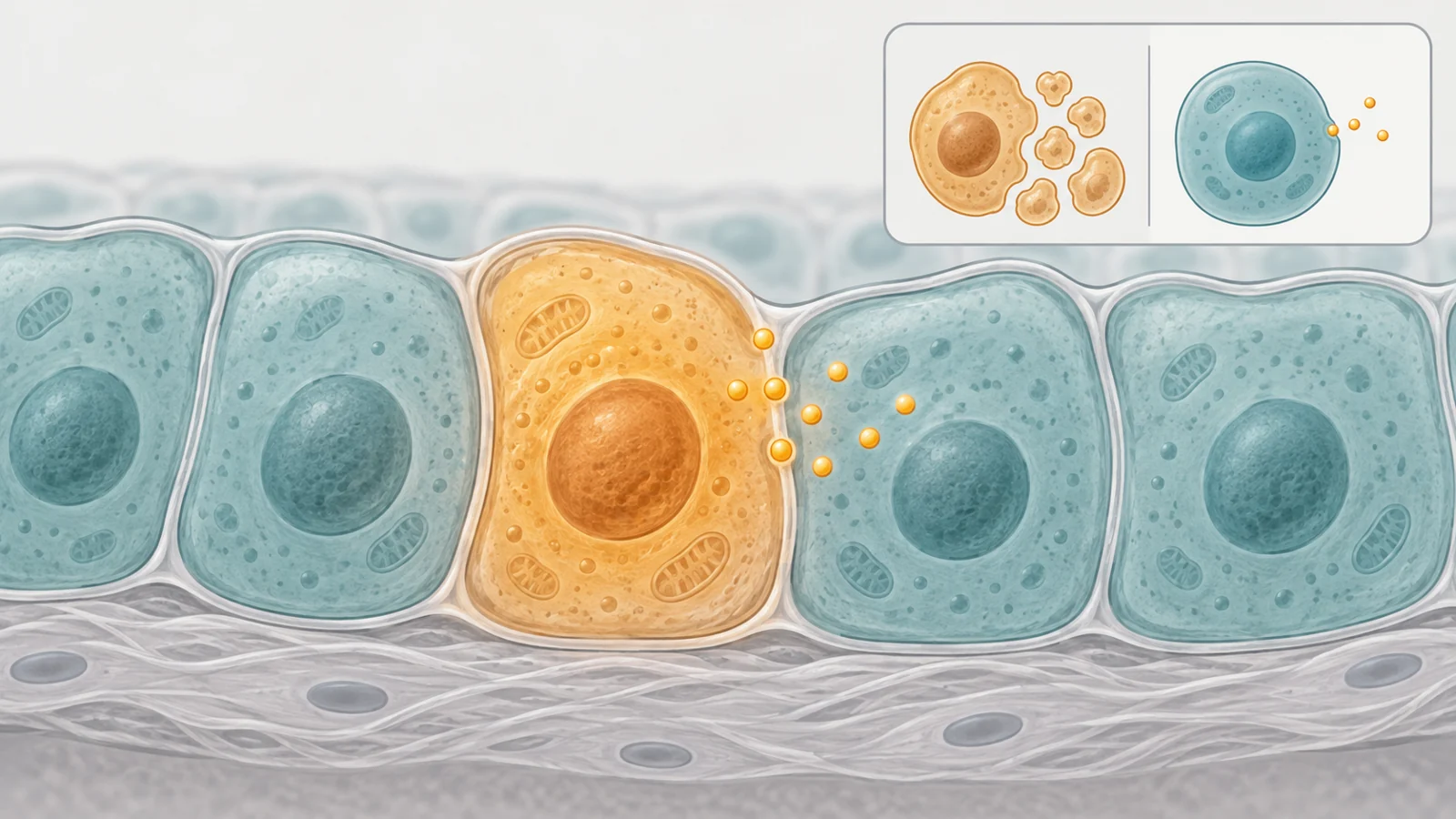
Senescence itself has useful roles. It can prevent damaged cells from continuing to divide, support tumor suppression, and contribute to wound healing and tissue regeneration. Problems can arise when senescent cells accumulate and their activity persists. Many produce a mixture of inflammatory and other signaling molecules called the senescence-associated secretory phenotype, or SASP. These secretions can alter tissue maintenance and induce senescence in other cells, extending the effects beyond the cells that first encountered damage.
What removing cells revealed in mice
Finding more senescent cells in older tissue establishes an association. Experimentally removing a selected population asks a more revealing question: does the course of aging-related damage change when those cells are gone?
The review describes genetically engineered mice in which researchers could activate a cell-death mechanism in cells expressing high levels of p16, a protein used as a senescence marker. In one model of accelerated aging, this intervention reduced age-related problems including muscle loss, cataracts, and loss of fat tissue. In naturally aged mice, the same general genetic strategy improved healthspan, extended median lifespan, and delayed tumor development.
These experiments provided evidence that selected senescent cells contributed causally to the conditions being studied. Removing them changed what happened to the animals. The cells were therefore more than passive indicators of accumulated damage.
Drug experiments followed a different route. Instead of relying on an engineered cell-death switch, compounds had to exploit biological vulnerabilities in the cells. The combination of dasatinib and quercetin produced benefits across several mouse disease models and extended lifespan in naturally aged mice. Genetic removal established the value of intervening in a cell population; drug studies tested ways of reaching that population through its existing biology.
Killing cells and quieting their secretions
Senolytics are drugs intended to eliminate senescent cells. Some act on survival mechanisms that help these cells resist apoptosis, the regulated process of cell death. Disrupting those defenses can make a susceptible senescent cell die. Dasatinib plus quercetin is one example discussed extensively in the review.
Susceptibility varies. Senescent cells differ according to their tissue of origin, the stress that produced them, and the survival pathways they use. The review notes that dasatinib plus quercetin does not induce apoptosis in certain senescent cell types. A compound active in one setting may therefore leave other populations untouched. This diversity shapes which diseases and tissues a candidate drug might be able to address.
Senomorphics take another approach. They suppress harmful secretions or other features of senescence without inducing the cells to die. Many interfere with pathways that regulate the SASP, reducing the messages that senescent cells send into their surroundings.
That distinction also affects exposure. Once a senolytic has removed susceptible cells, its immediate job is complete, creating a rationale for intermittent treatment. Suppressing secretions may require continued exposure because the cells remain present and capable of resuming that activity. The review presents these as different treatment strategies; the appropriate schedule still depends on the compound and biological setting. It also notes that some substances can suppress senescence-associated features at one concentration and kill cells at another.
What the early human findings actually measured
The pulmonary-fibrosis and diabetic-kidney-disease studies described in the review are useful to read side by side because they measured different parts of the proposed therapeutic chain.
In an open-label pilot involving people with idiopathic pulmonary fibrosis, intermittent oral dasatinib plus quercetin over three weeks was associated with improvements in six-minute walking distance, gait speed, and repeated chair-stand performance. These are functional measurements. They ask how well a person can carry out physical tasks, bringing the research closer to abilities that matter in daily life.
The pilot did not establish that lung fibrosis had reversed, and the physical-performance findings did not by themselves demonstrate senescent-cell clearance. Its open-label design also limits how firmly improvements can be attributed to the intervention. The findings offered an early reason to investigate function further, rather than a settled account of why performance changed.
The diabetic-kidney-disease study examined a different question. Following a three-day oral course of the same drug combination, researchers found reductions in cells carrying senescence-associated markers in fat and skin biopsies. These included increased activity of the enzyme SA-β-gal and expression of the proteins p16 and p21. Blood samples also showed reductions in several SASP factors.
Those findings connected treatment with changes in sampled tissue and circulating molecules. They do not establish restored kidney function. The distinction matters because a biological measurement can show that an intervention is affecting processes of interest without demonstrating that a diseased organ works better. Conversely, a functional improvement does not identify the cellular mechanism responsible for it.
Results also differed across candidates and diseases. The review reports that an osteoarthritis trial of UBX-0101, delivered by injection into the joint, failed to meet its primary endpoints—the main outcomes used to judge the trial’s success. That result belongs alongside the encouraging pilot observations. By August 2022, the human evidence supported continued investigation of particular treatments in particular diseases; it did not establish senolytics as a general treatment for aging or show that they extend human lifespan.
A toxic payload needs a better address
Navitoclax illustrates a practical drug-development problem. It targets proteins in the BCL-2 family that help cells survive and showed benefits in multiple animal models. But its toxicity to platelets limited its potential for translation into treatment. Activity against a desired cell population is only part of the requirement for a useful drug; effects on other cells can constrain its use.
One proposed solution changes how the active compound is released. Senescent cells often have increased activity of the enzyme SA-β-gal. Researchers can exploit that activity by attaching a galactose group to a drug, creating a prodrug that requires processing to release its active payload. The intention is to favor activation inside senescent cells after uptake.
The review describes Nav-Gal, a galactose-linked version of navitoclax, as having reduced platelet toxicity compared with the parent compound. This is a concrete example of redesigning a candidate around an unwanted effect. Preferential activation could improve the balance between reaching susceptible senescent cells and exposing other cells to toxicity. It does not make the enzyme an exclusive address for every disease-driving senescent cell or establish long-term safety in people.
Fewer markers do not tell the whole story
Measuring senescence is difficult because no universal marker specifically identifies every senescent cell. SA-β-gal activity, for example, can also occur in other cells or under other conditions. Different senescent populations carry different combinations of features, so researchers need multiple markers to characterize them.
This complicates the interpretation of a falling marker burden after treatment. A decrease can be consistent with fewer senescent cells, but it does not, on its own, reveal which cells died or whether the drug directly killed them. An intervention might instead encourage immune cells to clear senescent cells. Suppressing the SASP could also reduce the spread of secondary senescence, changing the eventual burden through another route.
To establish direct senolysis, the review argues for examining senescence and SASP markers together with evidence of apoptosis or other cell-death pathways. Methods that resolve individual cell populations could help identify which types are disappearing and how. That would make the connection between a drug’s proposed action and a measured tissue change more specific.
There is a further question of biological judgment. Because senescence can help with repair and tumor suppression, a treatment needs to distinguish harmful persistence from useful activity as effectively as possible. Disease stage, tolerability, side effects, and treatment timing remain consequential uncertainties. Intermittent dosing may help limit exposure, but a schedule alone cannot establish that beneficial cell functions are preserved. These issues determine whether a measurable cellular effect can become a durable, acceptable treatment.
What this could change
If researchers can safely reduce the activity or abundance of disease-driving senescent cells, they could gain a way to address a contributor to tissue dysfunction across several age-related conditions. Less persistent inflammatory signaling could help preserve the conditions tissues need for maintenance and repair. Where that produces lasting functional benefit, older adults might retain mobility, recover more effectively from physical stress, and experience less disability from particular diseases.
The practical payoff would be visible in daily capabilities—walking farther, rising from a chair more easily, or maintaining independence. From the August 2022 perspective, achieving that possibility depends on matching the intervention to the relevant cells and disease stage, then demonstrating durable patient benefit with acceptable safety. The early work makes those capabilities a concrete therapeutic ambition.
Key Sources
- Primary source: Cellular senescence: a key therapeutic target in aging and diseases.
DOI or Journal Page · Clinical Trial · 2022-08-01
Keep exploring