
Research Signal – Source date 2025-06-13
A cell can stop dividing and still influence everything around it. In cellular senescence, cells enter a stable nondividing state and undergo changes in their activity. Some release molecules that affect neighboring cells, immune responses, and the surrounding tissue. This helps explain why senescent cells attract attention in aging research: their persistence can have consequences beyond the cells themselves. It also explains a complication. Senescence participates in wound repair and tumor suppression, even as its chronic accumulation is implicated in tissue dysfunction and age-related disease.
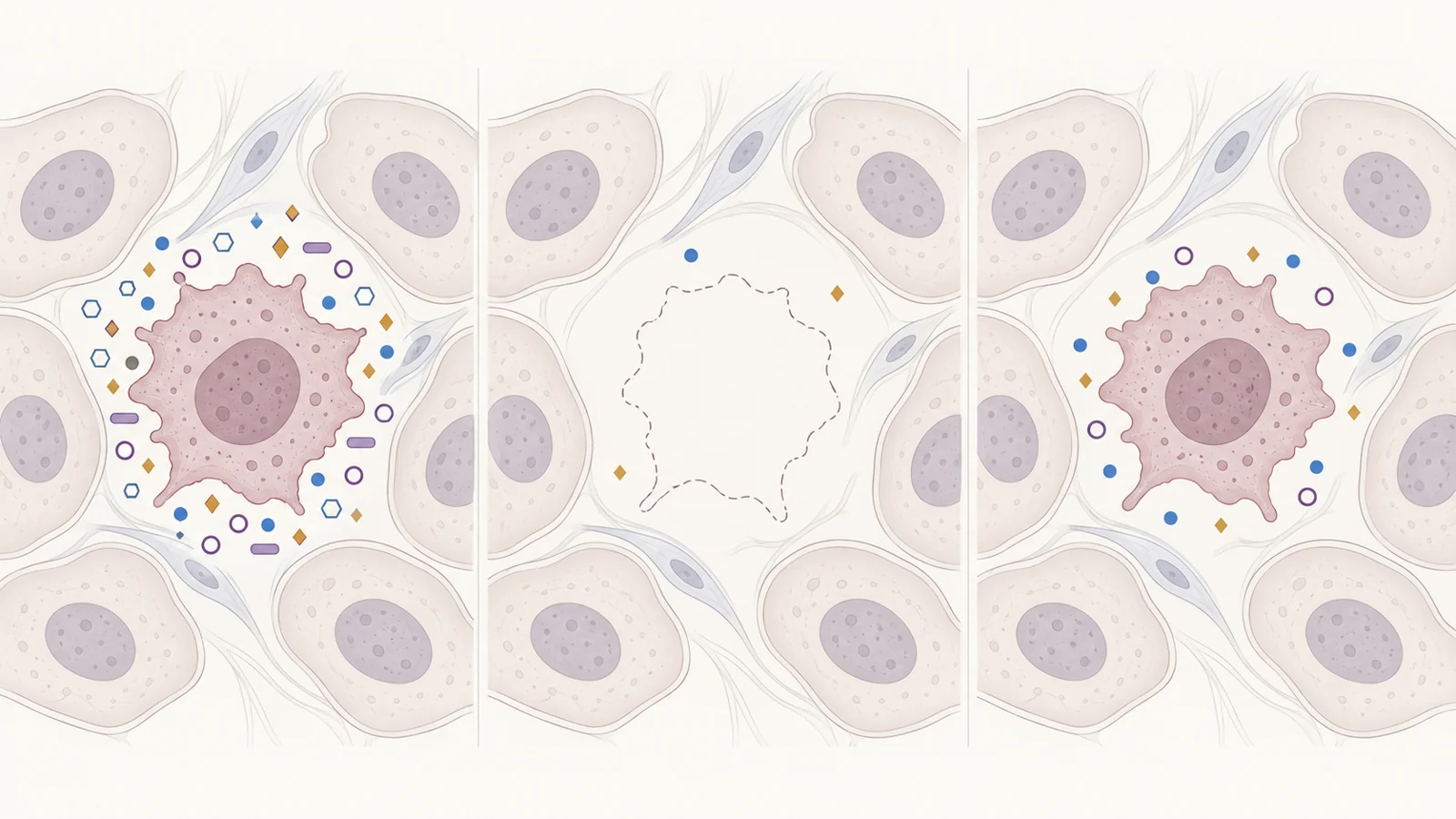
A review published June 13, 2025, examines two ways researchers are trying to intervene. Senolytics aim to eliminate senescent cells. Senomorphics alter aspects of their activity, including their secretions, without necessarily killing them. The paper brings together biological mechanisms, animal findings, and early clinical research. Its central practical question is how either approach might translate into better function for a person. The synthesis itself does not demonstrate longer human life or preserved health in generally healthy people.
Two ways to change a cell’s influence
Senolytics work by exploiting the mechanisms that help senescent cells stay alive. These cells can depend on survival pathways that block apoptosis, the process through which a cell undergoes programmed death. Disabling those defenses can make a senescent cell vulnerable. The intended result is removal of the cell, taking away its continuing contribution to the tissue environment.
The review discusses dasatinib, a drug that inhibits several signaling enzymes, and quercetin, a plant compound with effects on multiple cellular pathways. Used together, they are among the most studied senolytic combinations. Their activity also illustrates why “senescent” does not describe one uniform drug target. A cell in fatty tissue can rely on different survival mechanisms from a cell lining a blood vessel. The stress that triggered senescence and the surrounding tissue further shape its response. An agent effective against one population may have little effect on another.
Senomorphics intervene in what cells do while leaving them alive. One major target is the senescence-associated secretory phenotype, or SASP: the collection of molecules that senescent cells can release. These include inflammatory signals and molecules involved in tissue remodeling. The review describes drugs that act on pathways controlling the production of these secretions.
Rapamycin and related compounds provide an example. They inhibit mTOR, a regulator of cellular activity, and can dampen production of some SASP components. The paper describes interference with production of IL-1α, a molecule that helps drive the secretory response. This approach changes the cell’s output without requiring its destruction. But because both survival pathways and secretory programs vary, neither drug category guarantees the same response across tissues or diseases.
Secretions change as senescence persists
It is tempting to imagine the SASP as a fixed stream of inflammatory molecules. The review describes something more dynamic. What a senescent cell releases, and what those molecules do, can change with time and biological context.
Early in some senescence responses, secretions can favor tissue remodeling, fibrosis, or suppression of particular immune responses. The paper gives examples including TGF-β, a signaling molecule, and proteins associated with the material surrounding cells. These activities can help maintain tissue integrity or restrain excessive immune activation during an acute response. If the cells persist, however, related processes may contribute to scarring or an environment that permits immune evasion.
In chronic, unresolved senescence, the review describes a shift toward more inflammatory signaling, including molecules such as IL-6 and IL-8. Persistent secretions can recruit immune cells, disrupt stem cell function, and help spread senescence to neighboring cells. This is a context-dependent pattern, rather than a universal timetable followed by every tissue. It makes timing part of the therapeutic problem: suppressing a particular secretion during repair may have different consequences from suppressing it after prolonged dysfunction has developed.
Cell removal and continuing treatment carry different costs
For senolytics, an important obstacle is that a survival mechanism used by senescent cells may also be essential elsewhere. Navitoclax makes this problem concrete. It inhibits members of the BCL-2 family of proteins, including BCL-xL, which helps cells resist programmed death. Blocking that pathway can kill susceptible senescent cells.
Platelets also depend on BCL-xL for survival. The review describes dose-dependent platelet depletion, or thrombocytopenia, as a limitation of navitoclax. The drug can therefore act on its intended molecular target while still harming a cell population that treatment was not meant to remove. Greater potency against that target alone would not resolve the problem. Delivery and the distribution of the target across the body matter too.
Keeping senescent cells alive avoids cell removal, but it creates a different set of demands. Senomorphic drugs often affect pathways with many responsibilities beyond secretion control. The review raises the possibility of interfering with useful immune responses or cellular stress responses. Changing one measurable part of the SASP does not mean the rest of the drug’s activity is confined to that task.
There is also a question of how long suppression lasts. Because senomorphics leave the cells in place, their secretions could return after treatment stops, and dysfunctional cells could continue to accumulate. The authors also identify possible tolerance during prolonged treatment as a concern. These are potential limitations, not established outcomes for every compound. They nevertheless affect how a treatment would be judged: a benefit that depends on continuing exposure must be weighed alongside the consequences of that exposure. The review does not establish one strategy as the better clinical choice across patients and diseases.
What would count as a benefit for a person?
The animal findings summarized in the review provide reasons to test these approaches. In aged or diseased animals, dasatinib plus quercetin has reduced senescent-cell burden and improved physical function; some experiments have also reported longer lifespan. The paper describes preclinical findings in which rapamycin reduced senescence-related inflammation, improved stem cell function, and extended lifespan. These results concern particular experimental settings and cannot be carried over as estimates of what people should expect.
The human evidence discussed is earlier and more disease-specific. The review reports preliminary observations involving physical performance or senescence-associated markers in studies of conditions such as idiopathic pulmonary fibrosis and diabetic kidney disease. Such observations can help establish whether an intervention reaches relevant biology or produces a functional signal worth testing further. They do not establish that treating senescence prevents age-related decline in otherwise healthy people.
Interpreting a marker change is especially difficult because senescence lacks a single definitive clinical test. Researchers use indicators such as the cell-cycle regulators p16 and p21, an enzyme activity called SA-β-gal, and signs of DNA damage. The review explains that these are not exclusive to senescence, and some are difficult to assess in living patients without access to the relevant tissue. There is also no agreed method for adding up a person’s overall senescent-cell burden.
That leaves several explanations for an apparently encouraging measurement. A reduction in a senescence-associated marker might be consistent with fewer senescent cells, but the marker alone cannot establish that those cells were selectively cleared. A decrease in an inflammatory molecule might indicate altered secretion without showing that tissue function improved. Measurements of biological activity and measurements of a person’s capabilities answer different questions.
For someone living with tissue dysfunction, the consequential outcome would be a durable improvement in function or a reduction in disability. A physical-performance result therefore addresses a different level of benefit from a molecular change. Even then, its interpretation depends on how the study establishes a treatment effect, how long that effect lasts, and what adverse effects accompany it. The review’s early human observations support further investigation without settling those questions.
Preventive use raises the bar in another way. Someone who has few symptoms might receive an intervention for a benefit expected much later, while experiencing its risks sooner. The paper highlights difficulties in defining clinical success, selecting endpoints, and deciding how long follow-up should continue. A change in a proposed measure of biological aging, a change in physical capacity, and fewer disease complications are not interchangeable outcomes. Trials need to connect the chosen measurement to the benefit being claimed.
What this could change
If targeting senescence produces durable functional benefits with acceptable safety in humans, older people with age-related tissue dysfunction could retain physical function longer and experience less disease-related disability. The causal prospect is that reducing a persistent source of disruptive signaling, or changing its output, could help affected tissue maintain its function. That would give these interventions a practical role defined by what people can continue to do.
Tissue-directed delivery could make that prospect more achievable. The review discusses approaches such as targeted carriers and drugs designed to become active in particular tissues. If they can concentrate an intervention where it is useful while limiting exposure elsewhere, they could improve the balance between benefit and harm. Combined with a better understanding of which cells and secretions drive a particular disease, this could support treatments tailored to specific tissue problems. In the June 2025 picture, those delivery approaches remain development paths toward that capability, rather than established solutions.
Key Sources
- Primary source: Targeting Senescence: A Review of Senolytics and Senomorphics in Anti-Aging Interventions.
DOI or Journal Page · Peer-Reviewed Paper · 2025-06-13
Keep exploring