
Research Signal – Source date 2021-05-13
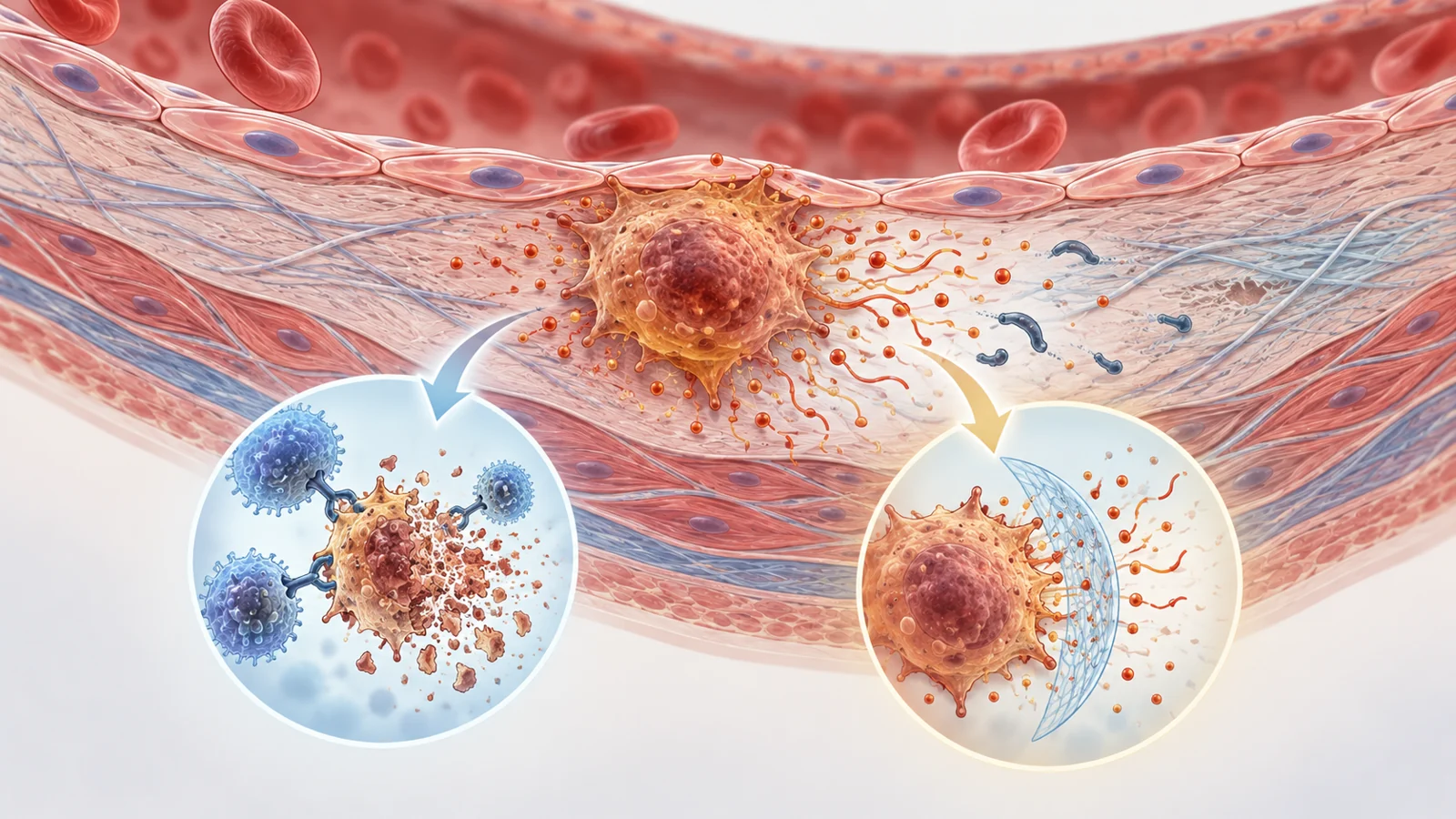
Ageing does not affect the cardiovascular system only through familiar risk factors. Cells can also enter a state called senescence, in which they stop dividing but remain active in surrounding tissue. Over time, these cells may accumulate in blood vessels and the heart, where their chemical signals can help sustain inflammation and structural damage.
A 2021 review asks whether therapies aimed at senescent cells could eventually be used against cardiovascular conditions associated with ageing. Its answer is prospective rather than clinical: the idea has produced interesting findings in animals, but cardiovascular senolytic treatment had not yet reached the stage of established human therapy described by the authors.
Why a cell that stops dividing can still matter
Senescent cells are not simply inert cells waiting to be cleared. The review describes them as contributors to a senescence-associated secretory phenotype, or SASP. This involves inflammatory mediators and matrix-degrading molecules released into the local environment.
The surrounding tissue therefore becomes part of the story. In the vessel lining, endothelial-cell senescence can impair a structure that helps regulate vascular function. Signals released by senescent cells may also influence the vessel wall and its supporting cells, contributing to a setting associated with inflammation, remodelling and stiffening. The relevant target is consequently not just one damaged cell, but the tissue environment that cell helps shape.
The review connects senescence with endothelial dysfunction and discusses animal findings involving arterial stiffness, aortic calcification and cardiac function. It does not make senescence the sole explanation for every cardiovascular disorder. Rather, it presents senescent cells and their secretions as possible contributors that might be therapeutically modified.
Three ways to intervene in senescence
Senotherapeutics is an umbrella term for approaches that affect senescent cells or their effects. The review groups them into three broad strategies.
Senolytics are intended to selectively kill senescent cells. Senomorphics, sometimes described as SASP suppressors, aim to reduce harmful secretions or alter the senescent phenotype without necessarily removing the cell. A third approach seeks to limit the increase or accumulation of senescent cells in tissue.
These categories describe biological actions, not permanent labels attached to every compound. The review notes that fisetin can have senomorphic effects in some cell types and senolytic effects in others, at least in laboratory work. The same substance may therefore behave differently depending on the cells and conditions involved. That matters for cardiovascular development because an intervention designed to remove one population could have a different effect elsewhere in the body.
The distinction also changes what a successful treatment would mean. Clearing a cell, quieting its secretions and slowing the appearance of additional senescent cells are not interchangeable outcomes. Each would have to be connected to a meaningful improvement in vascular or cardiac function, with its own safety considerations.
What the animal studies actually measured
The review discusses several findings involving different interventions, organisms and cardiovascular readouts. Dasatinib combined with quercetin was associated with improved vasomotor function in aged mice. In hypercholesterolemic mice, the combination was linked with reduced aortic calcification. In aged mice, it was also associated with enhanced cardiac function. These are distinct observations: vessel responsiveness, mineral accumulation in the aorta and cardiac performance are not the same measurement.
Other examples target senescence-related processes without being presented as direct senescent-cell clearance. Resveratrol-mediated activation of SIRT1 was reported to inhibit arterial-wall inflammation and stiffening in nonhuman primates. The SIRT1 activator SRT1720 was associated with reduced hypertension and arterial stiffness in mice. Blood pressure and arterial stiffness overlap as cardiovascular concerns, but a change in one does not automatically establish a change in the other.
The review also describes findings in aged mice in which pharmacological or genetic reduction of senescent cells was associated with stimulation of cardiac progenitor cells, increased cardiomyocyte proliferative capacity, reduced heart fibrosis and a more proliferative cardiomyocyte expression profile. These observations help explain why senescent cells have attracted attention in cardiovascular ageing research. They remain animal findings, however. An improved vascular readout in a mouse is not the same as fewer heart attacks, longer life or safer treatment in people.
The barriers between a promising target and a treatment
One practical problem comes before drug selection: identifying senescent cells reliably in living people. The review points to the lack of standardized biomarkers of senescence in vivo as a factor that has made human detection difficult. Without dependable ways to identify the relevant cells, clinicians may struggle to select patients, measure whether a treatment reached its intended target or distinguish a useful effect from an unrelated change.
Safety is another central obstacle. A drug that removes cells must be selective enough to avoid unacceptable effects on healthy tissues and blood-cell populations. The review gives navitoclax, also known as ABT263, as an example of a senolytic compound associated with neutropenia and thrombocytopenia, meaning reduced levels of neutrophils and platelets. It also raises the concern that some senolytic strategies could create potentially oncogenic mutations. These risks are not side notes; they shape whether selective clearance can become a practical cardiovascular intervention.
The review distinguishes cardiovascular senolytic evidence from other clinical contexts. At the time discussed, senolytic drugs had been clinically approved or tested in areas including oncology, idiopathic pulmonary fibrosis and chronic kidney disease, while cardiovascular senolytics had been tested in animal disease models and awaited clinical trials. Separate clinical research on mesenchymal stem-cell transplantation included cardiac improvement in cases of heart failure secondary to ischemic cardiomyopathy. That work does not establish that selectively clearing senescent cells improves cardiovascular disease.
The real question is therefore narrower than whether senotherapeutics are promising in general. It is whether a defined cardiovascular patient group can receive a defined intervention that changes a relevant vascular or cardiac process, with benefits that outweigh toxicity and with effects that can be measured reliably in humans.
What this could change
A usable senotherapeutic could eventually give clinicians another way to preserve healthier vessel function in older people: by reducing senescence-associated inflammatory signalling, limiting harmful tissue remodelling or slowing the stiffening of ageing arteries. Reaching that point would require human evidence showing meaningful cardiovascular benefit alongside an acceptable safety profile.
The potential payoff is not a claim of rejuvenation. It is a more targeted possibility: helping ageing vessels remain functional for longer by modifying cells and signals that contribute to their deterioration. The review places that possibility near the beginning of translation, where the biological rationale is substantial but the clinical capability still has to be demonstrated.
Key Sources
- Primary source: Is it the time of seno-therapeutics application in cardiovascular pathological conditions related to ageing?
DOI or Journal Page · Review or Meta-Analysis · 2021-05-13
Keep exploring