
Research Signal – Source date 2023-03-16
A cell that stops dividing can still have important work to do. When damage or stress pushes a cell into senescence, a stable state of growth arrest, that response can help prevent damaged cells from multiplying. Senescent cells also participate in tissue repair. Yet when they persist, their activity can contribute to an environment that damages surrounding tissue. That creates a difficult treatment question: when should medicine change what a cell is doing, and when should it remove the cell altogether?
A review published on March 16, 2023, examines those choices across cellular mechanisms, animal experiments and early human studies. It compares drugs intended to change senescent cells’ secretions, drugs intended to eliminate the cells, and approaches that recruit immune clearance. Its contribution is to connect these different therapeutic actions with the evidence needed to judge them. Changing a biological measurement and improving a patient’s disease are separate achievements.
A cell can stop dividing and still affect its neighbors
Senescence can follow several kinds of stress, including DNA damage and shortening of the protective ends of chromosomes. Growth arrest limits further division, but the cell remains biologically active. Senescent cells can also resist apoptosis, the process of programmed cell death. Together, those features help explain how a cell can stop multiplying yet remain in tissue and continue influencing it.
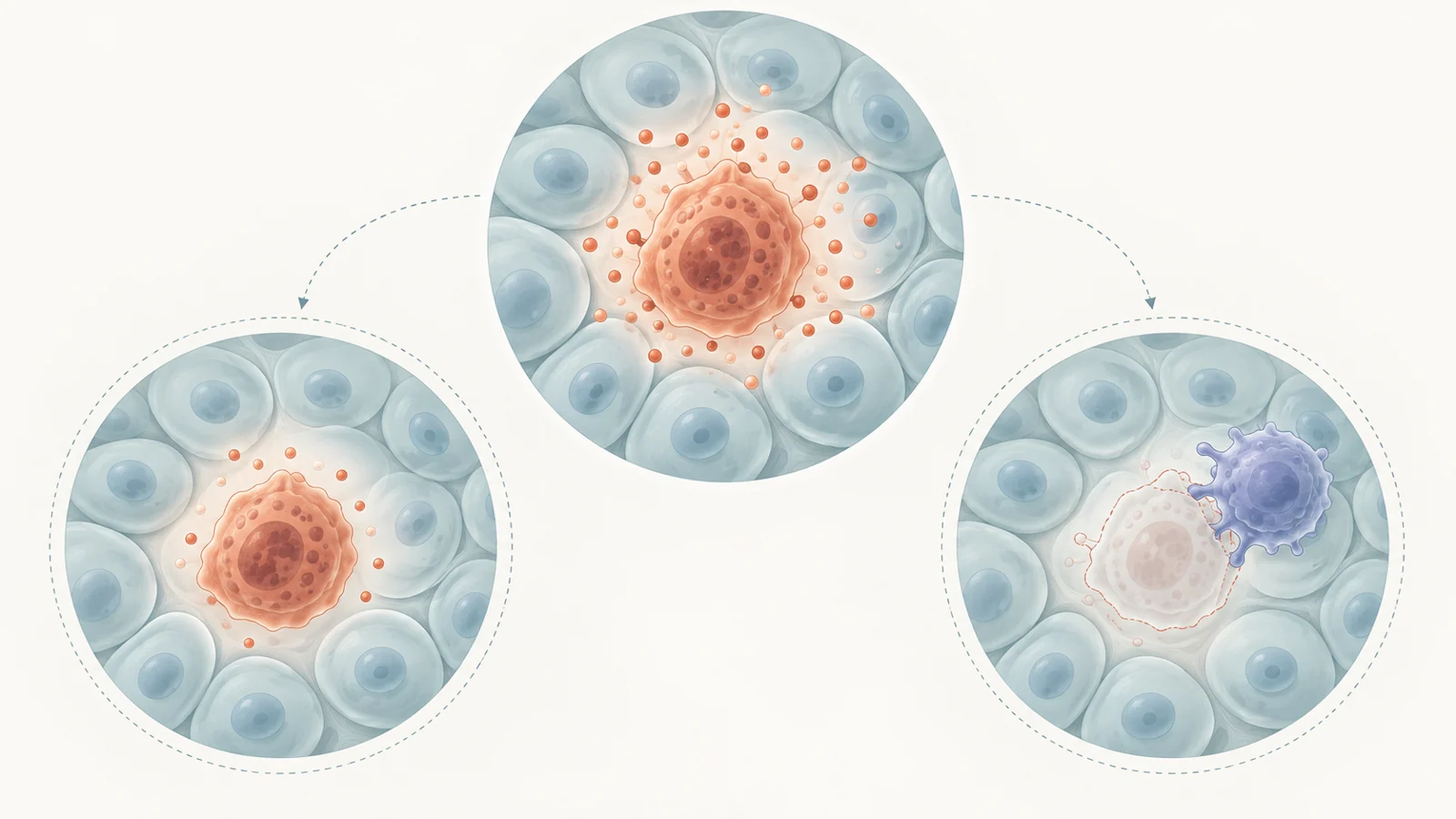
One important influence comes from the senescence-associated secretory phenotype, or SASP. This is the mixture of signaling molecules and other substances a senescent cell releases. It can include inflammatory signals, growth factors and proteins that break down components of the surrounding tissue. These secretions affect the conditions in which neighboring cells live, repair damage and respond to immune activity.
The mixture varies with the cell type, its environment and the stress that caused senescence. That variation matters because the consequences extend beyond the secreting cell. The review describes effects that can sustain inflammation, alter tissue structure and interfere with the environments that support stem cells. A persistent population can therefore influence tissue function without needing to expand through continued division.
Immune clearance helps determine how long that influence lasts. The review describes tightly controlled, short-lived senescence in some normal physiological processes, followed by removal of the cells by the immune system. Animal studies implicate several immune cell types in this surveillance. Clearance varies across tissues and disease conditions, however, and the rules governing it remain incompletely understood. When senescent cells accumulate, continuing inflammatory secretion can contribute to the chronic inflammation associated with aging.
Changing secretion and eliminating cells do different things
Senomorphics are interventions intended to modify the harmful secretions of senescent cells or the pathways controlling them. Their aim is to alter cellular behavior while leaving the cell in place. Keeping growth arrest intact while reducing damaging secretion would change the cell’s relationship with surrounding tissue without requiring its elimination.
Senolytics are drugs intended to selectively eliminate senescent cells. They seek to exploit vulnerabilities in the mechanisms that allow these cells to survive despite damage and stress. Removing a cell would also remove its continuing contribution to local secretion. Immune-based approaches pursue elimination through another route, using the body’s clearance machinery. The review discusses immune-mediated removal as a potentially important direction, while emphasizing the need to understand interactions between senescent cells and immune cells more fully.
Wound repair shows why the distinction matters. According to the review, senescent cells arising after injury can release a growth factor that helps initiate formation of repair tissue. Other secreted proteins help regulate excessive fibrous tissue buildup. The authors also describe evidence that pharmacological suppression of senescence can impair wound healing. Both the presence of the cell and what it releases can therefore matter at particular stages of repair. A strategy suited to persistent, disease-associated senescence cannot simply be assumed to suit an actively healing wound.
These approaches make different biological changes, and the review does not establish one as the best option across tissues. Its comparison instead makes the treatment decision more specific: changing secretion, disrupting cell survival and recruiting immune removal each intervene at a different part of the process.
A biological response is different from a treatment success
The human findings discussed in the review illustrate why the question being tested matters as much as the treatment’s proposed mechanism.
In its account of a study involving 11 patients with diabetes and kidney disease, participants received a combination treatment intended to eliminate senescent cells for three days. The review reports reductions in senescence-related measurements in adipose tissue, including fewer cells identified as senescent, along with lower levels of circulating SASP components. Adipose tissue is body fat; the blood measurements assessed substances circulating beyond the sampled tissue.
Those findings address whether an intervention can produce a detectable biological response in people. They are relevant to the proposed mechanism because measurements associated with the intended target changed after treatment. But a reduction in those measurements does not by itself establish improved kidney function, less disability or a lasting clinical benefit. A tissue sample and a blood test answer questions about biology that are related to, but distinct from, how a patient feels and functions.
The review also reports that the phase 2 study of UBX0101 in painful knee osteoarthritis failed to meet its expected outcome. That result concerns a particular intervention used for a particular disease. The authors discuss possible explanations, including the suitability of the strategy, dose and participant selection. These remain possibilities, rather than established reasons for the result.
The two accounts cannot be treated as opposing verdicts on the whole field. They involve different interventions, populations and endpoints. The diabetes and kidney disease account supports a claim about changes in senescence-related measurements. The osteoarthritis account shows that a proposed therapeutic strategy can fail to deliver its expected outcome in a disease trial. Neither result settles the prospects of every treatment directed at senescent cells.
Animal experiments described in the review provide a broader basis for pursuing the idea, including improvements in several disease-related changes after senescent-cell elimination. Moving from those experiments to human treatment requires evidence at the level of the intended clinical use. The findings discussed here do not establish extension of human lifespan or reversal of human aging.
Finding the intended cells is only part of the problem
A central difficulty is identifying senescence reliably. The review describes commonly used markers, including increased levels of the growth-arrest proteins p16 and p21 and greater activity of a particular cellular enzyme. But markers are not equally present in every senescent cell type, and some also occur outside senescence. Researchers therefore use combinations of features to identify the state.
This creates an interpretation problem. A marker is a measurable clue to cell biology; it is not automatically a precise count of every senescent cell in an organ. Using multiple features can strengthen identification, but the review describes no single clear, sensitive and accurate marker that solves the problem across senescent cell types. The evidence does not establish a universal clinical test that could determine who needs treatment.
Even perfect identification would leave a separate treatment-matching problem. Senescent cells differ in their secretions and in the molecular mechanisms that keep them alive. Recognizing a cell as senescent does not reveal which survival pathway a drug must affect or which secreted factors matter most in a particular disease. The authors accordingly call for disease-specific understanding of these mechanisms, alongside attention to differences between patients.
Efficacy and toxicity add another dimension. A candidate must produce enough of the intended biological effect to benefit a patient, with an acceptable burden of unwanted effects. The review calls for better optimized interventions and biomarkers that can inform a clear balance of benefit and risk. It does not establish a treatment schedule that can be applied broadly across tissues and diseases.
What this could change
From the March 2023 perspective, the potential clinical advance is disease-specific control of an ongoing contributor to tissue dysfunction. If researchers can connect an intervention’s effects on persistent senescent cells to meaningful patient benefit at acceptable toxicity, clinicians could gain a way to reduce continuing tissue damage. That could help an affected organ retain its function for longer.
The causal promise is concrete: reducing a sustained source of harmful tissue activity could slow the loss of function that makes an age-related disease disabling. For patients, success would mean more than a lower laboratory measurement. It could mean preserving the capacity to carry out everyday activities for longer as they grow older.
Key Sources
- Primary source: Emerging Therapeutic Approaches to Target the Dark Side of Senescent Cells: New Hopes to Treat Aging as a Disease and to Delay Age-Related Pathologies.
DOI or Journal Page · Peer-Reviewed Paper · 2023-03-16
Keep exploring