
Research Signal – Source date 2022-01-10
Sarcopenia is more than a decline in muscle size. It involves progressive changes in muscle quantity and quality, strength, and physical function. Those changes can make movement slower and increase the risk of falls, frailty, injury, and loss of independence. The condition has several proposed contributors, including neuromuscular decline, inflammation, oxidative stress, altered hormone levels, and mitochondrial dysfunction.
A review published on January 10, 2022, examines cellular senescence as one possible biological link between aging and muscle decline. Senescent cells have entered a stable, essentially irreversible state in which they stop dividing after stress or other damaging signals. That shutdown can be protective because it helps prevent potentially dangerous cells from continuing to proliferate. In aging tissue, however, accumulated senescent cells may also interfere with repair and release signals that disturb nearby cells. The review therefore points to a therapeutic tension: changing senescence might help preserve muscle, but broadly disabling it could remove functions that protect other tissues.
When muscle repair has to leave standby
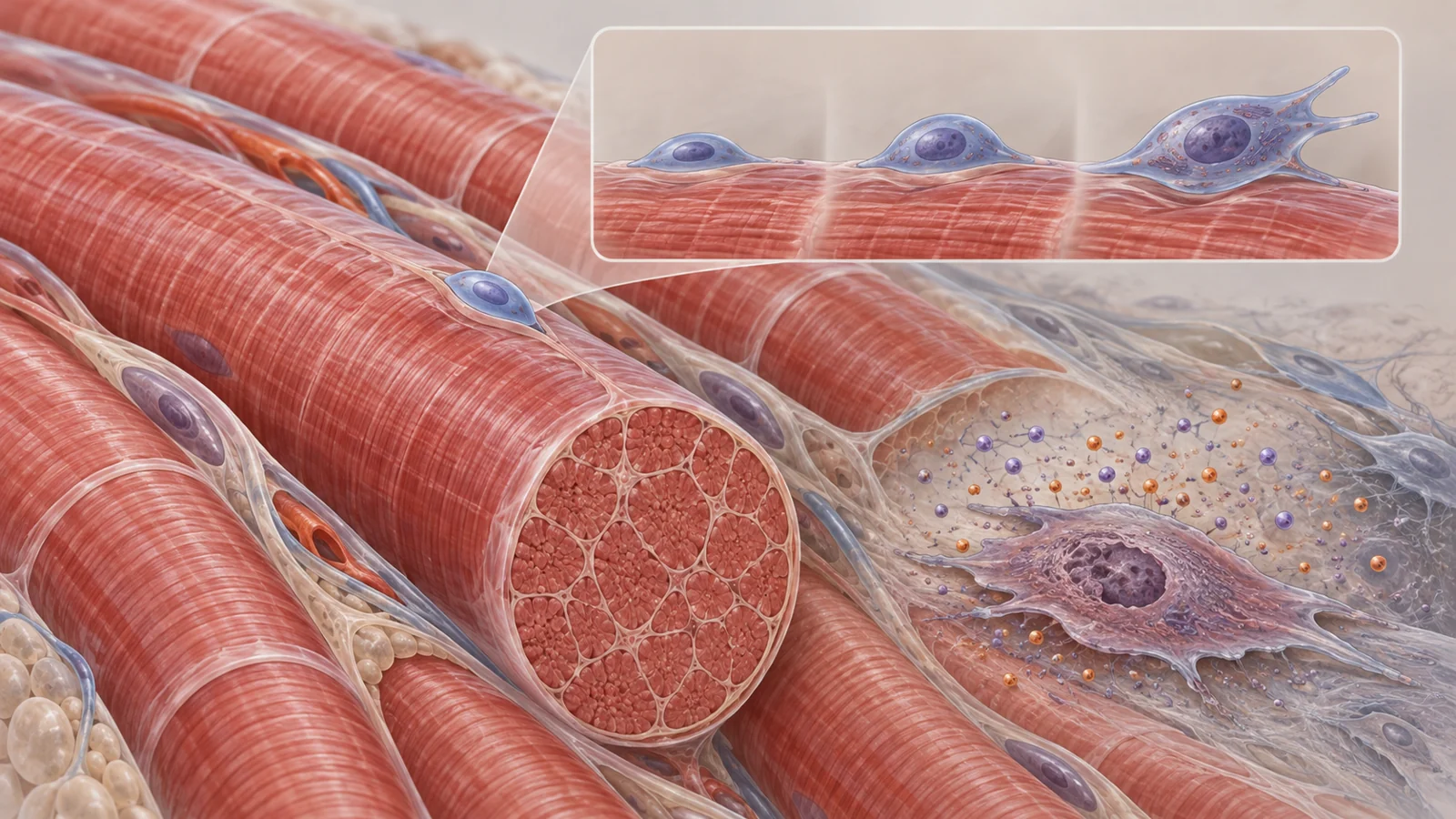
Adult skeletal muscle normally maintains a reserve of satellite cells, also called muscle stem cells. These cells sit alongside muscle fibers in a quiet, reversible state known as quiescence. When injury or another stress demands repair, they can activate, enter the cell cycle, produce new muscle fibers, and replenish the stem-cell pool through self-renewal.
Quiescence and senescence are not the same state. A quiescent satellite cell is paused but available for future work. A senescent cell has undergone a more permanent change in cell-cycle behavior and may lose the ability to regenerate tissue effectively. The distinction matters because aging muscle can contain cells that look inactive without all being biologically equivalent.
The review discusses experiments in geriatric mice in which muscle stem cells shifted from reversible quiescence toward an irreversible senescent state. The cell-cycle inhibitor p16INK4a was implicated in that change. When researchers suppressed p16INK4a in the experimental setting, older satellite cells regained features of quiescence and the muscle showed evidence of improved regenerative capacity. These findings connect a change in the internal state of a repair cell with the declining ability of aged muscle to respond to damage.
The result does not mean that p16 is simply a harmful molecule to remove. Cell-cycle brakes help limit inappropriate proliferation, and the review presents senescence as a double-edged process. The mouse findings instead show why the state of a muscle stem cell may be an important intervention point: a cell that cannot leave senescence cannot contribute normally to repair or maintain its own population.
Senescence can change the tissue next door
Senescent cells may affect muscle through more than their own loss of function. They can release a collection of cytokines, chemokines, growth factors, and matrix-remodeling enzymes known as the senescence-associated secretory phenotype, or SASP. These secretions can alter the local environment and contribute to the chronic, low-grade inflammation often associated with aging.
For a satellite cell, its surroundings are part of its working conditions. The review describes how inflammatory signals, protease activity, and changes in the extracellular matrix may disrupt the stem-cell niche. One proposed mechanism involves thickening of the basal lamina around satellite cells through additional matrix deposition, making it harder for those cells to activate and function. In this account, a senescent cell can influence a repair cell without being the repair cell itself.
The same inflammatory environment may also be associated with greater muscle protein breakdown and loss of muscle fibers. The review connects inflammatory cytokines with processes that accelerate protein degradation, while noting that sarcopenia develops through multiple interacting causes. SASP is therefore best understood as a possible route by which cellular aging reshapes muscle tissue, not as a complete explanation for every case of muscle loss.
This broader view changes the therapeutic question. Researchers are not only asking whether an old satellite cell can be returned to a more useful state. They are also asking whether the signals surrounding that cell can be made less hostile to regeneration without disrupting normal immune and repair functions elsewhere.
Possible interventions act on different levers
The review groups senescence-related intervention strategies into three broad categories. One approach interferes with the pathways that establish or maintain senescence-associated growth arrest. A second removes senescent cells selectively. A third reduces harmful effects of the SASP or changes the signaling network that produces it. These operations are biologically different, even though they share the goal of limiting age-related tissue damage.
The most striking sarcopenia-related example discussed in the review comes from a genetic clearance system tested in BubR1 progeroid mice. The INK-ATTAC design used p16Ink4a as a marker associated with senescent cells and allowed those cells to be eliminated after administration of an activating drug. In that model, removing p16-expressing cells throughout life delayed the appearance of sarcopenia-related signs. When clearance began later, it attenuated progression of muscle decline that had already developed.
Timing matters in interpreting that result. Delaying onset and slowing an established condition are different outcomes, and both were observed in a premature-aging mouse model rather than in ordinary human aging. The findings support the idea that senescent cells can contribute to muscle deterioration, but they do not specify how large or durable a benefit would be for an older person with sarcopenia.
The review also discusses senolytic compounds such as navitoclax, which can target anti-apoptotic proteins used by senescent cells. That discussion identifies a possible pharmacological route; it does not establish that navitoclax or another drug produces the same outcome as the genetic clearance experiment. A genetic system designed around p16-expressing cells and a drug with its own distribution, selectivity, and toxicity profile should not be treated as interchangeable evidence.
Reducing the SASP presents a different challenge again. Dampening inflammatory or matrix-remodeling signals might improve the environment around muscle stem cells, but many of the pathways involved also participate in other cellular activities. A treatment could alter the tissue environment without removing senescent cells, or remove cells while leaving other drivers of sarcopenia untouched.
Mouse protection is not a human mobility result
Senescence is attractive as a target partly because it has a harmful side and a protective side. The p53/p21 and p16/pRB pathways help enforce cell-cycle arrest, which can suppress the growth of potentially cancerous cells. Senescent responses can also participate in tissue repair and wound healing. Interfering with those pathways across the body could therefore have consequences beyond muscle.
The selectivity problem has several dimensions. A useful intervention might need to distinguish senescent cells from healthy quiescent cells, identify which senescent cells are damaging in muscle, preserve protective senescence in other settings, and avoid disrupting unrelated processes controlled by the same signaling network. The review emphasizes that these complications make broad suppression an uncertain strategy rather than an established treatment plan.
There is also a practical difference between changing a biological marker and improving a person’s movement. Fewer senescent cells, lower inflammatory signaling, or more active satellite cells would be intermediate biological outcomes. Older adults need meaningful gains in strength and physical function, such as being better able to rise, walk, climb, or avoid a fall. The supplied evidence does not show that clearing senescent cells achieves those outcomes in people with sarcopenia.
The review’s discussion of hormone-related treatment provides a useful comparison, even though it is a different intervention class. It cites a trial of the selective androgen receptor modulator MK-0773 in older women with sarcopenia in which skeletal muscle mass increased, while stronger evidence was still needed to show reversal of sarcopenia. A change in mass alone is not the same as restored strength or mobility. The same caution applies when evaluating senescence-targeting approaches: a molecular or tissue response would need to translate into functional benefit.
At the review’s January 2022 publication perspective, clinical trials targeting cellular senescence in sarcopenia remained an important next step. Such trials would need to test more than whether a pathway or cell population changes. They would need to show whether the intervention is safe, selective, and associated with durable improvements that matter to daily life.
How this could help older adults stay mobile
If a sufficiently selective intervention could preserve muscle stem-cell repair while reducing damaging signals from the surrounding tissue, it might help older adults retain the strength and physical function required for everyday movement. The potential benefit would come from supporting the muscle’s ability to respond to injury and maintain its fibers, not simply from changing a senescence marker.
That possibility depends on several conditions being met at once. The approach would need to produce meaningful functional gains in humans, work in the complex setting of ordinary aging, and preserve the protective roles of cellular senescence, including safeguards against uncontrolled cell growth. The 2022 review presents cellular senescence as a plausible set of intervention points for sarcopenia, not as a clinically validated way to restore mobility.
Key Sources
- Primary source: Cellular Senescence in Sarcopenia: Possible Mechanisms and Therapeutic Potential.
DOI or Journal Page · Review or Meta-Analysis · 2022-01-10
Keep exploring