
Research Signal – Source date 2025-11-20
Aging kidneys offer a close-up view of a larger question: how does the body’s changing inflammatory balance contribute to age-related disease? In a 2025 review, researchers describe how senescent cells—cells that have stopped dividing but remain active—may sustain inflammation in kidney tissue and interfere with its ability to repair itself.
The kidney is a useful setting for examining this process. It is richly supplied with blood and continually exposed to circulating inflammatory molecules and other signals. With age, kidney tissue can lose nephrons, develop fibrosis, and become less able to regenerate. The review connects those changes with cellular senescence and inflammaging, the chronic, low-grade inflammation associated with aging.
When a repair response lingers
Senescence can follow several kinds of cellular stress, including DNA damage, shortening of telomeres, oxidative stress, or mitochondrial dysfunction. A senescent cell no longer divides, but it does not simply go quiet. It can release cytokines, growth factors, chemokines, and proteins that alter the surrounding tissue. Researchers call this collection of secretions the senescence-associated secretory phenotype, or SASP.
The SASP is not a single, fixed recipe. Its composition can differ with the cell type, the trigger, the tissue environment, and time. Early in a response, some secreted factors may help with repair or attract immune cells that clear damaged cells. If senescent cells persist and their signals continue, the local environment may shift toward chronic inflammation and fibrosis. The same kind of cellular response can therefore have different effects depending on when and where it occurs.
Immune aging may add to the persistence. A less effective immune system may be slower to recognize and remove senescent cells, allowing more of them to remain and release SASP factors. Those cells may also influence neighboring cells through local signaling. Meanwhile, mitochondrial damage, impaired autophagy, changes in the gut microbiome, and chronic infections are among the other processes the review discusses as contributors to inflammaging. Their interactions are complex, and the review leaves open how inflammation and immune aging influence one another.
A vulnerable organ under repeated exposure
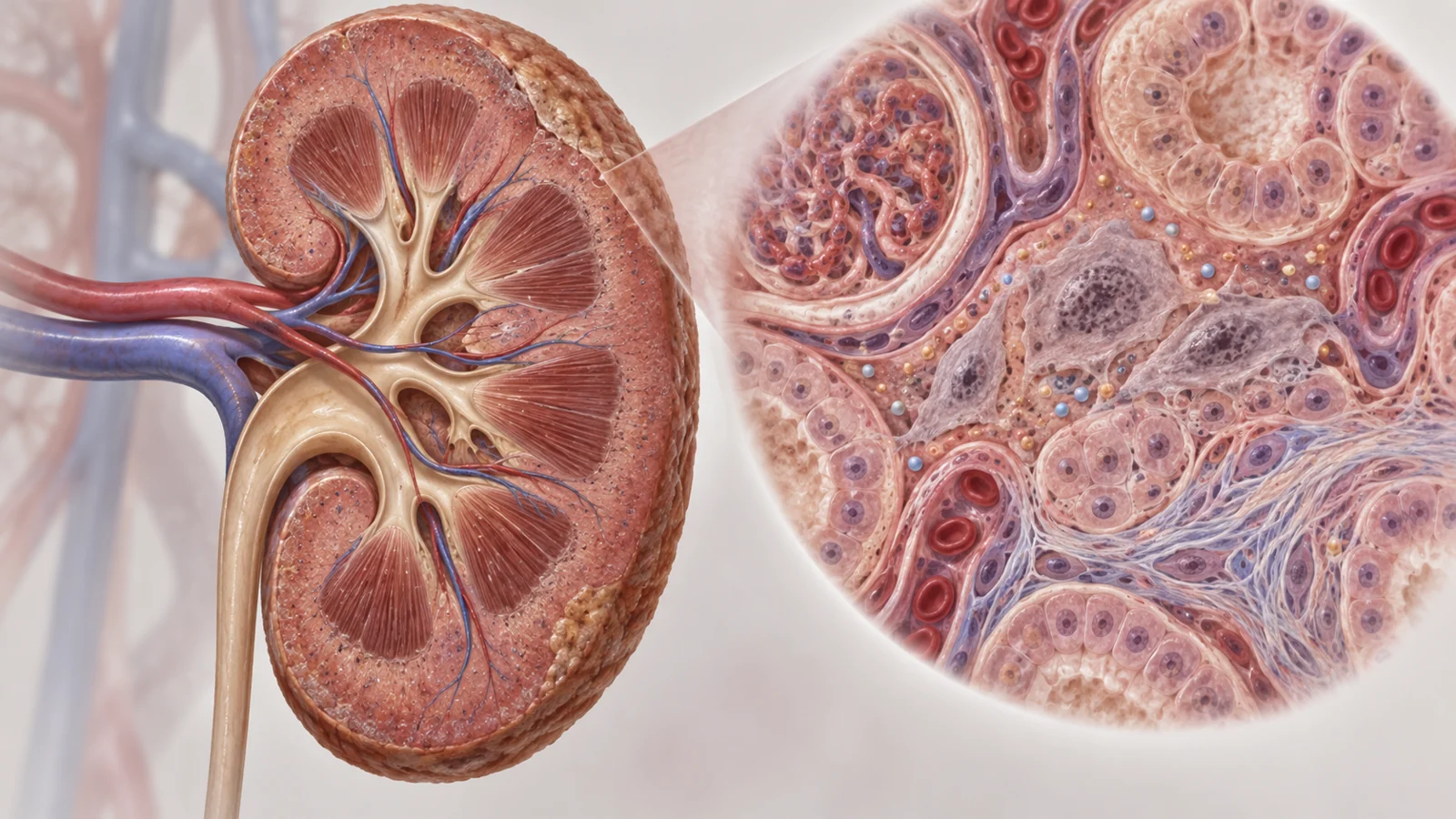
In the kidney, senescent cells have been observed in compartments including the glomeruli and tubules. The review describes their accumulation alongside fewer nephrons, glomerular scarring, and tubulointerstitial fibrosis—scarring in the tissue between and around kidney tubules. These changes are associated with declining kidney function and a reduced ability to regenerate after injury.
Inflammatory sensing may help connect the kidney’s surroundings to its tissue response. Pattern-recognition receptors, including Toll-like and NOD-like receptors, recognize danger signals from damaged cells and signals associated with microbes. Their activation can prompt immune responses. The review describes persistent activation of these pathways, together with innate immune cells, as part of kidney inflammation and fibrosis. Experimental inhibition of pathways such as TLR2 or HMGB1 has reduced inflammation or fibrotic changes in models, but that does not establish one universal causal sequence in people.
The distinction between blood and tissue also matters when interpreting inflammation. Higher levels of inflammatory molecules in circulation are associated with poor health outcomes, but an association alone cannot show that those molecules directly cause kidney decline. Inflammatory signals may arise within particular tissues and spill into the blood. A circulating measurement could therefore reflect local damage, contribute to it, or capture both processes. Researchers still need to establish how much systemic inflammation versus local kidney signaling drives human disease.
Clearing cells or quieting their signals
Two broad treatment ideas follow from the senescence model. Senolytics aim to eliminate senescent cells, reducing the source of their secretions. Senomorphics aim to dampen harmful signaling from those cells while leaving them in place. The difference matters because the SASP can vary and may include signals involved in repair or immune clearance as well as those linked to persistent inflammation.
The review describes promising kidney effects from senolytic approaches in preclinical models, including reduced inflammation and fibrosis. It also discusses approaches that modulate SASP-related pathways and innate immune signaling. These findings make senescent cells a potential target for research, but results in experimental models do not show which strategy could preserve useful repair responses while safely limiting harmful signaling in people.
The human studies cited by the review took place in other disease settings. They include investigation of a senolytic in knee osteoarthritis and work with dasatinib and quercetin in idiopathic pulmonary fibrosis. Those studies are relevant to whether senolytic approaches can be studied in people; they are not evidence of kidney benefit. The review identifies long-term efficacy and safety as unresolved, and it does not test a senolytic or senomorphic treatment in people with kidney disease.
What this could mean for aging kidneys
If researchers can identify which senescent-cell signals persistently harm kidney tissue—and reduce them without disrupting repair or safe immune responses—future treatments might help preserve kidney function as people age. That possibility depends on translating findings from models into durable, safe benefit for people with kidney disease. For now, the review’s contribution is a clearer account of why the kidney may be vulnerable and what must be understood before targeting senescent cells becomes a proven clinical approach.
Key Sources
- Primary source: From Senescent Cells to Systemic Inflammation: The Role of Inflammaging in Age-Related Diseases and Kidney Dysfunction.
DOI or Journal Page · Review or Meta-Analysis · 2025-11-20
Keep exploring