
Research Signal – Source date 2026-06-01
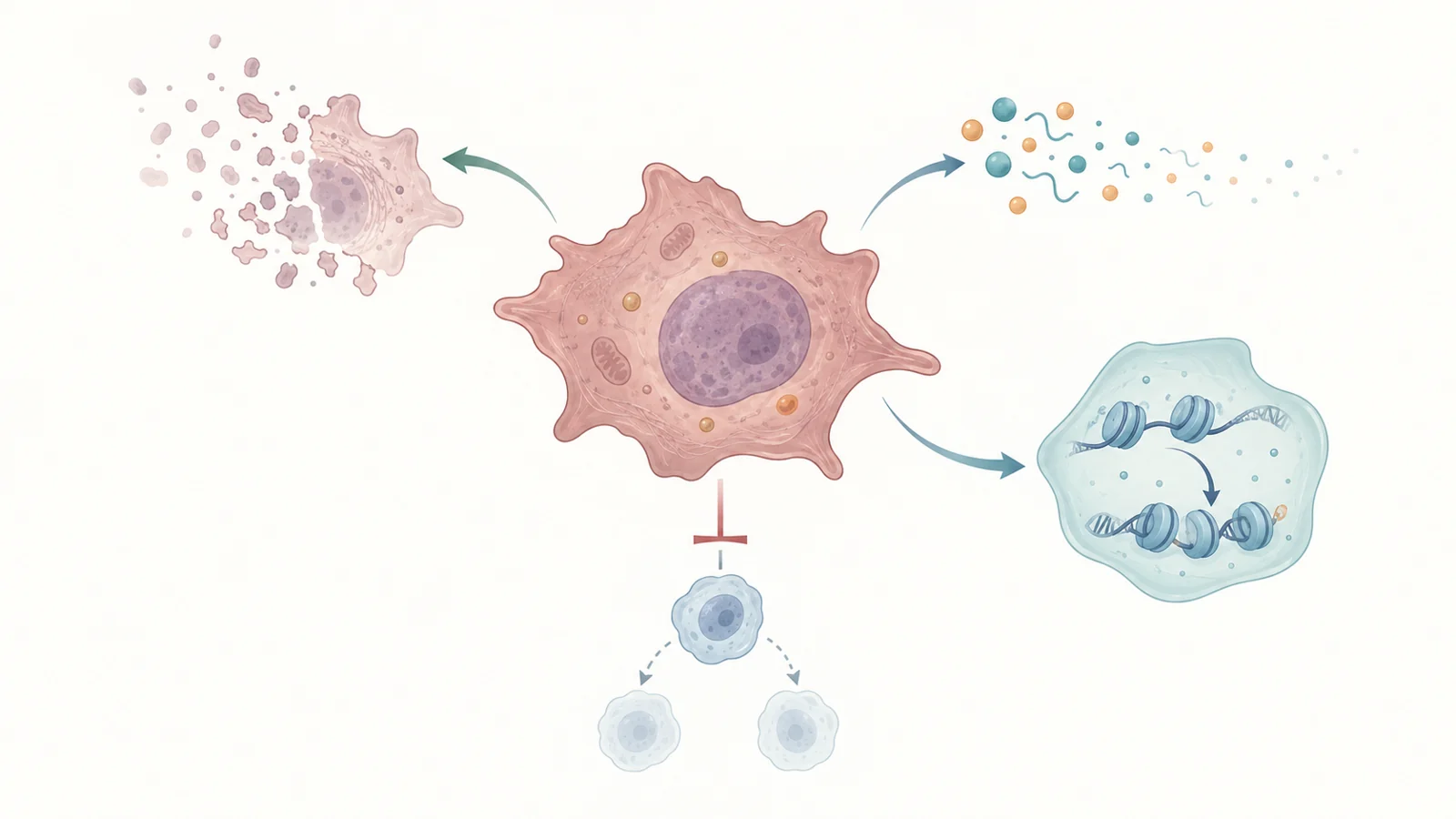
Senescent cells have stopped dividing, a change that can help prevent damaged cells from starting tumors. But cells that remain in tissues can also release inflammatory signals associated with tissue damage and disease. A review published June 1, 2026, describes three proposed ways to intervene: remove these cells, quiet their signaling, or try to reprogram their state. Each approach makes a different tradeoff, and the cells’ effects depend on where they are and what is happening around them.
The review brings together mechanistic research, animal findings and human studies of several interventions. It is not a new clinical trial or a head-to-head comparison of the three strategies. Its examples show why a treatment’s target and the outcome measured matter as much as the broad goal of slowing age-related decline.
Growth arrest can protect and harm
When a cell enters senescence, it stops dividing. This can act as a barrier to tumor initiation: a cell with dangerous changes may be prevented from multiplying. The same state can become problematic when senescent cells persist. They may secrete factors associated with the senescence-associated secretory phenotype, or SASP, which can influence nearby cells and sustain inflammation.
In cancer, those effects can pull in opposite directions. The review describes senescence as a potential brake on early tumor growth, while persistent senescent cells and their signals may, in some settings, encourage tumor progression, spread or recurrence. Aging also changes immune surveillance, which can make it harder for immune cells to recognize and clear tumor cells. Removing every senescent cell would therefore not automatically be beneficial; the value of removal depends on which cells are present and what role they are playing.
The balance differs across diseases, too. The review highlights protein-homeostasis loss and mitochondrial dysfunction in neurodegenerative disease, genomic instability and epigenetic change in cancer, and inflammation, senescence and nutrient-sensing changes in cardiovascular disease. These processes interact, but they do not contribute equally in every tissue or condition.
Three ways to intervene in senescent cells
Senolytics are intended to eliminate senescent cells. Dasatinib plus quercetin, often abbreviated D+Q, is one combination discussed in the review. The proposed appeal is direct: if a harmful population of persistent cells is removed, its effects on surrounding tissue may diminish. The challenge is selectivity. A treatment must reach the cells that are contributing to disease without removing cells whose growth arrest is protective.
Senomorphics aim to reduce harmful signaling from senescent cells while leaving the cells in place. This may preserve some functions of growth arrest while limiting chronic signals that disturb tissue. Rapamycin is discussed as an example of an intervention that affects nutrient sensing and is also presented among senomorphic strategies. Its effects illustrate why changing a broad aging-related pathway can involve tradeoffs, rather than acting on one cell population alone.
Senoreversion takes a different route: it attempts to change a senescent cell’s state through epigenetic reprogramming. Epigenetic changes regulate gene activity without changing the DNA sequence. The review describes animal-model research in which manipulating epigenetic processes reduced aging phenotypes or extended lifespan. Those findings do not show that senoreversion is safe or effective in people. Changing a cell’s state also raises a central question: can a treatment restore useful function without removing safeguards such as growth arrest?
Nutrient sensing and cellular cleanup widen the picture
Aging therapies do not all target senescent cells directly. Nutrient-sensing pathways help cells respond to available energy and nutrients. The review discusses mTOR, IGF-1 and AMPK as key pathways, and describes evidence that inhibiting nutrient-sensing activity can delay aging in organisms.
Rapamycin makes the potential tradeoff concrete. The review cites mouse research in which rapamycin prolonged lifespan, alongside findings that long-term use can cause skin and metabolic side effects and affect mTORC2, a related pathway whose inhibition has been associated with shorter lifespan in animal models. The review therefore points to more selective or intermittent ways of affecting mTORC1 as possibilities to investigate, not as established treatment advice.
Cellular cleanup is another connected process. Autophagy moves cellular material to lysosomes for turnover. The review describes several forms of autophagy and explains that this cleanup helps maintain protein balance and remove damaged or toxic material. Its activity tends to weaken with age, while enhancing autophagy has extended lifespan and healthy lifespan in animal research. These links help explain why metabolic interventions may affect several aging-related processes at once, but they also make it harder to attribute an outcome to one mechanism.
Human studies measure different kinds of change
The clinical observations summarized in the review are specific to their study settings. In a study of people with diabetic nephropathy, D+Q was reported to clear senescent cells and reduce their burden in adipose and skin tissue. A separate study in people with idiopathic pulmonary fibrosis reported improved physical function and described the combination as well tolerated. These are different populations and outcomes; neither observation on its own demonstrates broad improvement across age-related disease.
A phase 2 study of D+Q for bone loss in postmenopausal women reported a larger response among participants with higher senescent-cell burden: bone formation increased by 34% and bone resorption decreased by 11% in that subgroup. That finding connects a measured tissue characteristic with a response in the studied setting. It does not establish that the same subgroup pattern applies to other diseases or that the changes produce lasting benefits for patients.
Other interventions have been assessed with different measures. Two phase 2 studies summarized by the review found that four months of urolithin A supplementation enhanced muscle endurance and offset age-related muscle decline. A 12-month phase 2b study of spermidine supplementation in older adults reported no changes in memory or biomarkers; the review notes that the dose was lower than in other work it discusses. The result is a reminder that a plausible intervention can produce a different outcome depending on the dose, population and measure used.
These examples are not interchangeable tests of whether a person is aging more slowly. Tissue cell counts, physical function, memory and biomarkers answer different questions. The review also describes short and small clinical studies, varied endpoints and individual differences as challenges in interpreting anti-aging trials. An observed change in a tissue or molecular measure can help researchers test whether an intervention affects its intended process. To establish a meaningful clinical benefit, studies also need outcomes that show whether people function better or experience less disease over time.
A marker can track biology without settling the outcome
Epigenetic clocks estimate age-related patterns from DNA methylation, a chemical modification involved in regulating gene activity. The review describes these clocks as tools that can predict chronological age and offer insight into biological aging. It also emphasizes that the relationship between age-related methylation changes, gene activity and changes in tissue function needs further study.
A shift in a clock or other biomarker can therefore be useful evidence about a biological response, but it is not a substitute for a patient outcome. Researchers still need to determine whether a measured change corresponds to lasting improvements in health, and whether that relationship holds for the disease and tissue being studied. That distinction matters when interpreting interventions whose clinical studies report changes in markers but not the same functional outcomes.
How targeting aging cells could help treat disease
Treatments tailored to the aging mechanism and tissue involved in a particular disease could eventually reduce harmful effects from senescent cells while preserving useful functions such as protection against tumor initiation. That capability depends on identifying the relevant cells, targeting them selectively and maintaining acceptable long-term safety. It also depends on showing that a biological change translates into outcomes patients value. If those conditions are met, aging research could help make disease treatment more precise without treating every aging-related process as the same problem.
Key Sources
- Primary source: Insights into the therapeutic strategies for aging and aging-associated diseases.
DOI or Journal Page · Review or Meta-Analysis · 2026-06-01
Keep exploring