
Research Signal – Source date 2024-10-24
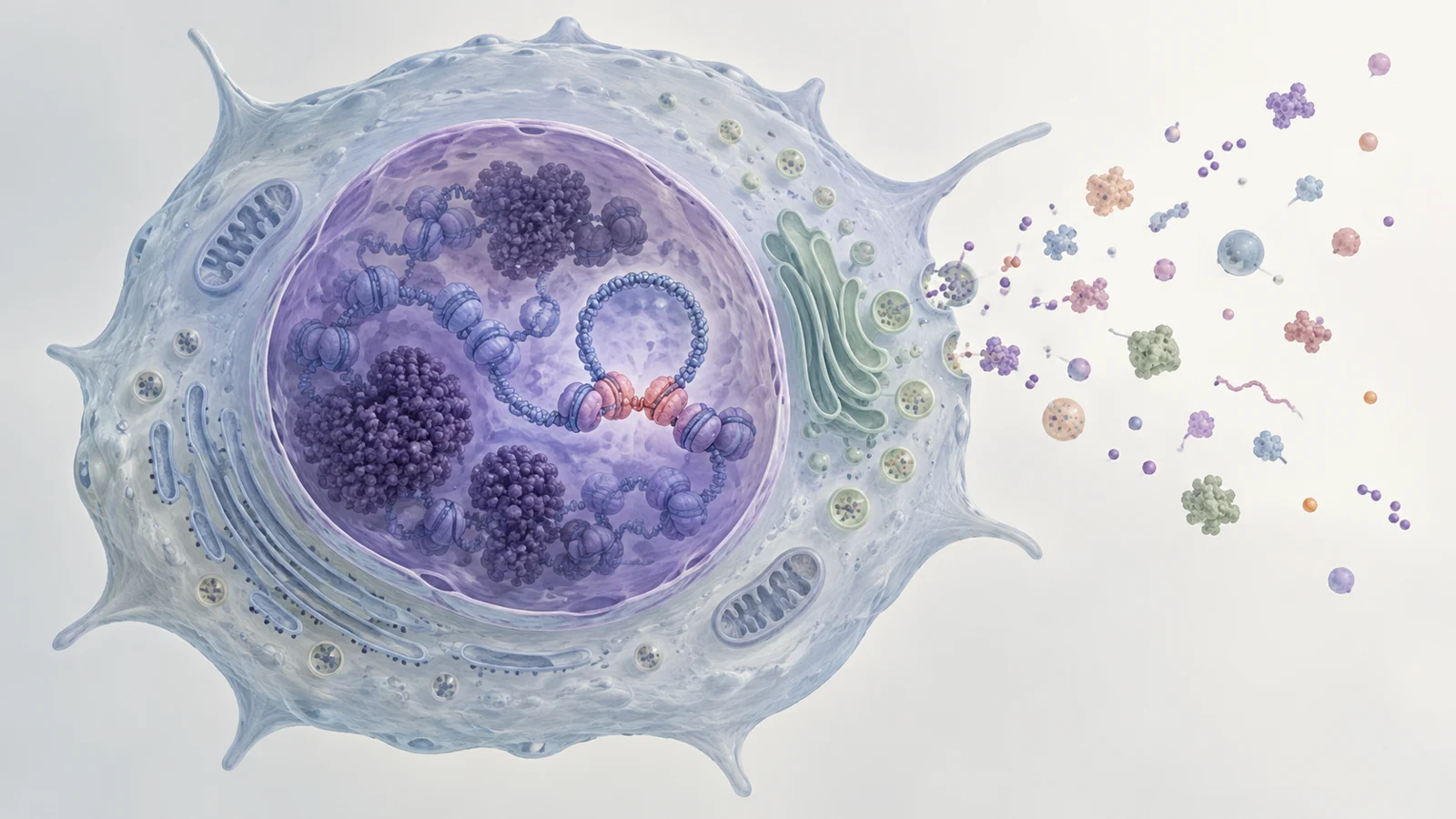
A cell can stop dividing and still affect the tissue around it. Senescent cells release a mixture of molecules—including inflammatory signals, growth factors and enzymes—known collectively as the senescence-associated secretory phenotype, or SASP. A review published on October 24, 2024, describes how changes in the cell’s DNA packaging can help regulate that output.
The review brings together findings from different cell models and observations in tissues. It is not a new treatment experiment. Its central idea is that senescence changes the organization and accessibility of DNA, influencing which genes can be read and how strongly some SASP molecules are produced. The details matter: the routes described are not identical in every model, and the SASP itself is a varied collection rather than one fixed recipe.
A stopped cell can remain an active source of messages
Cellular senescence is a state in which a cell loses its ability to proliferate. Persistent DNA damage, oncogene activation, oxidative stress and other triggers can lead to it; the review also discusses senescence after repeated cell division and after some cancer treatments. In addition to growth arrest, senescent cells can undergo changes in chromatin, metabolism and secretion.
The SASP includes pro-inflammatory cytokines and chemokines, as well as growth factors and proteases. These molecules can influence neighboring cells and immune activity. When senescent cells accumulate over time, their secretions are one proposed contributor to chronic, low-grade inflammation associated with aging, sometimes called inflammaging. The implications vary with the tissue, the trigger and the surrounding conditions.
DNA is not loose in the nucleus. It is wrapped around histone proteins and folded into chromatin, whose organization helps determine whether gene-reading machinery can reach a stretch of DNA. In senescence, that organization is remodeled. Some regions become more accessible; others remain packed or become more repressive. The resulting changes can affect the genes that contribute to SASP.
The neighborhood around a gene can change its activity
At a broad scale, the genome is arranged into regions associated with active or repressed DNA. These are often called A and B compartments. In the senescence models the review describes, some regions shift from a B compartment toward an A compartment, a change associated with increased expression of SASP-related genes. The review describes a gene encoding the SASP regulator NF-κB as predominantly located in active A compartments.
A gene’s local neighborhood also matters. DNA folds into domains that bring some distant sequences into closer contact. Enhancers are regulatory stretches of DNA that can help switch genes on; when an enhancer contacts a gene’s promoter, it can support transcription. In senescent cells, the enhancer–promoter connections around SASP genes can be rewired, and more highly connected enhancers are associated with greater SASP transcription in the reviewed findings.
One example shows why DNA packaging is more than a static on-or-off switch. The protein HMGB2 can bind DNA and affect chromatin structure. In oncogene-induced senescence, chromatin-bound HMGB2 at SASP gene locations is described as helping prevent repressive chromatin from spreading into those regions. That protection can keep SASP genes from being silenced. The review also describes different HMGB2 behavior in replicative senescence, so this example should not be treated as a universal mechanism.
Chemical marks help tune access to SASP genes
Cells also regulate chromatin with chemical marks on histones. Some are associated with active genes, while others are linked to repression. The mark H3K27ac is associated with active enhancers. The transcription factor AP-1 can act as a pioneer factor: it binds regulatory DNA in relatively closed chromatin and helps open access to genes. The review describes AP-1 and the reader protein BRD4 as part of the machinery that supports expression of some senescence and SASP genes.
Repressive marks can work in the other direction. The histone mark H3K27me3 is associated with gene silencing. In several models summarized by the review, reducing the enzyme EZH2, which adds this mark, can remove repression at SASP gene locations and allow expression to rise. The enzyme JMJD3 can also reduce H3K27me3 at particular SASP genes, including IL-6 and IL-8, in the findings described.
A counterintuitive example involves MLL1. Reducing or inhibiting MLL1 lowers SASP expression, but the measured reduction in its associated activating mark at SASP gene locations was modest and did not match the size of the change in transcription. The review instead links the effect to MLL1’s role in activating the DNA-damage response. In other words, a regulator can affect SASP through a broader cellular pathway, not only through the histone mark it is known to modify.
Histone loss and replacement alter the material of chromatin
Senescent cells can lose canonical histones, the proteins that package DNA into nucleosomes. With fewer histones, chromatin can become less compact and more mobile. The review connects histone loss around SASP-related gene promoters with increased transcription in some models, while also describing persistent DNA damage as a possible contributor to histone eviction. The precise link between these processes is still being worked out in the reviewed account.
At the same time, senescent cells can accumulate histone variants—alternative forms of histone proteins that have specialized roles. The variant H2A.J is reported at SASP promoters in studied settings, where it is linked to changes in chromatin access and increased expression. Another variant, H2A.X, is associated with DNA damage responses and senescence signaling; the review describes evidence connecting it with SASP activation after irradiation. These variants provide additional ways that the composition of chromatin can shape gene activity.
Repressed genetic elements can feed inflammatory signaling
Some DNA sequences are remnants of ancient mobile genetic elements. LINE-1 sequences can copy themselves through an RNA intermediate, while human endogenous retroviruses are old viral sequences integrated into the genome. In healthy cells, repressive chromatin helps keep many such sequences quiet. The review describes how reduced repression during aging or senescence can allow some of them to become active.
For LINE-1, activity can produce DNA copies in the cell’s cytoplasm. For endogenous retroviral sequences, transcription can produce viral-like material and RNA that may be reverse-transcribed. The review traces these nucleic acids to sensing pathways such as cGAS/STING, which can promote inflammatory signaling and SASP factors in the studied settings. It also discusses experiments in which inhibiting reverse transcriptase reduced inflammatory effects in cells or mice. Those findings suggest one route from altered DNA packaging to inflammatory output, but they do not establish a treatment for age-related disease.
Different routes into senescence leave different patterns
The review cautions against treating all senescent cells as one biological state. It describes replicative senescence, in which cells stop dividing after repeated passages, as showing an age-related DNA-methylation pattern associated with epigenetic clocks. That pattern was not reported for the oncogene-induced and DNA-damage-induced models discussed. DNA methylation—chemical tags on DNA—can influence gene activity, and some inflammation-related SASP genes were described as hypomethylated.
The contrast matters for interpretation: an epigenetic feature observed in one way of inducing senescence may not appear in another. The SASP also varies between models and in living tissues. A mechanism found in cultured fibroblasts therefore cannot automatically be assumed to explain every senescent cell in an aging organ.
A possible way to quiet secretion has trade-offs
The review discusses two broad therapeutic strategies. Senolytics aim to eliminate senescent cells; senomorphics aim to alter their behavior, including by reducing SASP production. Changing chromatin regulators could, in principle, dampen some secreted signals while leaving growth arrest in place. The review cites examples in which manipulating epigenetic regulators reduced SASP expression in cell models.
But SASP is not uniformly harmful. It can recruit immune cells that help clear senescent cells, contribute to tumor suppression, and support wound healing or tissue repair in some settings. Broad or sustained suppression could interfere with those functions. The review also notes that the balance between senescent cells and their effects may matter, and that senolytic approaches can affect healthy cells as well.
Some epigenetic drugs discussed in the review were being studied in trials for other diseases, including cancer. Those trials do not show that the drugs safely suppress SASP or improve aging-related outcomes. The review presents epigenetic modulation as a possible senomorphic direction, with safety and efficacy still to be established.
What selective control of senescent cells’ signals could change
If researchers can identify which chromatin controls drive harmful SASP activity in a particular tissue while preserving useful immune and repair signals, it may become possible to reduce some damaging effects of senescent cells without eliminating them. That could offer a more selective route to addressing age-related inflammation. The path depends on distinguishing senescence states and proving that the intervention helps people without disrupting the protective roles of SASP.
Key Sources
- Primary source: The role of the dynamic epigenetic landscape in senescence: orchestrating SASP expression.
DOI or Journal Page · Review or Meta-Analysis · 2024-10-24
Keep exploring