
Research Signal – Source date 2022-04-04
Research Signal · April 4, 2022
A cell that stops dividing can still influence the tissue around it. Cellular senescence is a stress response that arrests cell division, helping prevent damaged or potentially cancerous cells from multiplying. It also participates in normal development and tissue repair. But when senescent cells persist, the molecules they release can sustain inflammation and, in some cancer settings, help create conditions that favor tumor progression.
That combination of growth arrest and continuing biological activity raises a therapeutic question. Could drugs remove selected persistent cells, or reduce their secretions, to improve care for people with cancer or HIV?
The April 4, 2022 paper Senotherapeutics in Cancer and HIV, published in Cells, examines this possibility. It is a narrative review bringing together mechanisms, laboratory experiments, animal studies and selected human findings. Its authors did not conduct a new treatment trial, and the paper provides no pooled estimate of effectiveness. The evidence supports investigating a therapeutic direction; it does not establish a treatment benefit for either patient population.
Two ways to act on a cell that remains active
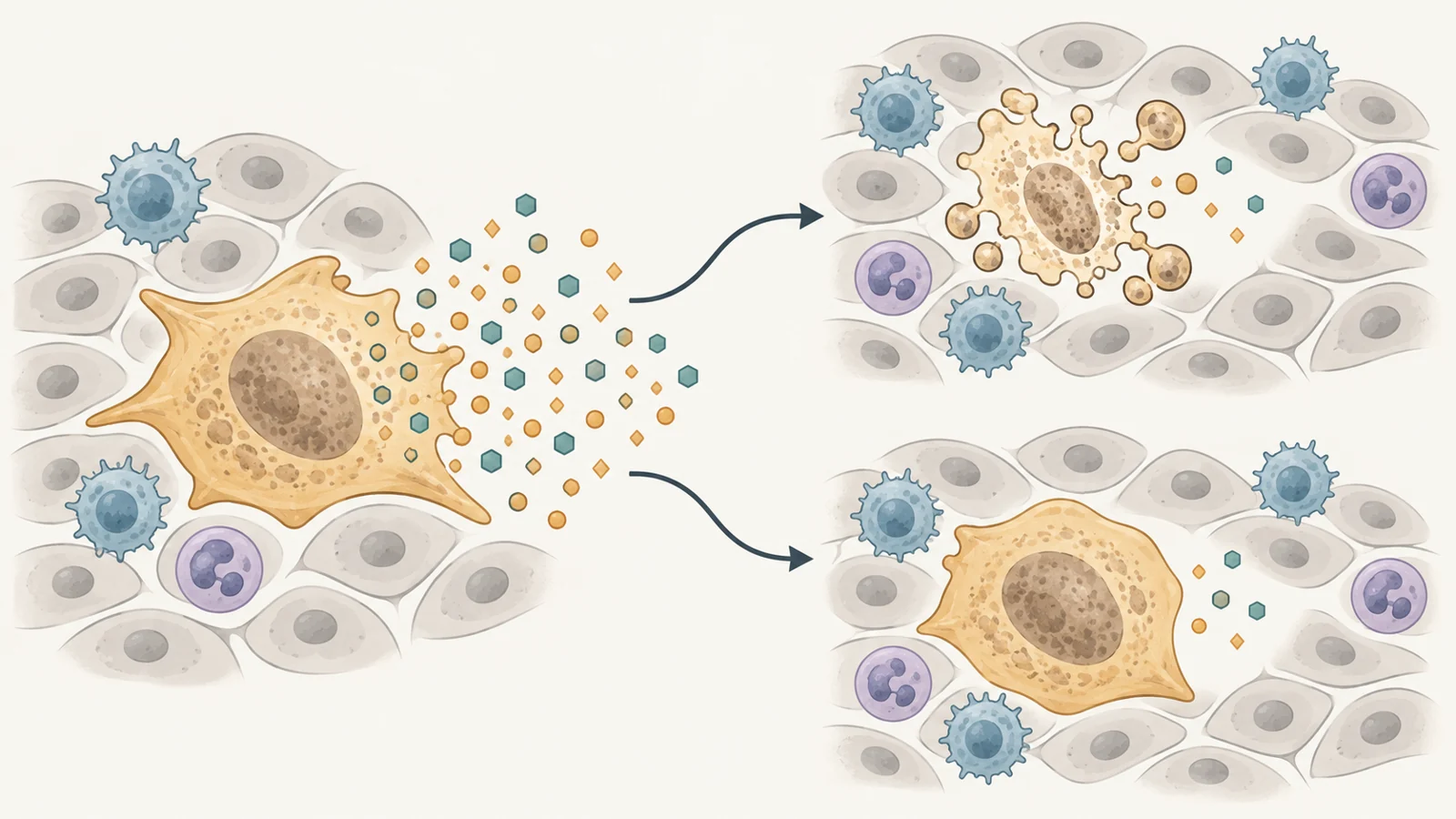
Senescent cells release a mixture of signaling molecules, growth factors and enzymes known as the senescence-associated secretory phenotype, or SASP. These substances can change immune activity and the behavior of neighboring cells. Stopping division therefore leaves another route through which a cell can affect its surroundings.
Senotherapeutics aim to intervene in this biology in two different ways. Senolytics seek to eliminate selected senescent cells. Senomorphics, also called senostatics in the review, seek to suppress their secretions or other features of senescence. The distinction matters because reducing a cell’s output does not necessarily remove the cell itself.
The senolytic approach draws on a survival feature of some senescent cells. They increase the activity of pathways that protect them from apoptosis, the process of programmed cell death. The review describes experiments in irradiated precursor fat cells that identified increased activity in survival pathways, including members of the BCL-2 protein family. Blocking such defenses can make susceptible senescent cells die. Dasatinib and quercetin were early compounds investigated through this line of work.
Rapamycin illustrates the other approach. It inhibits mTOR, a regulator of cell growth and survival. In studies summarized by the authors, rapamycin suppressed SASP-related activity, including signals involving the inflammatory molecules IL-6 and IL-1α, without eliminating senescent cells. A reduction in inflammatory output and a reduction in cell number are therefore different experimental results, even when both fall under the senotherapeutic label.
Cancer treatment creates a question about timing
Chemotherapy and radiotherapy can induce senescence through persistent DNA damage. This can arrest the growth of tumor cells, but treatment can also induce senescence in healthy tissues. The review connects persistent treatment-associated senescence with concerns about tissue dysfunction and later disease, making the cells left behind a possible target for an additional intervention.
This introduces a question about treatment sequence. After an anticancer treatment has induced growth arrest, could targeting the remaining senescent population limit its subsequent effects? That possibility requires knowing which cells persist, where they are and when intervention would help. It cannot be answered simply by showing that a compound kills senescent cells in a dish.
One concrete experiment discussed in the paper used ES2, an experimental peptide designed to disrupt the interaction between FOXO4 and p53. That interaction can help senescent cells survive by restraining apoptosis. In mouse models of melanoma with a BRAF mutation, ES2 combined with a BRAF inhibitor induced apoptosis and produced a survival advantage. The authors also describe activity against both normal and cancerous senescent cells.
The result gives a specific example of combining a senescence-directed intervention with an anticancer drug. Its scope remains a mouse melanoma experiment involving a BRAF inhibitor. It does not demonstrate a successful sequence of chemotherapy followed by senolytic treatment in patients, nor establish that senotherapeutics prevent human cancer relapse, prolong survival or reverse treatment-related frailty.
HIV brings inflammation and viral persistence into separate focus
For people living with HIV, the starting point is different. Antiretroviral therapy, or ART, can suppress viral replication and has greatly improved life expectancy. Yet persistent low-grade inflammation and immune activation can remain despite effective viral control. These processes help explain why researchers are interested in senescence-related biology alongside ART.
The review describes several possible contributors, including inflammatory effects of HIV proteins, coinfections such as cytomegalovirus, mitochondrial dysfunction and a weakened intestinal barrier that allows bacterial material to cross into the body. Senescence is part of this investigation, but those multiple routes make it inappropriate to attribute all inflammation in treated HIV to senescent cells.
A human trial involving ruxolitinib supplies a more direct, though limited, observation. Ruxolitinib inhibits JAK signaling, which participates in inflammatory responses. The review reports good tolerability in the trial and reductions in markers associated with immune activation and cell survival. These included HLA-DR/CD38 and Bcl-2, among others. Such measurements can show that a drug changes biological activity. They do not establish that senescent cells were cleared or that participants experienced fewer age-related illnesses or longer survival.
A separate proposal concerns the latent HIV reservoir. This consists of cells carrying persistent viral genetic material that ART does not effectively eliminate. The authors discuss associations between BCL-2 and cells supporting latent infection, as well as evidence that the HIV protein Tat can increase BCL-2 expression in monocytes. Because BCL-2 helps cells survive, blocking it is proposed as a way to attack cells that support viral persistence.
The overlap is at the level of a survival pathway. It does not show that every reservoir cell is senescent, or that a senolytic would necessarily reach and eliminate the reservoir. Reducing immune activation and reducing latent infection are distinct goals. The evidence summarized here establishes neither an HIV cure nor a basis for stopping ART.
Finding the right cells is only part of the problem
Senescence is difficult to identify with a single measurement. Researchers commonly combine features such as increased activity of the enzyme SA-β-gal, changes in proteins associated with the nucleus, increased cell-cycle inhibitors such as p16 or p21, and secreted factors. No single marker reliably identifies every relevant senescent population. That complicates both selecting a treatment target and proving that a drug acted on it.
Even cells classified as senescent can respond differently to the same compound. Their original cell type and the stress that induced senescence influence their biology. Navitoclax provides a concrete example. The review describes senolytic activity in certain cultured blood-vessel lining cells and lung fibroblasts, but not in primary human precursor fat cells. A drug can therefore look selective in one experimental system while failing to target another senescent population.
Selectivity also has a second meaning: sparing cells whose loss would be harmful. Navitoclax has reported blood-related toxicity, and the review identifies low platelet counts as a problem encountered with some senotherapeutic compounds. Other candidates raise concerns about immunosuppression or adverse effects during prolonged use. Existing clinical use for another disease does not establish that a drug is safe or effective for a new senotherapeutic purpose.
Delivery adds another constraint. A compound must reach the tissue containing the relevant cells at an exposure that changes their behavior without unacceptable effects elsewhere. Because senescence also contributes to useful growth arrest and repair, the therapeutic target must be defined by its role in a particular illness. The essential causal question is whether that population is helping drive disease and whether changing it improves the patient’s condition.
The review brings together experiments with different cells, inducing stresses, treatments and outcomes. Its examples clarify possible mechanisms and development problems, but cannot tell readers how much clinical benefit to expect.
What this could change
If persistent senescent cells are shown to cause a meaningful share of treatment-related tissue damage, safely targeting them could eventually add another component to cancer care. Alongside controlling the tumor, clinicians might gain a way to limit continuing tissue dysfunction in survivors. That would require demonstrating that an intervention preserves useful tissue functions and produces benefits patients can experience, rather than merely changing laboratory markers.
For people whose HIV is controlled with ART, a successful approach to senescence-related inflammation could reduce part of the burden of inflammation-associated illness that viral suppression leaves unresolved. The path to that benefit depends on identifying the responsible cells or secretions, reaching them safely and showing improved health outcomes. From the April 2022 perspective, these are plausible clinical possibilities whose value still has to be demonstrated.
Key Sources
- Primary source: Senotherapeutics in Cancer and HIV.
DOI or Journal Page · Clinical Trial · 2022-04-04
Keep exploring