
Research Signal – Source date 2021-07-21
Older adults are more likely to develop wounds that heal slowly or become chronic, including venous leg ulcers, diabetic foot ulcers, and pressure ulcers. The problem is medical as well as economic: the publication estimates that care for non-healing or poorly managed wounds costs billions of dollars each year. That makes any biological explanation for delayed repair worth examining carefully.
One candidate is cellular senescence, a state in which cells stop dividing but remain biologically active. Senescent cells can release signals that influence nearby cells and tissues. Their presence is therefore not automatically a sign of failure. In a wound, a temporary senescence response may help coordinate repair. With aging, however, senescent cells become more common, and a response that should resolve can persist in a tissue already affected by inflammation, comorbidities, or malnutrition.
The resulting treatment puzzle is easy to state but harder to solve. If senescent cells can support repair, removing all of them could interfere with healing. If they remain active for too long, their signals may help keep a wound in a damaging inflammatory environment. The July 21, 2021 publication, An Insight into Aging, Senescence, and Their Impacts on Wound Healing, brings together the research behind that tension. It is a synthesis of mechanisms, animal experiments, observations from cultured human-ulcer cells, and an early human intervention with a different tissue endpoint—not a clinical trial showing that a senescence-targeted treatment closes chronic wounds.
A temporary senescence response can support wound repair
Normal skin repair is usually described in three overlapping phases: inflammation, proliferation, and remodeling. Inflammation helps clear damaged material and organize the early response. Proliferation builds new tissue, while remodeling reshapes and strengthens the repaired area. Aging slows the process across these phases, and additional health problems can make the delay more difficult to reverse.
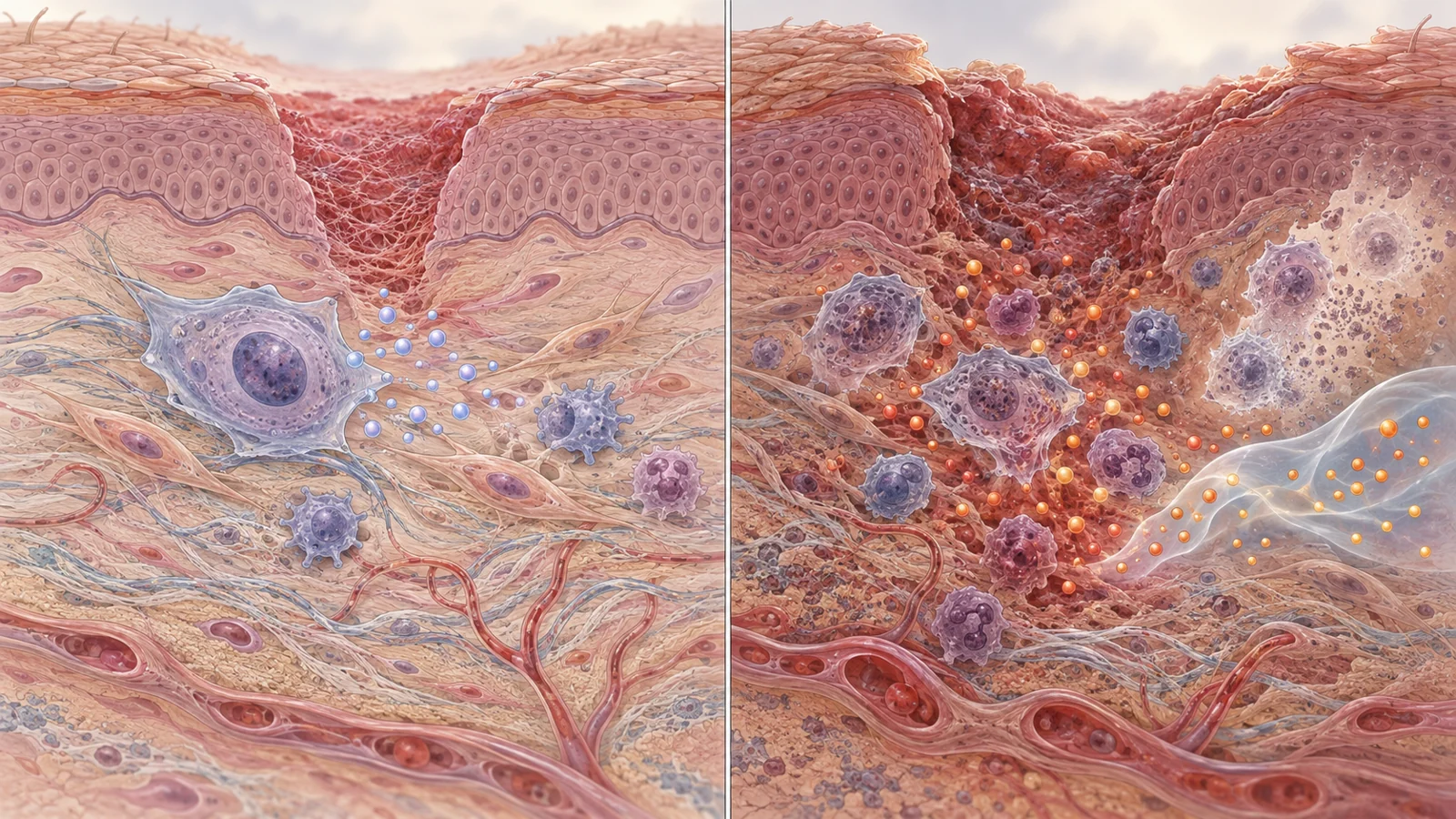
Senescence adds a layer of timing to this sequence. A senescent cell is no longer progressing through ordinary cell division, but it has not become biologically silent. It can change its shape and internal structure, resist programmed cell death, and release a collection of signals known as the senescence-associated secretory phenotype, or SASP. Those secreted factors can alter the behavior of neighboring cells.
The synthesis describes a short-lived senescent-cell presence in young mouse wounds, lasting roughly 3 to 12 days. In that setting, the cells were associated with reduced fibrosis and with changes in myofibroblasts, cells involved in contraction of the wound. One SASP component discussed by the authors, PDGF-AA, is a growth signal associated with wound contraction and closure. The point is not that every senescent cell is helpful. It is that a limited, local response can participate in an orderly repair process.
The same biology becomes more concerning when the response persists. The authors describe a shift toward pro-inflammatory and tissue-degrading effects when senescent cells remain in the wound. This is why the question is not simply whether senescence is good or bad. The relevant issues include which cells are senescent, what they are secreting, where they are located, and whether the response is resolving as the wound progresses.
Chronic wounds can reinforce the signals that delay repair
Chronic wounds provide conditions in which senescence may be sustained. Cells taken from human venous ulcers and pressure ulcers and grown in culture showed features associated with senescence. The cultured-cell observation is important because it connects the biology discussed in animal work with material obtained from human wounds, but it is not the same as demonstrating that a treatment heals those ulcers.
The wound environment itself may add pressure to the system. Pathogenic microorganisms can increase reactive oxygen species in keratinocytes and promote inflammation, according to the synthesis. A persistently inflammatory ulcer can then intensify senescence-related signaling, while senescent cells may influence neighboring cells through their secretions. This creates a feedback problem in which the local environment is not moving cleanly from early inflammation toward tissue growth and remodeling.
Aging also brings other contributors. Malnutrition and accumulated comorbidities can permanently hinder healing, and senescence is not presented as the sole cause of chronic wounds. The authors discuss a mouse model of diabetes in which intrinsically senescent macrophages were associated with impaired wound healing, adding another example of how the identity and state of the affected cell may matter.
Evidence from aged mice points in the same direction but remains animal evidence. In the cited work, older mice showed elevated and sustained expression of the cell-cycle regulator p21 after wounding. Reducing that sustained expression with p21 siRNA improved wound-healing rates. This finding supports the idea that excessive or prolonged senescence can be a modifiable part of delayed repair in aging mice. It does not establish an equivalent target, schedule, or benefit for older human skin.
Removing cells and changing their secretions are different strategies
The synthesis separates two broad ways of modifying senescence. Senolytics are intended to selectively eliminate senescent cells. Senomorphics leave the cells in place but alter senescence-related signaling, including components of the SASP. The approaches address different biological problems: one changes which cells remain in the tissue, while the other changes what those cells do to their surroundings.
That difference matters because clearance can remove cells participating in useful repair, while continuous suppression of their secretions could interfere with functions that are beneficial during a limited phase of healing. The source discusses examples such as dasatinib and quercetin in senolytic research, and metformin and rapamycin as agents studied for effects on senescence-related signaling. These are research examples, not treatment recommendations or evidence of a preferred regimen for chronic wounds.
The senolytic evidence described includes older mice receiving repeated oral dasatinib and quercetin, with improved physical performance after four months. The publication also cites a three-day oral treatment in a Phase I human trial that reduced senescence in adipose tissue in people with diabetes. Neither result measures closure of a human wound. The mouse endpoint concerns physical performance, and the human endpoint concerns senescence in fat tissue. They help show that senescence-related interventions can be studied in living organisms, but they do not supply wound-treatment efficacy.
Senomorphics raise a different practical issue. Because they modify a continuing secretory state rather than remove the cells, they may require ongoing exposure. The authors note concerns about safety with chronic treatment and about the fact that SASP components differ among cell types. A compound that changes signaling in one senescent population may not produce the same effect in another. Proving that a drug is genuinely senolytic or senomorphic is itself difficult, so the label should not be treated as a shortcut to clinical usefulness.
Translation depends on the wound endpoint
The gap between biological plausibility and patient care is especially clear when the measured tissue changes. Lower senescence in adipose tissue is not the same as faster closure of a wound in skin. A physical-performance improvement in aged mice is not the same as a reduction in ulcer duration, recurrence, infection, pain, or wound-care visits. The wound-specific animal observations and the early human adipose result therefore belong to separate lines of evidence.
The timing issue is equally important. The 3–12-day observation came from young mouse wounds. It describes a phase of repair in that model; it does not identify the correct moment to intervene in an older person’s wound. Human and mouse wound healing also differ, and aging can alter the underlying tissue environment. A strategy designed to reduce persistent senescence would need to avoid suppressing a temporary response that contributes to closure.
Natural compounds are discussed in the publication as another area of investigation, but the authors emphasize unresolved questions about dose, bioavailability, and long-term safety. Some compounds require relatively high doses to produce effects in experimental settings, and the amount that reaches a relevant tissue can vary. There were not long-term human studies establishing the pharmacodynamics, pharmacokinetics, or hazardous consequences of excess exposure for these anti-senescence approaches. That uncertainty does not support consumer supplement use or a self-directed wound regimen.
The practical test for this field would therefore involve more than detecting a senescence marker. A useful intervention would need to affect the right cell population in the right tissue, preserve necessary repair activity, and improve a clinically meaningful wound outcome in people. The 2021 synthesis makes the biological case for investigating that possibility while leaving the human wound benefit unresolved.
What targeted senescence treatment could mean for chronic wounds
For older patients, the potential benefit is concrete: wounds might close more reliably, remain less trapped in prolonged inflammation, and require fewer extended episodes of wound care. That outcome would depend on translating the age-related biology into a safe human treatment that reduces damaging persistence without erasing the short-lived senescence activity that can support repair. As of the publication’s July 2021 perspective, senolytic removal and SASP reduction were promising research directions, not established care for chronic wounds.
Key Sources
- Primary source: An Insight into Aging, Senescence, and Their Impacts on Wound Healing.
DOI or Journal Page · Peer-Reviewed Paper · 2021-07-21
Keep exploring