
Research Signal – Source date 2023-05-01
A treatment schedule can become part of the burden of cancer care: each infusion means another visit, and immune-based cancer drugs can also cause lasting side effects. For people whose advanced lung cancer remains controlled, could pembrolizumab be given less often without weakening its effect? A 2023 paper describes a trial designed to test that question across several possible schedules. It lays out how the comparison could identify a longer interval worth considering, but it does not report that any reduced-frequency schedule preserves survival.
Why a longer interval is biologically plausible
Pembrolizumab is an antibody that blocks PD-1, a protein on immune cells that can dampen their activity against cancer. The drug is intended to help those cells attack cancer. Its effects may outlast the time it remains in the bloodstream: studies of another anti-PD-1 drug, nivolumab, found that PD-1 binding on immune cells could remain substantial weeks after an infusion, including across a range of doses.
Earlier comparisons also gave researchers reason to question whether more frequent or higher-dose treatment is always needed. Across several studies of pembrolizumab and nivolumab, some dose comparisons did not show clear differences in outcomes. Those studies varied in drug, dose, cancer type and outcome, however. Receptor binding is a measure of a drug’s interaction with its target, not proof that a longer interval between pembrolizumab infusions keeps lung cancer under control. That clinical question needs its own comparison.
Five intervals put the unknown schedule to a test
REFINE-Lung was planned as a UK multicentre phase 3 randomized trial for people with advanced non-small-cell lung cancer (NSCLC). Eligible participants would have completed six months of pembrolizumab without their cancer progressing and be planning to continue treatment. People who began pembrolizumab alone or alongside chemotherapy could enter the planned comparison.
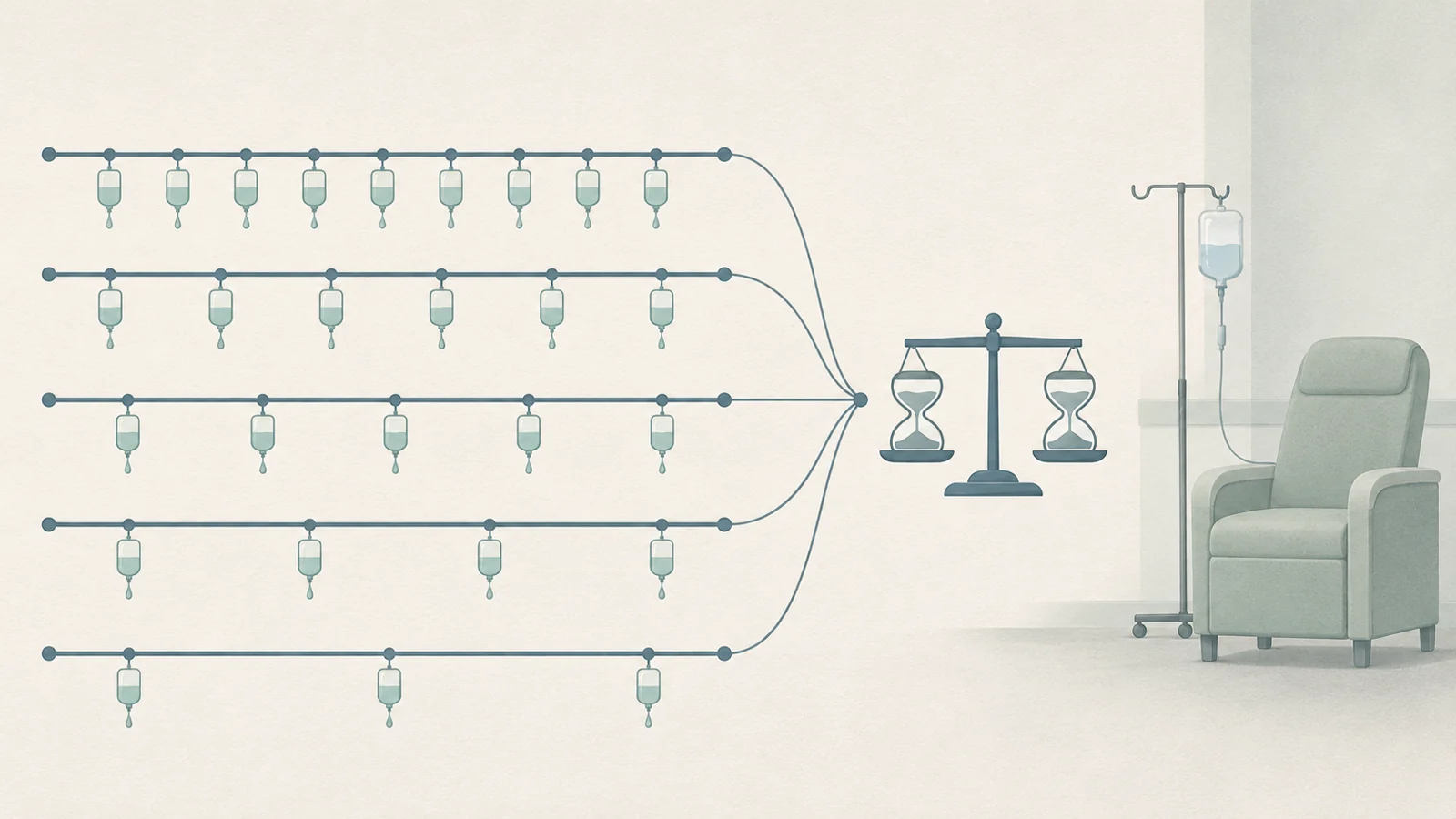
The standard schedule in the trial is pembrolizumab every six weeks. The study proposes comparing it with intervals of nine, 12, 15 and 18 weeks. Rather than choose one longer interval in advance and test only that schedule, investigators designed the trial to spread participants across a range of possibilities.
The analysis would use outcomes from all the treatment groups to estimate how efficacy changes as time between doses lengthens. Information can be shared across the groups to fit a frequency–response curve: an estimate of the relationship between infusion spacing and outcome. That approach can help locate the longest interval that still meets the study’s standard for maintaining survival, even when the best interval is not known beforehand.
The decision rule is about two-year survival
The study defines its primary outcome as overall survival at two years. The planned selection rule is to identify the least frequent schedule that meets a prespecified non-inferiority criterion against six-week dosing. In plain terms, non-inferiority means the trial is designed to judge whether the longer schedule keeps survival within an agreed margin of the control schedule.
REFINE-Lung sets that margin at a risk ratio of 0.88. The ratio compares two-year overall survival in a reduced-frequency group with survival in the six-week control group. To qualify, even the lower end of the study’s 95% confidence interval—a range expressing uncertainty around the survival ratio—must be above 0.88. The investigators selected this margin to preserve at least half of the estimated treatment benefit; that calculation is part of the trial design, not a REFINE-Lung survival result.
The threshold does not mean that researchers expect survival to fall by 12%, or that a schedule will qualify simply because its observed survival is close to the control group. The estimate must meet the confidence-interval rule. Readers could also apply a stricter threshold to the eventual frequency–response curve, although the trial might not have enough statistical power to establish non-inferiority at that alternative margin.
A staged opening adds a safeguard
Starting every longer-interval group at once could expose participants to a schedule that is less effective. The plan therefore begins with an internal pilot comparing six-week and 12-week dosing. The other reduced-frequency groups would open only if an interim comparison of progression-free survival—the time until cancer worsens or a participant dies—found no significant difference between six- and 12-week dosing. The researchers chose 12 weeks as the initial test because, if that interval proved detrimental, they reasoned there would be little basis for extending the standard six-week schedule further.
The plan also includes ongoing review by an independent data monitoring committee, which would consider at six-month intervals whether randomization to all groups should continue. If cancer progressed in a participant assigned to a reduced-frequency group, the plan was to offer treatment beyond progression with a return to the standard six-week schedule.
These features describe how the investigators proposed to manage uncertainty while testing a less frequent schedule. They do not tell us how the groups actually fared. The paper presents a trial design, not comparative REFINE-Lung survival findings.
Simulations set the recruitment target
The planned trial aimed to recruit 1,750 participants. That figure is a design target based on simulations, not a count of people enrolled or evidence of a treatment result. The simulations used assumptions including two-year overall survival of 65%, drawing on completed studies and the fact that participants would already have completed six months of treatment without progression.
Under the design simulations, 1,550 participants across five groups would give the trial an 80% chance of finding the 18-week schedule non-inferior to six-week dosing if the longer schedule truly met the chosen rule. The 1,750-person target also allows for roughly 10% of participants to be lost from the study. A conventional two-arm trial testing 12-week against six-week dosing was separately estimated to need 1,660 participants under different assumptions, including 90% power and a different significance level. Those figures cannot be read as a direct contest: the designs test different questions and use different statistical assumptions. The multi-arm proposal aims to learn about a range of intervals in one study, rather than answer only whether one chosen alternative qualifies.
How this could shape the future
For someone whose advanced lung cancer remains controlled, fewer trips for an established treatment could mean more time away from infusion appointments. That future would depend on a longer interval preserving survival in the trial and on health systems adopting the schedule. REFINE-Lung’s proposed contribution is a way to seek a defensible interval across several options, rather than rely on guesswork about which longer schedule to test. The nearer milestone is a reduced-frequency interval meeting the study’s prespecified two-year overall-survival non-inferiority rule against six-week dosing; the 2023 paper describes the design for reaching that decision, not whether the milestone was met.
Key Sources
- Primary source: REFINE-Lung implements a novel multi-arm randomised trial design to address possible immunotherapy overtreatment.
DOI or Journal Page · Review or Meta-Analysis · 2023-05-01
Keep exploring