
Research Signal – Source date 2021-06-05
A cancer treatment can stop a cell from multiplying without immediately making it disappear. That possibility sits at the center of a review published on June 5, 2021, about the connection between cellular redox biology, senescence and therapeutic targeting.
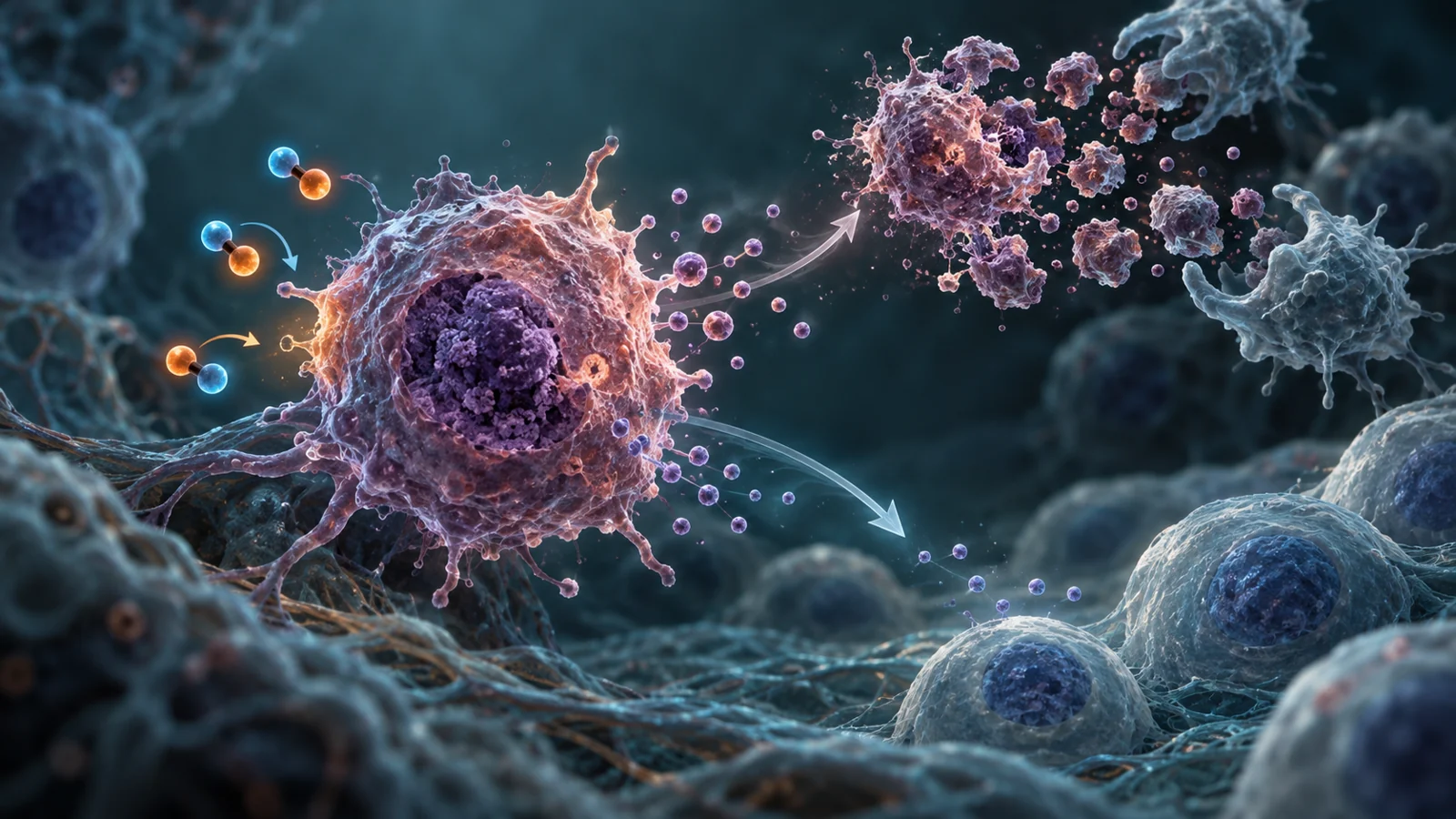
Senescence is a state in which a cell enters a lasting form of growth arrest. The cell no longer divides normally, but it is not necessarily inert. Senescent cells can change their gene activity and release inflammatory cytokines, growth factors, enzymes and other materials into their surroundings. This collection of secretions is known as the senescence-associated secretory phenotype, or SASP.
That combination creates a difficult treatment question. Growth arrest can help restrain a damaged cell and prevent uncontrolled proliferation. Yet a senescent cell may also alter nearby tissue, support inflammation or, in some experimental cancer settings, survive treatment and later regain the ability to multiply. The review brings these threads together without presenting a new cancer intervention trial. Its central proposal is that the chemistry sustaining senescence may also help determine how such cells should be targeted.
A stopped cell can still send signals
The basic idea of senescence emerged from observations that primary human fibroblasts could divide only a limited number of times before reaching a permanent growth-arrested state. In cancer biology, a similar arrest can occur when a cell experiences stresses that make continued division dangerous. The cell-cycle regulators p21 and p16 are among the markers associated with this state, but senescence is more than a single marker or switch.
Senescent cells can release soluble signals such as interleukins and chemokines, secreted enzymes, and proteins associated with the extracellular matrix. IL-6 and IL-8 are highlighted in the review as important inflammatory components of the SASP. These secretions can help recruit immune activity and contribute to tissue repair or remodeling. In other settings, they may create an environment that supports persistent inflammation or tumor progression.
The same biological program can therefore have opposing consequences. Permanently stopping an abnormal cell from dividing can act as a barrier against tumor formation. If the arrested cell remains in tissue and continues signaling, however, its presence may influence neighboring cells. In tumors, the surrounding environment and the properties of the surviving cells can determine whether senescence contributes to containment or to a more permissive setting for disease.
The review emphasizes that the switch between these roles is not fully understood. Timing, location, cell type and the surrounding immune environment all matter, which is why simply counting senescent cells cannot by itself predict whether removing them would help.
Redox is more than an antioxidant switch
Redox biology describes how oxidizing and reducing reactions shape the chemical state of a cell. A sustained shift toward a more pro-oxidant environment can damage lipids, proteins and nucleic acids. Those changes can activate DNA-damage responses, alter transcription factors and influence whether a cell continues dividing, dies or enters senescence.
Mitochondria are one important source of reactive oxygen species, and the review describes evidence linking senescence-associated mitochondrial dysfunction with greater oxidant production. In experimental systems, this production can help activate NF-κB, a regulator involved in inflammatory signaling during senescence. Redox changes may therefore participate both in initiating senescence and in maintaining its signaling state.
The important qualification is that “reactive oxygen species” is a broad category, not one uniform substance. Different reactive molecules have different reactivities, targets and biological effects. A rise in one species may affect a particular protein or signaling pathway, while another may cause a different response. That is why the review treats the identity and location of the reactive chemistry as important rather than presenting oxidation as a universal on-or-off signal.
This also helps explain why general antioxidant strategies have not delivered a simple answer. In cell experiments summarized by the review, sub-lethal chemotherapy or hydrogen peroxide could trigger DNA damage and premature senescence, and catalase or N-acetylcysteine could rescue some of those effects. But the broader biology is more specific than the idea that all oxidants are harmful and all antioxidant action is beneficial. The authors propose that restoring or redirecting redox balance might eventually connect senomorphic and senolytic strategies, while recognizing that the relevant redox pathways differ across contexts.
What chemotherapy leaves behind
Chemotherapy is intended to produce enough damage in tumor cells to stop them or kill them. The review describes a third possibility for a surviving subpopulation: cells exposed to treatment may enter therapy-induced senescence. Persistent DNA-damage signaling can hold them in an arrested state, while tumor heterogeneity means that not every cell responds in the same way.
Some of these cells may remain permanently arrested. Others may enter a temporary state that looks senescent but later loses its arrest. The review uses the term “pseudo-senescence” for tumor cells that regain proliferative capacity, distinguishing them from cells that remain permanently growth-arrested. In experimental models, cells that escape therapy-induced senescence have been associated with stem-like features and more aggressive regrowth.
The survival machinery inside the cell helps shape this outcome. Anti-apoptotic members of the Bcl-2 family help prevent programmed cell death. In the cancer models discussed by the review, increased Bcl-2 or Bcl-xL activity could shift cells away from apoptosis and toward an arrested state after treatment. The cell has not necessarily recovered; it has survived by resisting one route to death while remaining unable to divide normally.
That survival can become clinically important in principle because a residual cell population may later contribute to tumor regrowth. The review presents this as an experimental and mechanistic concern, not as proof that senescence-targeting drugs prevent recurrence in patients. It also leaves open a key biological question: what determines whether an arrested tumor cell stays arrested or re-enters the cell cycle?
Two ways to intervene
Senotherapeutic approaches described in the review pursue two different immediate objectives. Senolytics are intended to preferentially eliminate senescent cells, often by disabling survival pathways that those cells rely on. Senomorphics, also called senostatics, aim to change the behavior of senescent cells or reduce harmful effects of their secretions without necessarily killing them.
Navitoclax illustrates the senolytic approach. It is a small-molecule inhibitor of several Bcl-2-family proteins, including Bcl-2, Bcl-xL and Bcl-w. In animal models summarized by the review, navitoclax cleared some chemotherapy-induced senescent tumor and stromal cells and was associated with a lower residual tumor burden or recurrence risk in those models. The immediate action was cell elimination, not simply suppression of the SASP.
Rapamycin illustrates a different goal. By inhibiting mTOR signaling, it has been studied as a way to reduce SASP-related inflammatory activity. The review describes lower IL-6 and IL-8 production, reduced transcription of some inflammatory signals and reduced mitochondrial reactive oxygen species in experimental systems. In prostate cancer mouse models, rapamycin suppressed SASP factors in senescent stromal fibroblasts and reduced their effects on tumor growth. That is a change in the surrounding signaling environment rather than a claim that every senescent cell has been removed.
The distinction matters because removing cells and quieting their secretions carry different risks and may be useful in different settings. A cell that is dangerous because it can resume division may call for a senolytic strategy. A cell whose secretions are driving inflammation may instead be approached with a senomorphic strategy. The review also proposes exploring combinations of senolytics from different classes to target senescence pathways in different diseases.
Selectivity is the hard part
A drug does not act on “senescence” in the abstract. It acts on the survival machinery, signaling pathways or chemical features present in particular cells. Navitoclax demonstrates this limitation. In the studies summarized by the review, it affected some senescent fibroblasts and endothelial cells more than other senescent cell types. Its activity in cancer cells also varied, with resistance linked in some models to differences in proteins such as Noxa and Mcl-1.
The same target can also be present in healthy cells that need protection from the drug. Navitoclax’s activity against Bcl-xL was accompanied by concern about platelet toxicity. The review describes experimental attempts to improve the therapeutic window by making the drug more selective for senescent cells. One approach, Nav-Gal, links navitoclax to a galactose group that can be cleaved in cells with increased lysosomal and galactosidase activity associated with senescence. In laboratory and mouse work summarized by the review, this design showed more senescent-cell selectivity and less thrombocytopenia than navitoclax at the tested doses.
A related experimental Bcl-xL degrader, PZ15227, recruits cereblon, a component of the cell’s protein-disposal machinery that is present at low levels in platelets. The review describes senescent-cell clearance and reduced platelet toxicity in preclinical models. These results make delivery and activation part of the targeting problem: identifying a vulnerability is not enough if the same vulnerability is important in healthy tissue.
Early human observations add another layer of caution. In a phase I study summarized by the review, a short course of dasatinib plus quercetin in people with diabetic kidney disease was associated with reductions in senescent-cell measures in adipose and skin tissue and with lower levels of some circulating SASP factors. A separate 14-person pulmonary-fibrosis study reported improved physical-function measures after intermittent treatment, while pulmonary-function tests and a frailty index did not change.
Those observations came from different diseases, tissues and endpoints. They show that senolytic activity or changes in senescence-associated measurements can be studied in people, but they do not establish an anticancer benefit. Nor do cell clearance, lower SASP markers or an improvement in one physical-function measure prove tissue rejuvenation, longer life or preservation of every useful role senescence may play. Moving toward cancer treatment would require evidence that a proposed intervention reaches the relevant cells, spares essential healthy functions and produces a meaningful patient outcome.
What targeting senescent cells could change for cancer patients
The review’s most consequential possibility is a more durable form of cancer control. After treatment, selectively addressing residual cells that remain alive in an arrested state could, in principle, reduce the pool capable of supporting later tumor growth. Reducing tumor-supporting secretions from senescent cells could offer a complementary route, particularly where the surrounding tissue is part of the disease process.
Patients could benefit through fewer recurrences or less harm to nearby tissues if those benefits are demonstrated in humans. The path remains conditional: researchers would need to identify which senescent cells matter in a particular cancer, match the intervention to their survival and signaling machinery, and show that selectivity is strong enough to avoid unacceptable effects. The review presents redox regulation as a possible connection among these strategies, not as a universal explanation or a finished treatment. Its practical promise lies in making persistent cancer cells and their secretions more tractable targets while preserving the protective functions of senescence.
Key Sources
- Primary source: The redox-senescence axis and its therapeutic targeting.
DOI or Journal Page · Review or Meta-Analysis · 2021-06-05
Keep exploring