
Research Signal – Source date 2024-11-07
Fat tissue stores energy and sends signals
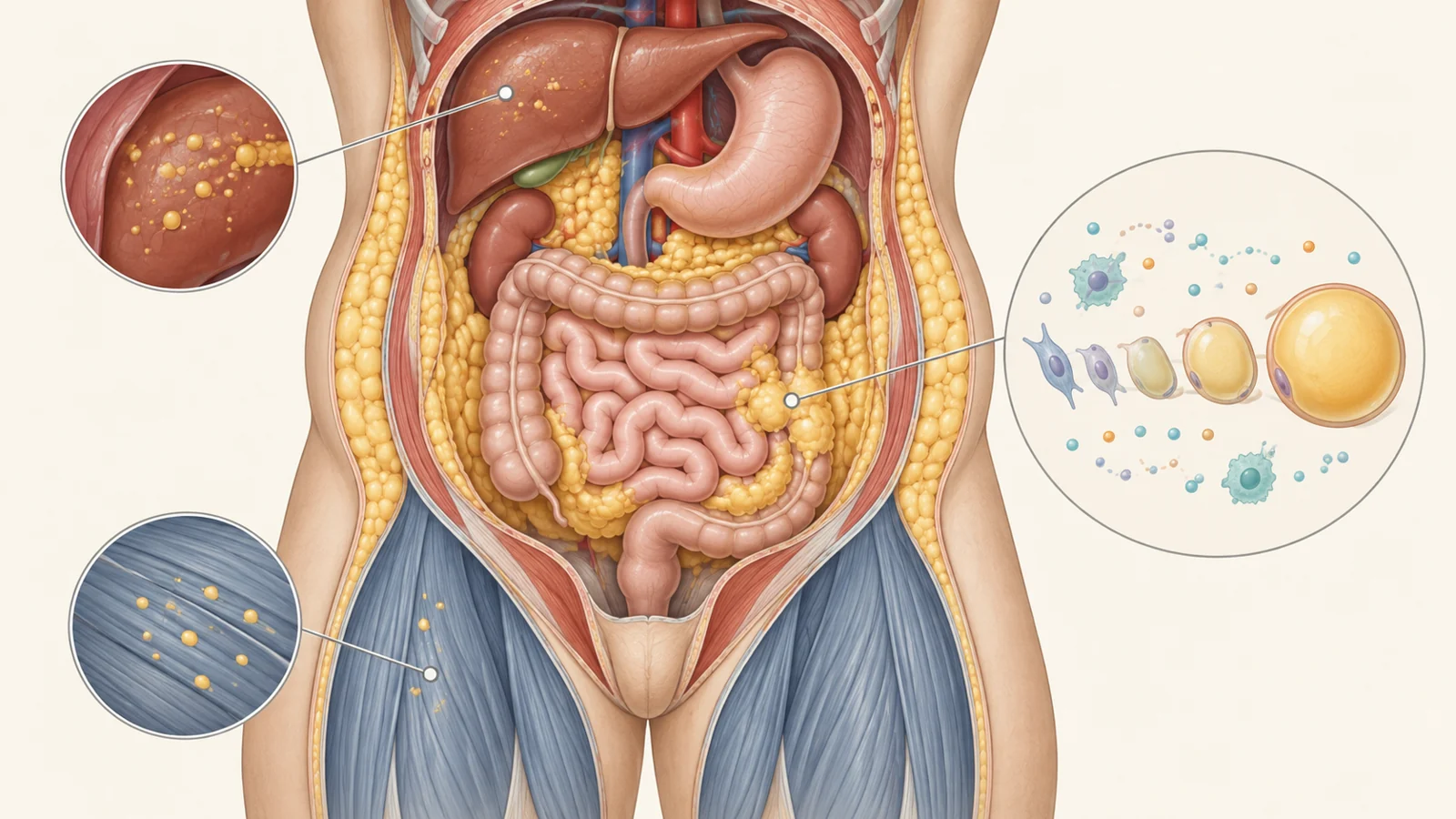
Fat tissue is more than an energy reserve. White adipose tissue stores surplus energy in large fat cells and releases hormones and other signals, called adipokines, that help regulate appetite, inflammation, metabolism and insulin sensitivity. Its capacity to store fat safely therefore matters beyond body size.
With age, fat distribution can shift. Subcutaneous fat beneath the skin may decline while visceral fat around abdominal organs increases. Fat can also accumulate in places such as the liver and muscles. Visceral and misplaced fat are associated with inflammation and metabolic disruption, including insulin resistance. The concern is not simply how much fat the body contains, but where it is held and whether fat tissue can still perform its storage and signaling roles.
When making new fat cells becomes harder
Adipogenesis is the process by which precursor cells mature into fat cells. The review describes age-related declines in this process alongside changes in the signals that guide it. In aged preadipocytes, levels of several factors that promote maturation can fall, while stress-related factors that oppose it can rise.
Fewer newly matured fat cells may leave existing cells to handle more storage or limit the capacity of subcutaneous fat tissue to expand. When storage capacity is strained, lipids can spill over toward visceral depots and other organs. The review connects this pattern with inflammation and impaired insulin responses, including reduced insulin-mediated glucose uptake in muscle and metabolic changes in the liver.
This makes the role of fat-cell formation context-dependent. Limiting adipogenesis may reduce fat accumulation in some settings, but broadly suppressing it could also restrict functional storage and the signals healthy fat tissue provides. The review’s examples do not establish one universally beneficial direction for changing these pathways in older adults.
Three compounds, three routes through the biology
The review describes polyphenols—plant compounds found in foods and studied as isolated compounds—as acting on several processes linked with aging fat tissue. The examples illustrate different mechanisms rather than a single established treatment.
Resveratrol is discussed in connection with AMPK, a cellular energy-sensing pathway. The review links resveratrol’s activation of AMPK through LKB1 to mitochondrial biogenesis and separately describes resveratrol alleviating mitochondrial dysfunction and oxidative stress through LKB1/AMPK in aged rats with high-fat-diet-related muscle atrophy. This is an animal example of a pathway relevant to energy handling; it does not show that resveratrol preserves fat storage or improves aging outcomes in people.
Quercetin is linked to oxidative stress, an imbalance between reactive oxygen species and the body’s defenses against them. The review describes quercetin activating Nrf2, which increases antioxidant proteins, and also summarizes effects on inflammatory pathways. These mechanisms could matter because oxidative stress can impair fat-cell function and alter adipokine release. They do not establish a useful dose or a human health effect.
EGCG, a tea polyphenol, is discussed in relation to growth-factor signaling. The review describes EGCG inhibiting the TGF-β/SMAD pathway and reducing activity in stress-related MAPK pathways in experimental contexts. These signals can influence cell development and inflammation, but changing a pathway does not by itself show that the net effect on aging fat tissue is beneficial.
Inflammation can keep dysfunctional tissue in a loop
Aging fat tissue can accumulate senescent cells—cells that have stopped dividing but remain metabolically active. These cells can release inflammatory signals as part of the senescence-associated secretory phenotype, or SASP. In the review’s account, such signals can reinforce inflammation and dysfunction in surrounding tissue.
Polyphenols including resveratrol, quercetin and EGCG are discussed for effects on senescence-related pathways and inflammation. The cited mechanisms vary, and the review describes complex roles for senescence and its secreted signals. Evidence that a compound alters these pathways is not evidence that it selectively clears senescent fat cells in people.
The distance from a pathway to a useful intervention
The evidence assembled in the review spans different compounds, tissues and experimental settings. A pathway response in cells or animals does not establish that a person can absorb an effective amount, that the amount is safe over the long term, or that changing the pathway improves a meaningful health outcome with age.
Dose and bioavailability—the amount of a compound that reaches the body in a usable form—remain central translation questions. The review calls for further work on effective amounts, long-term safety and human efficacy. Its examples do not identify a best compound or establish a supplement recommendation.
What healthier fat tissue could change as we age
If future research establishes interventions that are effective, absorbable and safe in people, preserving functional fat storage and signaling could help limit harmful lipid spillover into the liver and muscles. That could, in turn, reduce some of the metabolic disruption associated with misplaced fat as people age. The review makes this a research possibility, not a demonstrated benefit of polyphenol supplements.
Key Sources
- Primary source: Crosstalk between adipogenesis and aging: role of polyphenols in combating adipogenic-associated aging.
DOI or Journal Page · Review or Meta-Analysis · 2024-11-07
Keep exploring