
Research Signal – Source date 2021-05-01
Aging research has raised an appealing possibility: some existing medicines and dietary supplements might be reused to target senescent cells, cells that have stopped dividing and can contribute to age-related conditions. The proposed benefit is not necessarily limited to one disease. If senescent cells appear in several tissues, changing their behavior could eventually affect more than one aspect of health.
But a plausible biological target is only the beginning of a clinical question. The National Institute on Aging convened a workshop in August 2019 to consider how drugs and supplements with senolytic or senomorphic effects might be evaluated in phase II trials. The resulting report, published May 1, 2021, focuses on the practical problems between cellular action and useful treatment for people with age-related illness.
The attraction is a shortcut, not a verdict
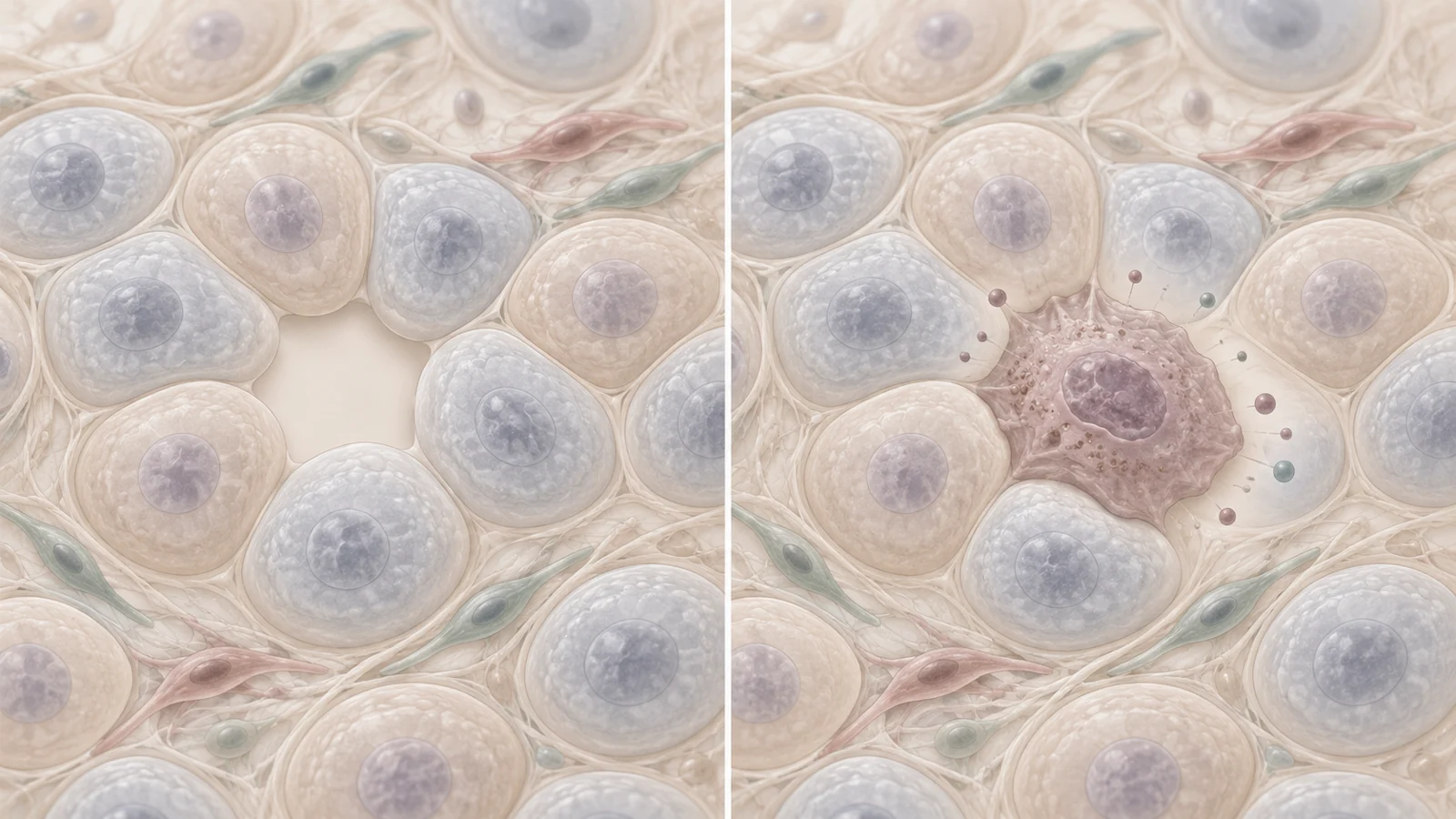
Senolytics are agents intended to kill senescent cells. Senomorphics take a different approach: they alter the behavior of those cells, including the signals they release. The distinction matters because removing a cell and changing its secretions are different interventions, with different ways to measure success and different possible harms.
Several potential senolytics began as anticancer drugs. Some of the biological machinery involved in cancer cells is also relevant to senescent cells, making those medicines candidates for repurposing. Their use in a new setting could involve lower doses or intermittent treatment, particularly because senescent cells do not need to be eradicated in the same way as cancer cells. Those possibilities do not remove the central safety question. A compound that affects several kinds of cells may be cytotoxic more broadly than intended.
The workshop report highlights concerns that would need attention in human studies. The report flags possible harms of these interventions, including reduced immune surveillance against cancer, re-entry of senescent cancer cells into the cell cycle, and impaired tissue repair and regeneration. These are not reasons to abandon the approach. They are reasons to test whether a candidate is selective enough, whether its effects last, and whether its benefits outweigh its risks in the patients being studied.
A 14-person study can test feasibility without proving benefit
The report uses an early human example involving dasatinib plus quercetin in 14 people with idiopathic pulmonary fibrosis, a disease marked by scarring in the lungs. The study was open-label and uncontrolled. Participants received the combination intermittently over three weeks, allowing researchers to examine safety and whether a larger study was feasible.
Several observations were reported after treatment. One serious adverse event was judged unrelated to the intervention, and several nonserious events were recorded, including headaches, lung symptoms, and fatigue ranging from moderate to severe. Gait speed, walking distance, and a physical-performance score improved compared with measurements taken before treatment. Changes in senescence-associated secretory phenotype factors were also moderately correlated with changes in physical function, lung function, and frailty.
Those findings make the study useful as an early feasibility example, not as a reliable estimate of treatment benefit. Without a comparison group, an apparent change can have several explanations. The report specifically notes that repeated performance testing can produce learning effects: people may perform differently simply because they have become familiar with the tests. The study also cannot show that any functional change resulted from removing senescent cells, rather than from another action of the drugs or from ordinary variation.
The larger lesson is about what a small study must prepare researchers to measure. Safety, function, biological markers, and the relationship between them all matter, but each answers a different question. A change in a blood signal is not automatically a change in a patient’s disease, and a change in physical performance is not automatically evidence that senescent cells were the cause.
A marker is useful only if it points to the right tissue
Clinical testing becomes harder because senescence is not a single fixed state. The report describes signatures that vary with the stress that induced senescence, the cell type involved, and the time since senescence began. Fibroblasts, melanocytes, keratinocytes, and astrocytes can show substantially different patterns of gene expression. Some genes form a shared core, while other signals change with the cell and the timing.
A useful trial marker therefore needs to do more than move after treatment. Researchers would want to know which senescent cell types it reflects, where those cells are located, and whether the measurement changes when the intended cells are killed or their behavior is altered. A panel designed for one tissue may not answer the same question in another.
Sampling makes the problem tangible. Organs relevant to an illness may not be easy to biopsy repeatedly, especially in older participants. The workshop report discusses the possibility of relating senescent-cell burden in less accessible tissues to signals measured in blood, such as selected inflammatory or matrix-related factors, or to markers measured in more accessible skin or subcutaneous fat. That approach would be useful only if the relationship were demonstrated rather than assumed.
This is also where biological attribution becomes separate from clinical outcome. Researchers could show that a drug reached or influenced a target cell population and still need to determine whether that change improved breathing, mobility, resilience, or another patient-important outcome. Conversely, a patient’s condition could change without a reliable indication that the intended senescence pathway was responsible. Trials need measurements that connect those steps without treating them as interchangeable.
Age alone cannot choose the patient or the schedule
A chronological age threshold would be a blunt way to select people for a senescence-targeting trial. The report points instead toward questions about senescent-cell burden, disease severity, and the balance between likely benefit and possible harm. A person with a high burden in tissue relevant to a symptomatic condition might be a more informative participant than someone selected only because of age.
Existing illness and treatment would also shape that balance. Older adults commonly live with several conditions and take multiple medicines. The combinations are diverse enough that interactions may not be predicted by studying one drug pair or one metabolic pathway at a time. The workshop report uses examples such as the possibility that lowering hemoglobin or hematocrit could worsen an existing tendency toward anemia, or that an immune-modifying senomorphic strategy could raise infection concerns in someone already vulnerable.
The right schedule is similarly patient-dependent. A proposed “hit-and-run” approach would give a senolytic intermittently rather than continuously. That could reduce exposure, but it creates another measurement problem: how quickly do senescent cells accumulate again, and how does that return relate to changes in the patient’s condition? Repeated markers would be needed to connect treatment episodes with biological and clinical changes.
These questions make trial design more than a search for the oldest participants or the strongest drug. The relevant candidate may depend on which cells are present, which illness is being treated, what other medicines a person uses, and how long the treatment effect is expected to last.
Trials would start where patients can benefit directly
The workshop report describes a staged route for studying these interventions. The initial focus proposed for the Translational Geroscience Network was symptomatic conditions in which participants could benefit directly, particularly when current treatment options are poor. Examples discussed include conditions associated with accelerated aging, as well as tissue-specific problems that might be approached locally, such as osteoarthritis or some skin conditions.
That sequence gives early studies a practical ethical purpose. Researchers could ask whether changing a senescence-related mechanism helps people who already have a problem, while measuring safety in the same population that might eventually receive the treatment. Prevention in people who do not yet have symptoms would come later, after efficacy and safety had been assessed in more immediate clinical settings.
Shared methods could make that progression more informative. The report calls for common procedures for storing specimens, running assays, and maintaining quality control, potentially through a central laboratory used by multiple studies. It also supports shared outcome measures for several aging-related conditions and risk factors. When separate trials collect compatible biological and clinical data, researchers can compare results more reliably and examine whether an intervention has effects beyond the condition that first brought a participant into a study.
That matters because senescence-related biology may cross disease boundaries, while patients themselves do not fit neatly into one-disease categories. A trial can remain focused on a specific illness and still collect information about mobility, frailty, other risk factors, and potential effects in more than one aging-related system. Standardization would not solve the biological complexity, but it could make scattered evidence easier to interpret together.
What this could change
A successful senescence-targeting treatment could eventually give clinicians a way to ease more than one age-related problem for patients living with overlapping illnesses. That possibility remains conditional on clinical studies showing that modifying senescent cells produces meaningful benefits with acceptable harms in the intended patients. If that evidence emerges, the same research infrastructure could support a careful progression from treating symptomatic disease to testing prevention in people at risk.
The immediate value of the NIA workshop report is that it makes the path to that possibility concrete. Selective action on the right cells, markers that reflect the relevant tissues, schedules matched to biological reaccumulation, and trial measures shared across studies would all be needed before a cellular mechanism could become dependable everyday care.
Key Sources
- Primary source: National Institute on Aging Workshop: Repurposing Drugs or Dietary Supplements for Their Senolytic or Senomorphic Effects: Considerations for Clinical Trials.
DOI or Journal Page · Review or Meta-Analysis · 2021-05-01
Keep exploring