
Research Signal – Source date 2026-03-25
Natural killer cells are immune cells that can respond quickly to infected, malignant, or stressed cells. A review published on March 25, 2026, brings together research on how these cells change with age and what those changes might mean for healthy aging. Its central idea is that natural killer cells help regulate the burden of damaged cells and the immune environment around them—but their effects depend on how well they function and where they act.
That makes a practical question harder than it first appears: if these cells can clear harmful targets, would increasing their activity help older adults? The review offers biological reasons to investigate that possibility, along with examples of conflicting effects across tissues. It does not establish that boosting natural killer cells extends healthspan in people.
A way to clear stressed cells
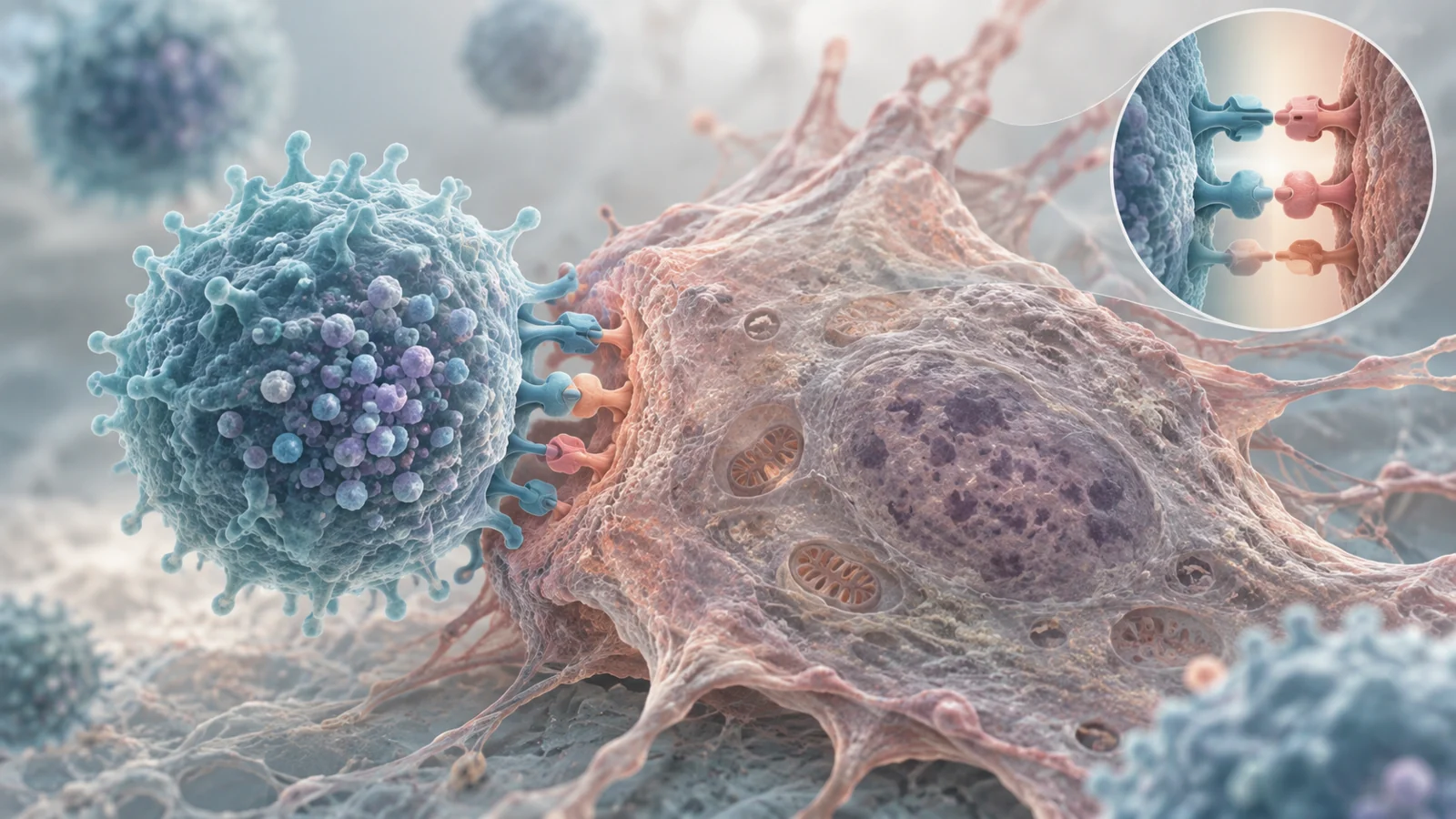
Natural killer cells recognize a range of signals from other cells and balance activating and inhibitory inputs before responding. When a cell is infected or becomes senescent—a state in which it stops dividing but can remain metabolically active—it may display stress-related molecules. The review describes molecules such as MICA, MICB, and ULBPs engaging activating receptors on natural killer cells. The cells can then release perforin and granzymes, which help kill the target.
Senescence can be protective at first: stopping damaged cells from dividing may limit further harm. Persistently senescent cells, however, can release inflammatory signals known as the senescence-associated secretory phenotype, or SASP. In principle, clearing some of these cells could help limit their accumulation and the effects they have on nearby tissue. The review therefore describes natural killer cells as part of the body’s senescence surveillance, not as the only system responsible for it.
Some of the more direct evidence comes from mouse experiments summarized in the review. Depleting natural killer cells in those models was associated with more senescent hepatocytes, greater fibrotic progression, and increased tumor formation. Interventions that enhanced their activity, including cytokine treatment or transfer of natural killer cells, restored clearance and reduced pathology in the models. These findings support a mechanism worth studying, but they do not show that the same interventions prevent disease or extend healthy life in older people.
The targets can also resist recognition. The review describes senescent cells shedding molecules that can dampen activating receptors, engaging inhibitory receptors, and releasing factors that suppress immune activity. Such escape mechanisms help explain why natural killer surveillance may weaken even when the cells are present.
Aging changes the cells, not just their number
A simple count can miss important changes. The review notes that total natural killer cell numbers may remain stable or even increase with age, while the mix of subsets shifts. The proportion of CD56bright cells, associated with cytokine production and immune regulation, tends to fall, while more terminally differentiated CD56dimCD57+ cells become prominent. These shifts can coexist with reduced proliferative capacity and weaker responses.
The balance of receptors changes too. Activating receptors such as NKG2D and DNAM-1 may decline, while inhibitory receptors including NKG2A and TIGIT become more prominent. The resulting changes can impair the formation of a killing contact with a target, reduce degranulation—the release of cell-killing contents—and lower cytokine secretion. Age-associated metabolic changes may further constrain the cells’ ability to respond.
The picture is not simply “fewer cells, less protection.” It is a remodeling of cell populations, signals, metabolism, and performance. A blood count alone cannot reveal whether natural killer cells can identify a target, carry out a response, or produce the signals that coordinate other immune cells.
The same response can protect or inflame
Natural killer cells operate within tissues, where their effects depend on local conditions and their interactions with other cells. In adipose tissue, the review describes a shift from roles in normal tissue remodeling toward a pro-inflammatory pattern in obesity and aging. In mouse models of obesity, natural killer cell activity was linked to inflammatory macrophage behavior and impaired insulin signaling; depleting the cells improved glucose intolerance in those models. These findings illustrate a possible harmful contribution in a particular metabolic setting, not a general effect of natural killer cells across people or tissues.
Blood vessels show another side of the balance. Natural killer cells may contribute to inflammation and injury within atherosclerotic plaques, yet they can also clear senescent endothelial and smooth muscle cells. The review suggests that the local environment—including metabolic stress and inflammatory signals—may shape which effect predominates. In other words, stronger activity is not automatically better: a response that helps remove a stressed cell in one context could add to tissue injury in another.
What a useful test would need to measure
Researchers can assess natural killer cells by their surface markers, their behavior in functional tests, or molecular patterns inside the cells. Flow cytometry can profile subsets and receptors such as CD56, CD16, CD57, NKG2A, NKG2C, and KIRs. Functional assays can test cytotoxicity, degranulation, or cytokine production. Each answers a different question: a marker describes what cells look like, while a functional assay asks what they can do under test conditions.
The review describes associations between some natural killer cell patterns and frailty, vaccine response, or infection risk. It also discusses emerging single-cell methods that may help characterize variation across cell populations. But functional tests remain technically demanding and are not standardized for routine clinical use, and the independent prognostic value of these measures remains to be established.
For now, natural killer cell measures are best understood as possible complements to other assessments, especially when immune surveillance, infection susceptibility, cancer risk, or senescent-cell burden is relevant. They are not a universal biological-age score. A useful measure would need to predict outcomes reliably in defined groups and show that changes in the measure track meaningful changes in health—not just shifts in a laboratory readout.
Different routes to changing natural killer cell function
The review discusses lifestyle factors, drug-based approaches, and cellular therapies, but the evidence behind them is not interchangeable. Exercise is associated with changes in circulating natural killer cells and measures of their activity, including in older adults. The review also discusses nutrition, sleep, and circadian alignment as factors that may shape immune function. These observations make lifestyle a plausible area for preserving immune competence; they do not establish a specific regimen as a natural killer cell treatment for longevity.
Drug approaches include cytokines such as IL-15, which have been studied for their ability to promote natural killer cell survival, proliferation, or cytotoxicity. The review also describes checkpoint-blocking strategies and other ways of altering immune or metabolic signaling. Much of this work is preclinical or comes from early clinical research and cancer treatment settings. A drug’s capacity to activate immune cells in oncology does not by itself demonstrate that it would be beneficial or safe for prevention in healthy older adults.
Engineered natural killer cells, including CAR-NK approaches, are further from preventive use. The review characterizes their aging-related applications as conceptual, with much of the relevant evidence drawn from oncology and preclinical disease models. In healthy aging, researchers would still need to establish which cells to target, how long engineered activity should last, whether it can be reversed, and how to prevent unwanted effects in tissues with ongoing inflammation.
Prevention raises the safety bar
Cancer treatment can justify risks that would be unacceptable for a person who is otherwise well. Preventive treatment asks healthy older adults to accept an intervention before they have an illness that needs treating, while the hoped-for benefit may take years to measure. That changes the balance: a modest chance of harm matters more when the benefit is uncertain and distant.
The review notes that excessive natural killer activity could, in principle, worsen tissue injury or contribute to autoimmunity. Any preventive strategy would need to show that it can be controlled and that its benefits outweigh those risks. Early studies may therefore be more appropriate in groups with specific, measurable health risks than in broad populations of healthy older adults.
Could natural killer cells help people stay healthy longer?
If researchers can identify when natural killer surveillance is impaired, measure it reliably, and restore it without aggravating inflammation or harming healthy tissue, these cells could become one useful target for reducing particular age-related risks. That might eventually support better ways to manage vulnerability to infection, cancer, or diseases linked to persistent senescent cells. The review provides a rationale for that research, while human outcome and long-term safety evidence would be needed before natural killer cell enhancement could be considered a preventive longevity strategy.
Key Sources
- Primary source: Natural killer cells: gatekeepers of healthy aging in longevity medicine.
DOI or Journal Page · Review or Meta-Analysis · 2026-03-25
Keep exploring