
Research Signal – Source date 2021-01-01
Mulberry fruit extracts improved Parkinson-like movement in some animal experiments. In a separate experiment, a mulberry leaf extract increased abnormal immobility caused by a drug that blocks dopamine signaling. The results may sound contradictory, but they came from different preparations and different models. They do not show what eating mulberries would do to a person’s movement or brain health.
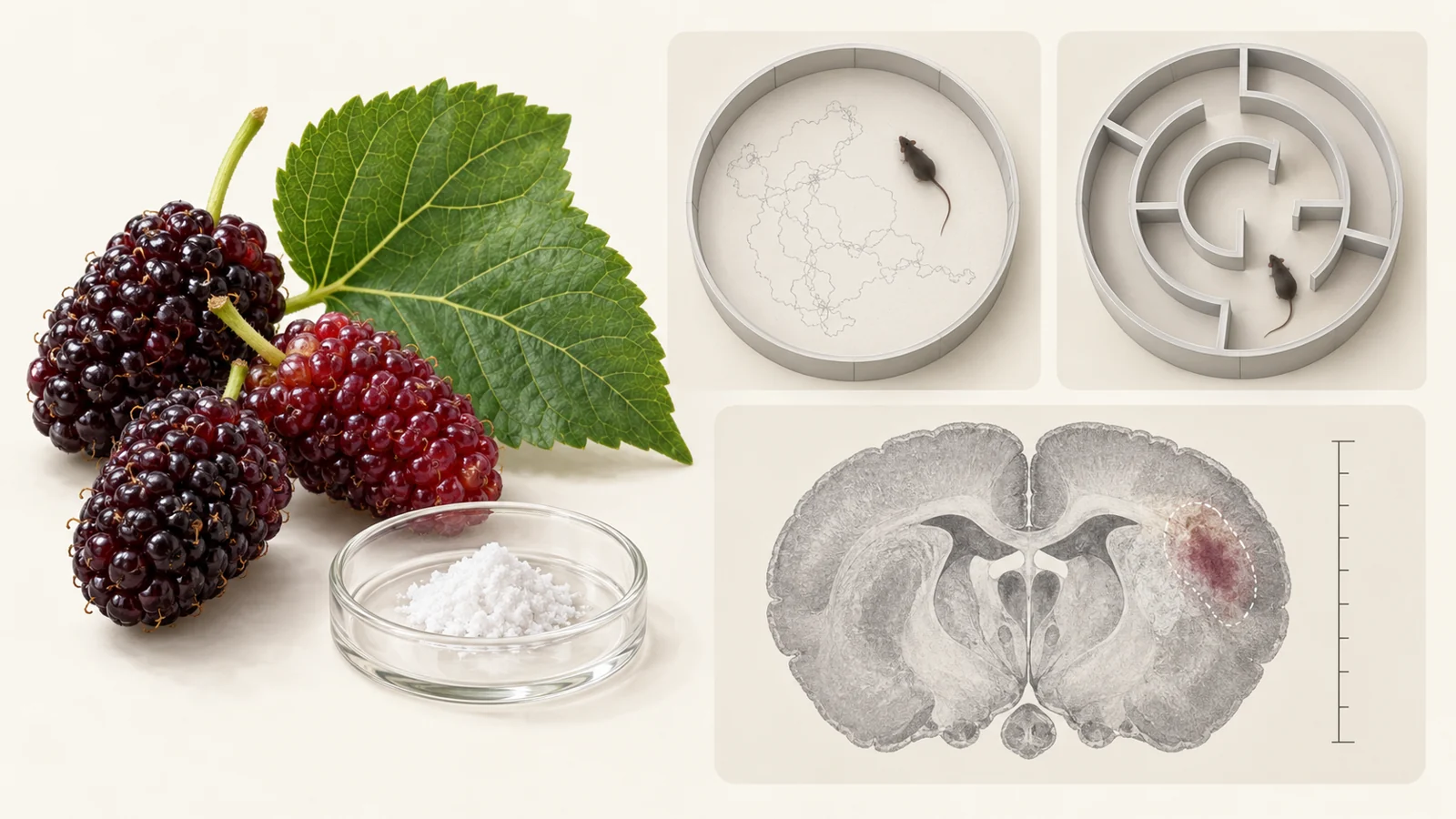
A 2021 systematic review gathered animal research on mulberry and the central nervous system. Its nine-database search covered studies published through September 18, 2017, and included 47 studies in its synthesis. The authors found reported effects across memory tasks, experimentally induced stroke, and other neurological models. The variety offers a broad view of what researchers had tested, while making it difficult to compare results as if they came from one standardized treatment.
What the animal studies measured
The review included studies of several mulberry species, plant parts and extracts. Researchers measured outcomes such as how animals performed in memory tasks and how much brain tissue was injured after experimentally induced stroke. Those are different kinds of evidence: a change in a task score describes behavior under a particular test, while a smaller measured injury area describes damage in a specific experimental model.
Fourteen studies reported on cognitive impairment using tests including the Morris water maze, object recognition, and passive or active avoidance. Several preparations were associated with better performance on some measures. For example, mice given mulberry preparations often took less time to find a hidden platform in the Morris water maze. But the pattern was not uniform: in some experiments, including one involving mice with induced stroke, the animals spent no more time in the target area during the retention test. A positive result on one measure therefore did not guarantee improvement on every memory measure.
Stroke experiments offered a more direct numerical example. In one mouse study summarized by the review, a purified mulberry-fruit compound called cyanidin-3-O-glucoside was given orally at 10 mg/kg 30 minutes after an induced stroke. The reported injured brain volume was 18% lower. Other studies tested different compounds and schedules, including treatments given before or after induced injury. These results describe specific experiments in animals; they do not establish that mulberry prevents strokes or treats one in people.
The preparations were not interchangeable
The review included 33 studies using Morus alba, while other studies examined species such as M. nigra, M. atropurpurea, M. laevigata and M. rubra. Researchers used fruit, leaves, roots, root bark and other plant material. Methanol and ethanol were common extraction solvents, and some experiments used isolated compounds rather than whole extracts.
The dose and delivery also varied substantially. Across the studies, reported amounts ranged from 0.2 mg/kg per day to 10 g/kg twice daily. Most treatments were given by mouth, while ten studies used injections into the abdominal cavity. These differences matter because the name “mulberry” alone does not identify what an animal received. A fruit powder, a leaf extract made with a particular solvent, and a purified compound are distinct interventions with different compositions and exposures.
The review’s authors noted that the active ingredients were identified in only a small number of the positive experiments. That leaves open which components account for particular effects, and whether findings from one extract can be expected from another. The wide dose range also points to a basic research problem: doses had not been standardized across similar experiments.
Two movement findings came from different models
Dopamine helps regulate movement, so changes to dopamine-producing brain cells or dopamine signaling are relevant to Parkinson-like symptoms and to drug-induced immobility. The review described fruit-extract experiments in which mulberry was reported to protect dopamine-producing neurons from certain toxic effects and improve Parkinson-like behaviors in rats. The authors discussed reduced oxidative stress and changes in cell-death signals as possible explanations, not as settled mechanisms shared by every mulberry preparation.
The leaf result came from a different setup. In that study, M. alba leaf extract was given to animals treated with haloperidol, a drug that blocks dopamine receptors and can cause catalepsy—abnormal immobility. After 28 days, the review reported a higher catalepsy score at 100 mg/kg of the leaf extract. The same review also described reduced footshock-induced aggression in another experiment, which the authors considered consistent with possible dopamine-blocking activity of the leaf extract.
These findings do not directly test fruit against leaves under the same conditions. The Parkinson-like experiments and the haloperidol-induced catalepsy experiment used different plant materials and models. The review’s authors suggested that plant part and extraction solvent could yield different chemical mixtures, which might help explain the tension. Those explanations remain hypotheses. The experiments do not identify a single established mechanism that accounts for all the reported movement effects.
How much confidence the evidence supports
The review followed a systematic search and screening process, identifying 1,187 records before including 47 studies in its qualitative synthesis. It also assessed the quality of the animal studies using SYRCLE, a tool for judging bias in animal experiments. The authors rated 44 of the 47 studies at high risk of bias. They highlighted concerns involving how animals were assigned to groups and whether researchers were blinded when carrying out or assessing experiments.
That assessment changes how strongly the positive findings can be read. Small, methodologically weak studies can produce results that are difficult to reproduce, and the review’s varied preparations and doses add another layer of uncertainty. The review also found no human clinical trial among the included studies. It did not establish a safe or effective mulberry preparation or dose for human neurological use, and it did not report a systematic toxicology assessment of the included interventions. Exposure after absorption and metabolism, dose selection and safety therefore remain unresolved questions for translation.
The most defensible conclusion is that animal experiments had produced several promising observations worth investigating, alongside results that depend on the particular model and extract. The review is a record of that research landscape through September 2017, not evidence that mulberry is a brain-health treatment.
A possible route to brain protection after stroke
If the stroke findings can be reproduced with a defined mulberry-derived compound at an exposure that is achievable and safe, that compound could become a candidate for limiting brain tissue injury after stroke. Establishing that possibility would require consistent results, a clearer understanding of exposure and safety, and eventual testing in people. The animal findings make that research question plausible; they do not make the treatment available today.
Key Sources
- Primary source: Effects of Mulberry on The Central Nervous System: A Literature Review.
DOI or Journal Page · Review or Meta-Analysis · 2021-01-01
Keep exploring