
Research Signal – Source date 2021-02-18
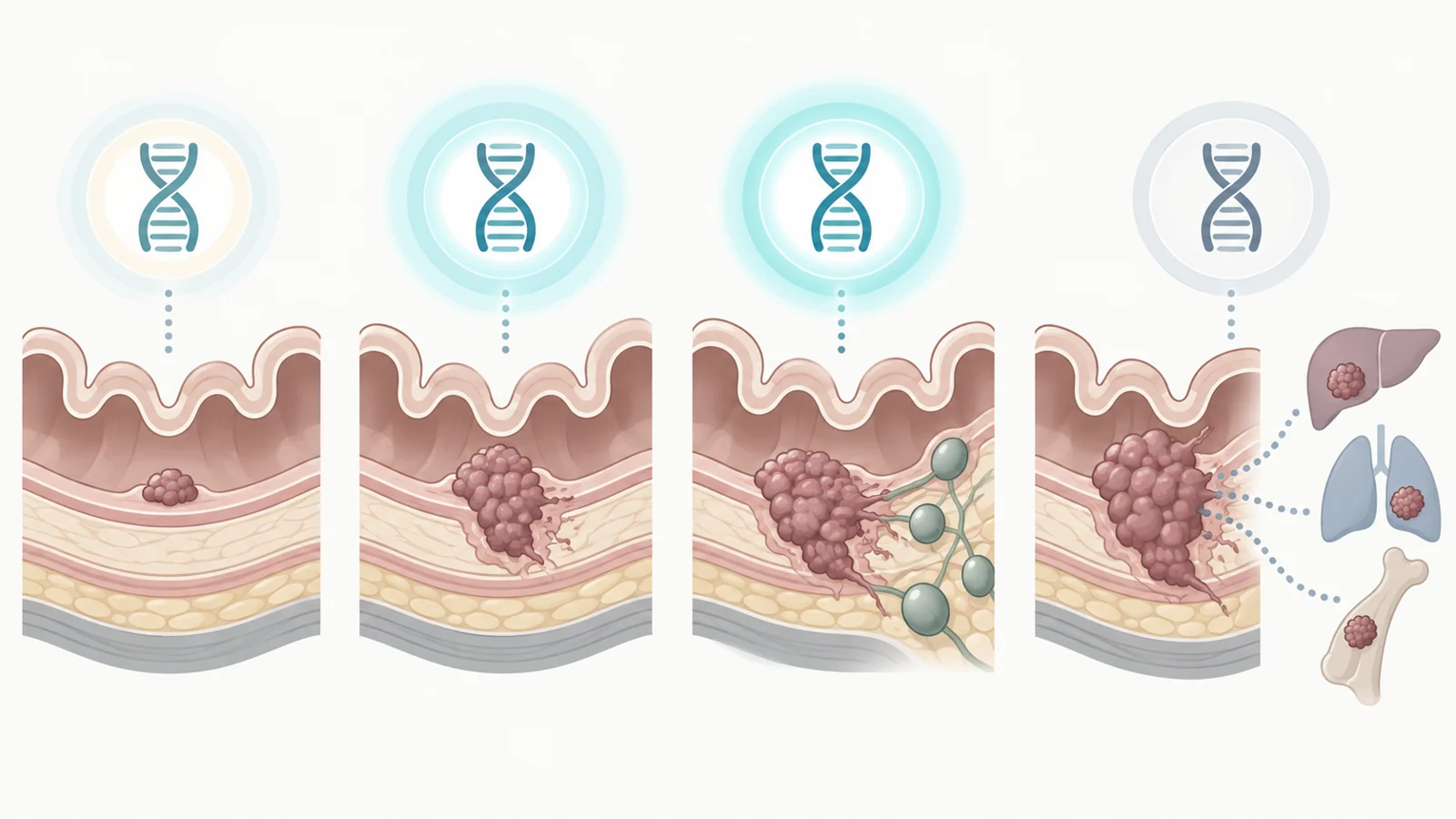
A tumor marker can be associated with better outcomes overall and still tell us little about prognosis at particular stages. In colorectal cancer, a large review found that MSI-high status—high microsatellite instability, a marker in a tumor’s DNA—was associated with less spread and better survival across the studies it pooled. The clearest survival association appeared in stages II and III. Stage I survival was excellent regardless of the marker, while stage IV disease without immunotherapy showed no survival benefit associated with MSI-high status.
The finding carries a tension. MSI-high tumors were also associated with some features considered adverse under the microscope, including poor differentiation, mucinous or signet-cell features, and higher grade. Yet across the pooled results, MSI-high status went with lower rates of lymph-node and distant metastases and with better survival overall. Those observations can coexist; the review does not establish that the marker itself prevents spread or explain a mechanism that would resolve the apparent contradiction.
A broad pattern with a stage-specific shape
The 2021 paper brought together 136 studies of colorectal cancer, covering 92,035 patients. Of those, 11,746 cases—13%—were MSI-high. The researchers searched several medical databases for original studies, with the search running from database inception through June 2019. They combined results using a random-effects meta-analysis, a method for pooling findings across studies while allowing that study results may differ.
Across the full group, MSI-high status was associated with better overall survival, disease-free survival, and disease-specific survival. The paper also reported significantly lower rates of lymph-node and distant metastases among MSI-high cases. These are pooled associations across the included studies, not a prediction for every person with colorectal cancer.
What the survival numbers describe
The pooled odds ratios were 0.81 for overall survival, 0.73 for disease-free survival, and 0.69 for disease-specific survival. The paper interpreted these results as associations with better outcomes for MSI-high colorectal cancer. Overall survival concerns survival from any cause; disease-free survival concerns remaining free of disease; and disease-specific survival concerns survival in relation to colorectal cancer.
Each odds ratio summarizes a comparison made across studies. It is not the percentage of patients who survive, nor does 0.81 mean that a particular patient’s chance of survival is 81%. The reported 95% confidence intervals were 0.73–0.90 for overall survival, 0.66–0.81 for disease-free survival, and 0.52–0.90 for disease-specific survival. These ranges describe uncertainty around the pooled estimates; they do not translate the findings into an individual outlook.
The stage changes how much the marker adds
For stage I colorectal cancer, survival was excellent regardless of MSI status. When survival is already very good in both groups, the marker may add little to the broad prognosis comparison captured by these studies. The result is not that MSI status reverses the outlook in stage I; rather, the review did not find it to be a robust prognostic marker there.
Stages II and III showed the clearest association between MSI-high status and better overall and disease-free survival. In these stages, the marker distinguished groups with different pooled outcomes more clearly than it did in stage I. The lower rates of lymph-node and distant metastases across MSI-high cases also form part of the review’s broader picture of less dissemination, though the abstract does not provide stage-specific metastasis estimates.
The pattern was different in stage IV. Among the studies of stage IV colorectal cancer without immunotherapy, MSI-high status was not associated with a survival benefit. That qualifier matters: this finding describes the evidence summarized for patients not receiving immunotherapy. It should not be extended to people receiving immunotherapy or treated as an answer about their outcomes.
What the pooled comparison can and cannot show
A meta-analysis can make a pattern easier to see by combining many studies. Here, the scale—more than 92,000 patients—makes the overall associations substantial evidence to consider. But pooling results across studies does not by itself show that MSI-high status caused the difference in spread or survival. Other differences among patients, tumors, treatments, and studies may affect the comparisons.
The abstract does not provide enough detail to assess study-level adjustment or how much the results varied across studies. That limits how precisely readers can judge what explains the pooled association and how consistently it applies across patient groups. The search ended in June 2019, even though the paper was published on February 18, 2021; the publication date should not be mistaken for the end of the evidence search.
How a tumor DNA marker could sharpen prognosis
If these stage-specific associations remain reliable when tested across relevant patient and treatment groups, MSI-high status could help clinicians give patients a more useful discussion of prognosis. The potential benefit is a clearer account of what the marker adds at stages II and III, where the pooled survival differences were most evident, and where it adds less at stage I or in stage IV disease without immunotherapy. That would improve interpretation of risk; this review does not show that changing treatment or follow-up because of the marker improves outcomes.
Key Sources
- Primary source: Rate of dissemination and prognosis in early and advanced stage colorectal cancer based on microsatellite instability status: systematic review and meta-analysis.
DOI or Journal Page · Review or Meta-Analysis · 2021-02-18
Keep exploring