
Evidence date · 2022-06-23 · Research note 2 of 2
1 2
See current Track status →
Since the previous research note · Partly supported
Track continuity
Since the previous research note: How bacterial surfaces and chemistry shape mineral growth
Previous expectation: Choosing bacterial properties could enable mineral treatments tailored to sealing and binding if deposition remained reliable under application conditions.
What this study adds: The current study reports a three-strain culture with greater calcium carbonate mass than its reference strain, alongside individual-strain precipitation under alkaline and warm conditions. These results support parts of the biological-selection premise but do not, on the supplied evidence, demonstrate tailored mineral identity, controlled deposition rate or reliable sealing and binding.
What changed in this study
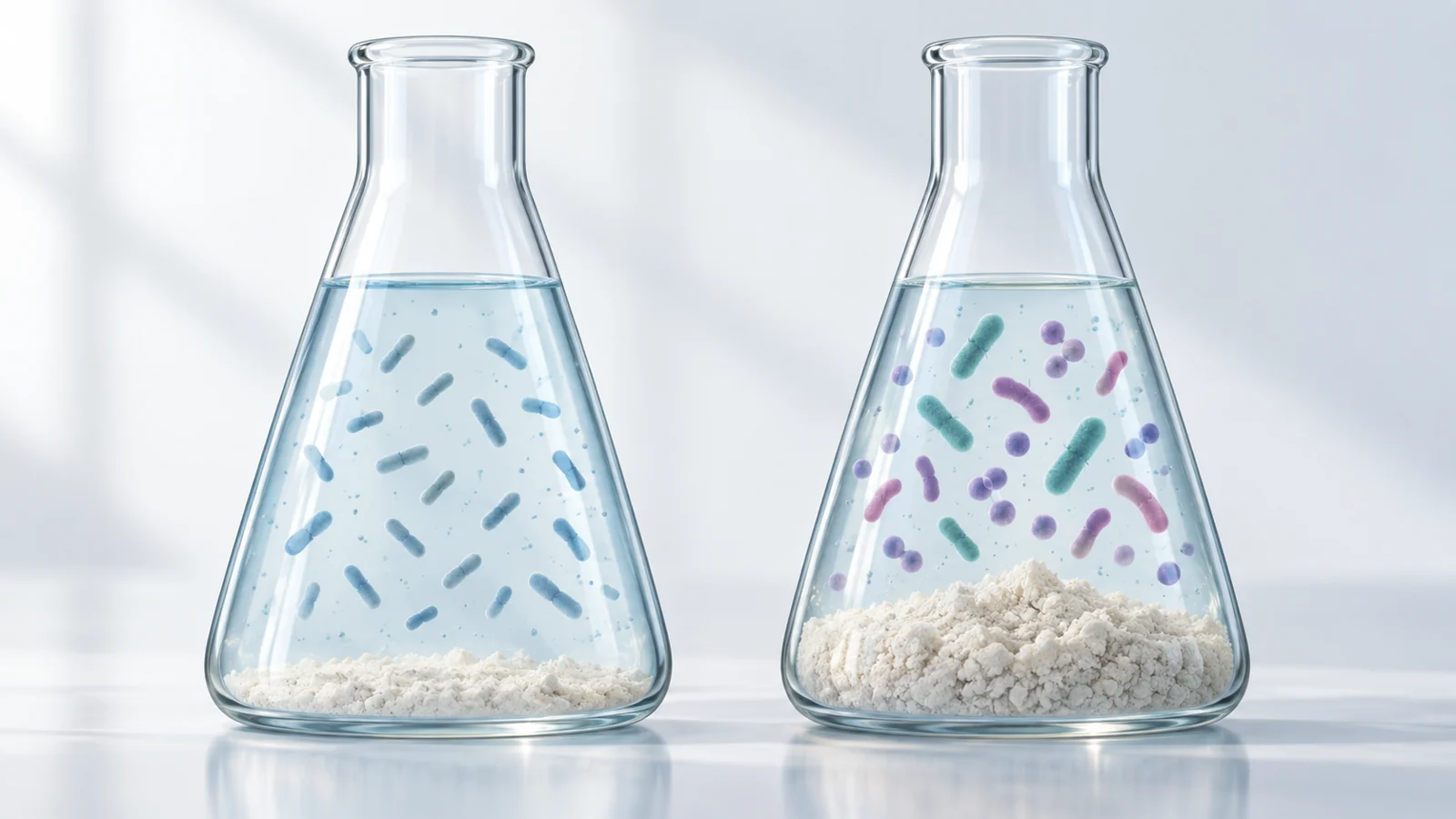
Calcium carbonate is a solid mineral, and bacteria can help form it through a process known as microbial-induced calcium carbonate precipitation. In a 2022 study, researchers tested whether combining strains could produce more of this mineral than a single well-known reference organism.
The three-strain culture contained Priestia megaterium TBRC 1396, Neobacillus drentensis TBRC 8147 and Sporosarcina pasteurii ATCC 11859. The mixture produced 1.4 times as much calcium carbonate by weight as S. pasteurii alone, which the study used as its comparison for efficient mineral precipitation.
That is a result about the amount of solid formed. It is not a measurement of how quickly the mineral appeared. Nor does the higher mass, by itself, show that the organisms cooperated, that the mixture would produce stronger material or that it would seal cracks more effectively.
The mixture changed the amount measured
The finding matters because culture composition may affect how much mineral a biological treatment can generate. A larger deposit could be useful in a construction or ground-treatment process if it forms in the right place and performs the intended job. The supplied abstract reports the mass comparison but does not establish controlled placement, crack sealing or soil binding.
The numerical advantage also needs to stay tied to its exact comparison. The abstract does not provide absolute yields, variability, replication details or enough experimental detail to judge how broadly the 1.4-fold difference would apply. It also does not establish that the three-strain culture kept the same advantage throughout every condition examined for individual strains.
The useful range depended on the strain
The researchers screened several bacteria for calcium carbonate precipitation under alkaline and warm conditions. TBRC 1396, TBRC 8147, TBRC 5949, identified as Bacillus subtilis, and TBRC 8986, identified as Priestia aryabhattai, were reported to generate calcium carbonate at pH 9–12 and temperatures of 30–40°C. TBRC 8147 also showed precipitation at 45°C.
Those details make the result more relevant to construction and consolidation settings than a result observed under only a narrow, mild condition would be. They show that particular strains retained the reported behavior across the listed ranges. They do not show that every strain, or the mixed culture as a whole, performed identically across those conditions.
Urea changes the process question
The organisms also differed in their relationship with urea. Ureolytic bacteria break down urea in a precipitation process associated with ammonia generation. Nonureolytic bacteria can form calcium carbonate without urea, potentially avoiding that part of the process.
The study identified TBRC 8147 and TBRC 8986 as nonureolytic strains capable of precipitation without urea. TBRC 8147 was one member of the three-strain mixture, while TBRC 8986 was part of the separate strain screening. That distinction is important: the reported urea-independent behavior belongs to specified individual strains. The available result does not establish that the mixed culture produced its higher mineral mass without urea or that it reduced ammonia.
What the comparison can support
Taken together, the study supports a narrower conclusion than “more bacteria will make better construction materials.” It shows a mixed culture with a higher reported calcium carbonate mass than its S. pasteurii comparison, and it identifies individual strains that precipitated mineral under alkaline, warm conditions or without urea. The evidence does not yet connect those separate findings to faster production, reliable deposition, improved material strength, crack repair or environmental superiority.
What this could change
If these strain behaviors remain reliable when tested inside real materials, bacterial treatments could eventually deposit enough useful calcium carbonate to help seal cracks in self-healing concrete, meaning concrete designed to seal its own cracks, or to bind soil. Construction users and ground-treatment practitioners could benefit from treatments selected for both mineral output and operation under relevant conditions. Reaching that capability would require the deposits to form where needed and to deliver the intended sealing or binding effect, not merely to weigh more in a culture test.
Key Sources
- Primary source: High level of calcium carbonate precipitation achieved by mixed culture containing ureolytic and nonureolytic bacterial strains.
DOI or Journal Page · Peer-Reviewed Paper · 2022-06-23