
Evidence date · 2021-04-01 · Research note 1 of 2
1 2
See current Track status →
Mineral deposits can act as a kind of glue, binding loose material or sealing gaps. That makes bacteria that encourage mineral formation attractive for stone conservation, soil consolidation and self-healing concrete. Finding a strain that produces a deposit, however, leaves a practical challenge unresolved. A useful treatment needs mineral growth in the right place, at a suitable pace and with properties suited to the material around it.
An April 2021 review, Bacteria-induced mineral precipitation: a mechanistic review, examines the processes behind that challenge. It brings together findings about bacterial surfaces, metabolism and surrounding water. Its contribution is a synthesis of how precipitation happens across different biological and experimental settings; it does not introduce a newly validated mineral treatment.
Here, bacteria-induced mineral precipitation means that bacterial activity indirectly encourages dissolved constituents to become solid minerals. Metabolic by-products change the surrounding chemistry, while cell surfaces interact with dissolved ions. This differs from the internally controlled formation of minerals such as magnetite in specialized compartments of some bacteria. The deposits considered here need not serve a specific bacterial function. They can emerge as an incidental consequence of cells living in a particular environment.
What gets a crystal started
Two requirements help explain the process. The surrounding solution must favor formation of the mineral, and an initial crystal nucleus must form. A nucleus is a tiny starting assembly from which a crystal can grow. Some early assemblies dissolve again before growth becomes established.
The first requirement involves supersaturation. For a particular mineral, the effective concentrations of its constituent ions can reach a state in which forming a solid is thermodynamically favorable. Bacterial metabolism can move the local environment toward that state by changing pH and the availability of ions. For calcium carbonate, the mineral prominent in many proposed building-material applications, the surrounding calcium and carbonate chemistry matters.
The second requirement concerns the barrier to getting crystallization started. Ions may assemble into nuclei in the solution itself, or they may assemble on an existing surface. A suitable surface can lower that barrier. This is one reason a calculation showing favorable saturation conditions cannot tell an engineer exactly when a visible deposit will appear. Organic substances can encourage crystallization or inhibit it even in a highly supersaturated solution.
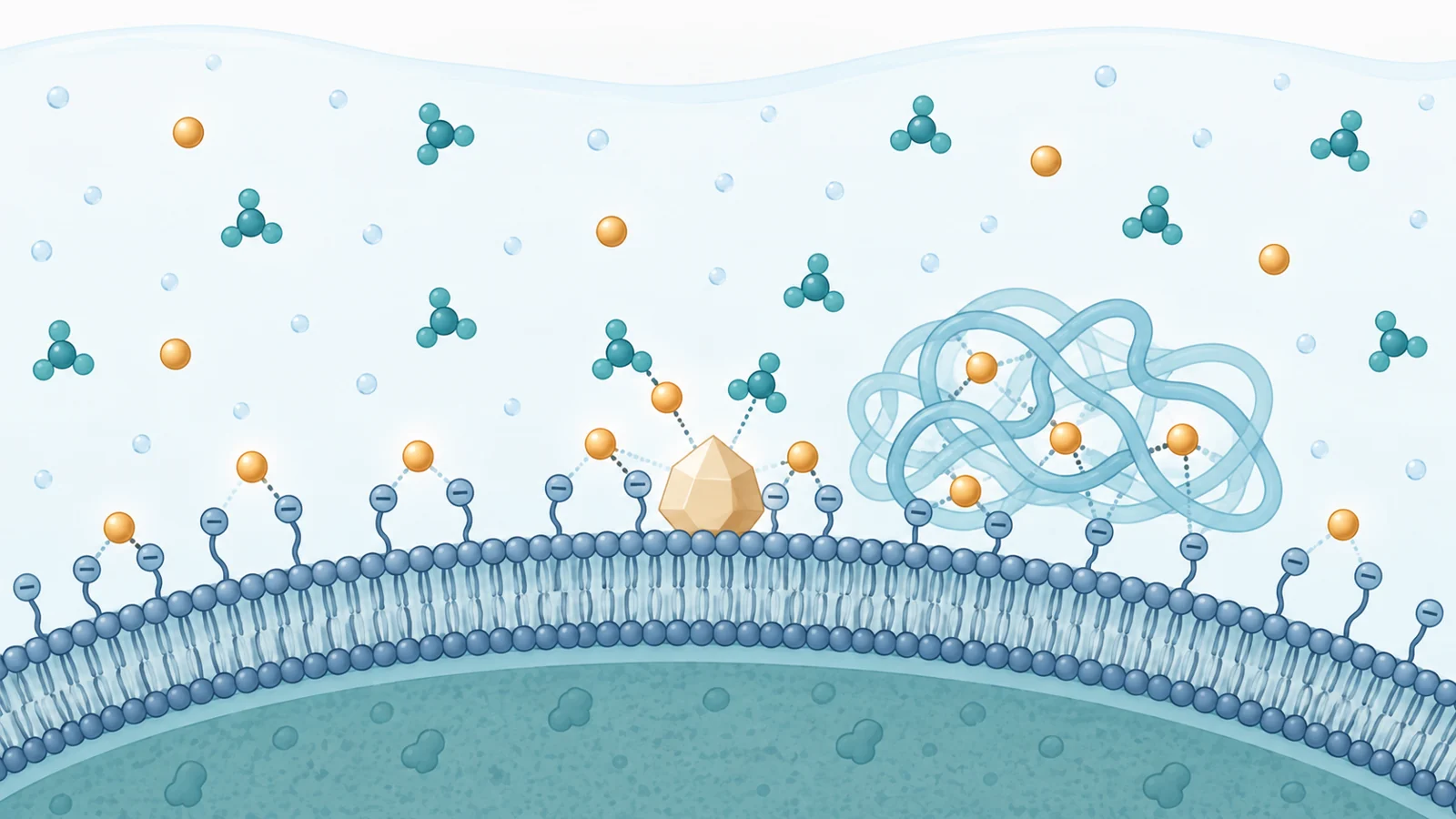
Bacterial surfaces provide abundant opportunities for these interactions. They carry chemical groups, including carboxyl and phosphate groups, that commonly give the surface a net negative charge. These groups attract positively charged ions, called cations, including calcium. A cell can therefore gather ions from dilute surroundings while also offering sites where nuclei may begin to form. The chemical makeup of the surface varies between bacteria, including differences in their cell envelopes and outer layers.
Metabolism and surfaces meet in the thin layer of water immediately around a cell. Ion concentrations there can differ from those in the wider liquid. Surface binding gathers cations, while nearby metabolic activity changes the supply of other mineral-forming constituents. A measurement of the bulk water may consequently miss the local conditions in which a crystal actually starts. Finding a bacterium that precipitates minerals reveals an outcome; directing the process requires understanding this small chemical neighborhood.
Why deposits can form near cells or farther away
The location of an enzyme can help explain where mineral deposits appear. The review describes work on biofilms of Alcanivorax borkumensis, in which carbonate precipitation was restricted to areas with high extracellular carbonic anhydrase concentration and activity. This enzyme speeds the interconversion of carbon dioxide and bicarbonate, affecting local bicarbonate availability. In that system, an enzyme outside the cells was associated with the places where crystals formed.
Other bacteria can produce a different spatial pattern. Ureolysis, the enzyme-driven breakdown of urea, can alter the chemistry strongly enough to generate high supersaturation. The review reports that some strongly ureolytic bacteria induced calcite precipitation at a considerable distance from their colonies. Mineral growth therefore need not trace the outline of a cell or remain immediately beside it.
The authors suggest that sufficiently strong ureolysis may even allow nuclei to form in solution without bacterial surfaces supplying the starting sites. That is a possible exception to the common role of surfaces in these systems. A deposit found far from a colony does not, by itself, establish how its first nucleus formed.
Together, these examples make the spatial question more concrete. A localized extracellular reaction can be associated with localized deposition, while a strong metabolic change can favor precipitation farther away. Those are different routes to arranging mineral growth, with different implications for where material accumulates.
Polymers can delay the start
The material surrounding bacteria adds a timing mechanism of its own. Extracellular polymeric substances, often shortened to EPS, include polymers that contribute to biofilm matrices and other coatings. They can bind ions and alter their movement, sometimes helping create conditions for precipitation. But producing more of this material does not reliably mean producing more mineral.
In cyanobacterial systems described in the review, EPS retained large amounts of divalent cations—ions carrying two positive charges—and inhibited precipitation in the surrounding solution. When the polymers degraded, they released those ions, allowing saturation to rise and minerals to precipitate. The sequence matters: ion capture can postpone deposition, while breakdown of the material that captured the ions can permit it. A polymer-rich environment can thus behave differently at successive stages of its own degradation.
The same ingredients can make different crystals
Calcium carbonate is a chemical composition, not a single crystal structure. Calcite, vaterite and aragonite contain the same chemical constituents arranged differently. These forms are called polymorphs. The proportions of those forms can respond to bacterial surface chemistry, giving the biological interface a role in what is produced as well as where it begins.
The review reports that certain chemical groups and organic components favor vaterite formation. It also describes changes in crystal shape associated with organic matter. In cited experiments involving amino acids and xanthan, calcite shapes shifted from rhombohedral forms toward rounded structures with radiating features, while the smaller crystals making up vaterite spheres changed shape too.
These observations distinguish crystal structure from morphology, the outward shape and arrangement of crystals. Two deposits described simply as calcium carbonate can differ on both counts. For an application, that creates a more specific material question than whether precipitation occurred. The findings do not establish that a particular shape or polymorph mixture provides better strength, durability or crack sealing; those properties require their own evidence.
Do the cells have to be alive
The contribution of active metabolism remains difficult to separate from that of the cell surface. Some studies summarized in the review found no precipitation on dead cells, suggesting that organic surfaces alone were insufficient under those conditions. Others observed minerals forming on dead cells and cellular debris.
The disagreement has several possible explanations. Species differ in their surface structures. The surrounding solution may already favor precipitation to different degrees. Methods used to kill or prepare cells may also alter the very surfaces being tested. The review leaves these possibilities unresolved and calls for systematic work to distinguish them. There is no universal live-cell requirement that can be carried from these findings into every bacterial mineral system.
Mineral growth can also create a problem for the organisms associated with it. Deposits on a cell surface can encase the cell, so continued precipitation and continued population growth need not serve the same end. The review describes ways bacteria can avoid entombment, including shedding mineral-encrusted outer layers and producing small particles that act as alternative precipitation targets. It also discusses mineral sheaths and capsules. Such observations show why the location of a deposit matters biologically, beyond its usefulness as a material.
Natural communities introduce another unresolved layer. Bacteria often grow together in biofilms, and the metabolic products of one group can influence another. Results from an isolated strain therefore do not establish reproducible control of deposition in the mixed communities and variable surroundings relevant to practical treatments.
What this could change
If these mechanisms can be translated into reproducible deposition under application conditions, bacterial mineral treatments could become better suited to particular sealing and binding tasks. Surface binding could help favor a desired mineral, while metabolic capabilities could influence how quickly it precipitates. The resulting deposits, together with embedded cells and organic material, could bind porous stone or soil and fill gaps in cement-based materials.
The practical benefit would come from matching mineral formation to the job. A treatment for a porous stone surface could be developed around the deposit needed to bind that material; a crack-sealing treatment could be developed around mineral accumulation in the gap. The authors also envisage using mechanistic knowledge to guide strain development through directed evolution or genetic engineering. From the April 2021 perspective, the prospective capability is to tailor the mineral produced and the pace of its formation—provided those choices can deliver reliable sealing or binding in the environment where the treatment must work.
Key Sources
- Primary source: Bacteria-induced mineral precipitation: a mechanistic review.
DOI or Journal Page · Review or Meta-Analysis · 2021-04-01