
Research Signal – Source date 2026-04-24
Mitochondria help cells produce energy, manage chemical signals and respond to changing demands. With age, their DNA can accumulate changes, their interconnected structure can become less effective, and cells may grow less able to remove damaged mitochondria. These processes can compound one another, but a change in a single measure—such as energy production or a marker of oxidative stress—does not necessarily mean a cell has recovered its ability to adapt.
A review published April 24, 2026, brings these maintenance processes together to explain why mitochondrial decline differs across tissues and why treatments that look promising in some settings may yield modest or inconsistent results in people. It synthesizes existing mechanistic, animal and human research; it does not test a treatment or show that one improves health or extends life in older adults.
DNA changes matter when a cell can no longer compensate
Mitochondria carry their own DNA, or mtDNA. Changes can include point mutations, insertions or deletions, and larger deletions or rearrangements. A cell may contain a mixture of altered and unaltered mtDNA, a state called heteroplasmy. The proportion of altered copies can matter, but mutation burden alone does not tell us whether a tissue is impaired.
Cells can compensate for some mitochondrial damage. The review describes evidence that mutations may become functionally apparent when demand for energy rises beyond the mitochondria’s capacity to compensate, including by replicating mtDNA. A mutation observed in a sample is therefore not, by itself, proof that energy production or tissue function has declined. The effect depends in part on how much damage is present, what the tissue needs to do and how much reserve remains.
Turnover also shapes the picture. Neurons and muscle and heart cells divide infrequently and can retain mitochondrial changes over long periods. In these long-lived cells, altered mtDNA may gradually become more common within a cell population. In tissues whose cells divide and renew more often, turnover can dilute some harmful changes, though the resulting patterns vary. The same type of DNA change can thus have different consequences in different tissues.
A mitochondrial network needs both joining and division
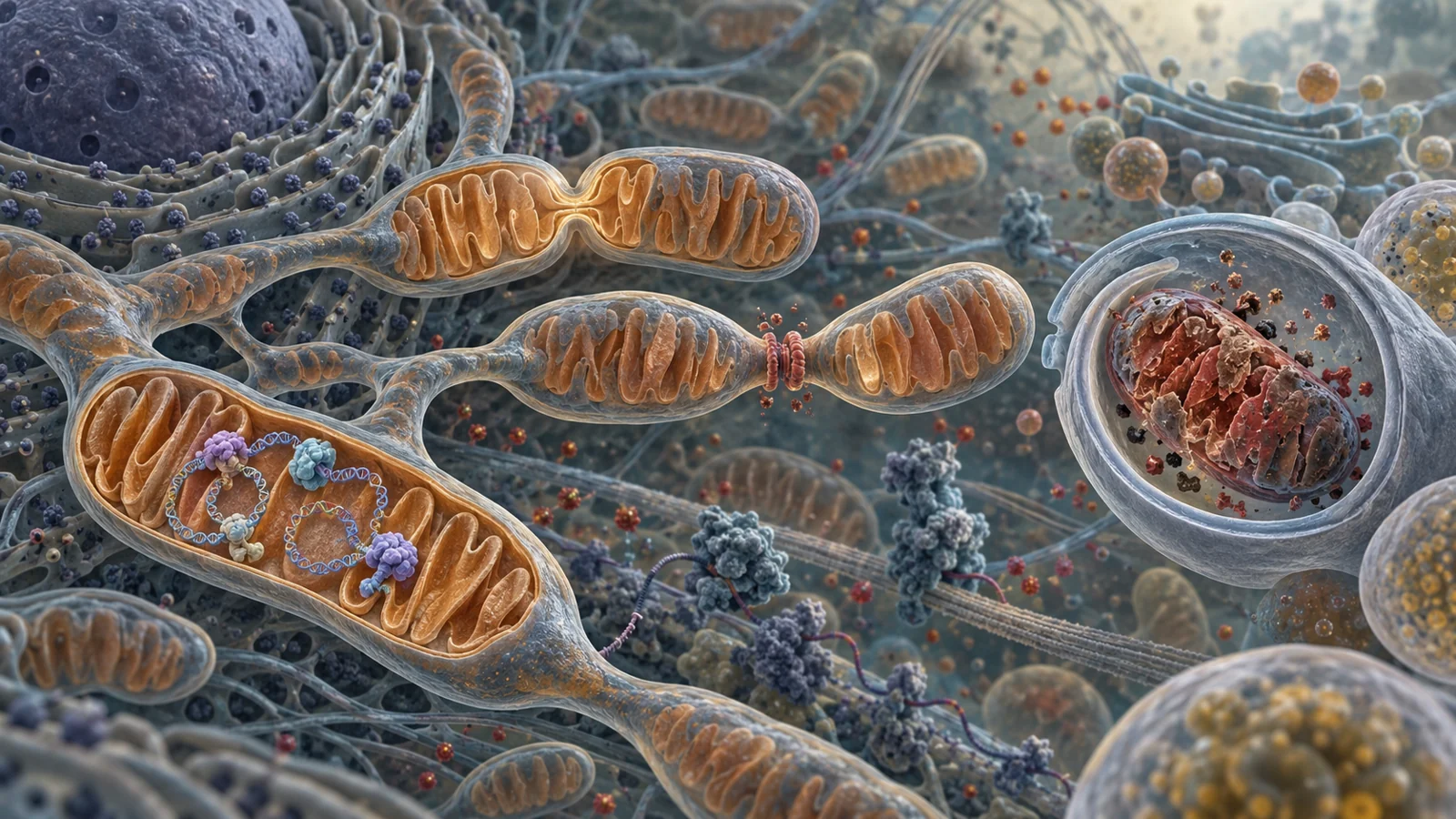
Mitochondria are not static energy packets. They continually fuse, exchange contents and divide. Proteins including MFN1 and MFN2 help join outer membranes, while OPA1 supports fusion of inner membranes. Drp1 helps constrict and divide mitochondria. These activities allow the network to adjust its shape as conditions change and help maintain its function.
The inner membrane forms folds called cristae, which are central to energy-producing activity. The review links age-related imbalances in fission, fusion and cristae remodeling with fragmentation, damaged internal structure and less efficient respiration. Changes to the proteins that govern mitochondrial architecture can therefore affect more than appearance: a disrupted network may be less able to produce energy efficiently or renew its components.
Neither joining nor dividing is beneficial in isolation. Cells use both processes, and each contributes to normal function and quality control. A treatment that pushes one side of this balance for too long could interfere with the other work the network needs to do.
Removing damaged mitochondria is a separate job
Reshaping a network does not do the same thing as removing a damaged organelle. Mitophagy is a form of selective cellular cleanup: the cell identifies mitochondria for removal and routes them into a degradation process. The PINK1–Parkin pathway is one route; receptor-mediated routes include BNIP3, NIX and FUNDC1.
The review describes mitophagy as less efficient with age across many tissues. If removal falters, dysfunctional mitochondria can accumulate, while the cell may become less able to switch between metabolic demands. The authors also discuss mitochondrial-derived vesicles as a possible compensatory route when bulk mitophagy is limited. Such alternatives add to the picture of cellular cleanup, but they do not mean that every damaged mitochondrion is removed or that one route can simply replace another.
Cells must maintain a balance: clear components that are no longer working well while retaining enough mitochondrial capacity to meet energy needs. Increasing turnover indiscriminately could disrupt that balance just as inadequate clearance can.
Mitochondrial stress also carries information
Mitochondria influence cell signaling as well as metabolism. Reactive oxygen species (ROS) can rise during stress and contribute to damage, but they also take part in normal redox signaling, which helps cells respond and adapt. Treating all ROS as waste to eliminate misses this role. The review describes how mitochondrial damage can also activate immune pathways when mitochondrial DNA and other damage-associated signals enter the cytoplasm or extracellular space, contributing to chronic inflammation associated with aging.
NAD+ links several of these functions. It supports redox balance, mitochondrial metabolism and signaling pathways involving sirtuins, AMPK and PGC-1α; the review also discusses altered mTOR signaling with age. Lower NAD+ levels are associated with mitochondrial decline, but this relationship does not establish that increasing NAD+ will restore function in every person or tissue. Human responses to precursors such as NMN and NR have been mixed and context-dependent, despite beneficial effects reported in some muscle research.
The practical challenge is that a signal can be harmful in excess and still serve a useful role. Strongly suppressing ROS, or persistently driving turnover or mitochondrial production, could alter processes cells rely on for adaptation and immune signaling.
Why promising treatments may not translate uniformly
The review surveys several approaches under study, including mitochondria-targeted antioxidants such as MitoQ, compounds intended to activate mitophagy such as urolithin A, NAD+ precursors, senolytics and gene-based strategies. These approaches act on different processes; the review does not establish them as interchangeable or show that they produce the same effects.
Some interventions have produced strong effects in preclinical models, while human results have been inconsistent or modest. The review points to differences in baseline metabolism, inflammation, mitochondrial genetic variation and compensatory capacity as possible reasons people respond differently. A compound’s uptake can also vary by tissue and mitochondrial membrane potential, so reaching a target in one setting does not ensure the same exposure or effect elsewhere.
That variation matters when interpreting a result. Improving a laboratory measure or a pathway in a model does not by itself show that an older person’s tissue has regained useful capacity, or that a change will improve health in daily life. The review does not identify a mutation threshold, biomarker or treatment strategy that applies across tissues and patients.
When intervention can disrupt what cells still need
Mitochondrial processes are part of normal cell function, so changing them too much or for too long can carry costs. Excessive antioxidant activity may interfere with redox signals and immune responses. Sustained stimulation of mitophagy or mitochondrial biogenesis could disturb cellular structures involved in energy production. Persistently shifting fission or fusion can also be damaging because cells need both.
These concerns may be especially important for older adults with chronic conditions. The review notes that age-related changes in physiological reserve, inflammation and medication handling may affect both treatment response and adverse effects. It also raises questions about NAD+ enhancement in people with cancer, chronic inflammation or increased DNA damage, and about possible off-target effects from senolytics. These are safety considerations discussed in the review, not proof that a particular intervention harms every person who receives it.
A central obstacle is matching an intervention to the right tissue, person and biological state, then knowing whether it has changed the intended process without disrupting others. The review identifies reliable biomarkers, targeted delivery and long-term safety assessment as unresolved needs. It does not establish durable clinical benefit from a coordinated mitochondrial treatment.
What targeted mitochondrial care could change for older adults
If researchers can identify when a tissue has lost the capacity to compensate, clear damaged mitochondria safely and preserve the signaling and energy functions that remain useful, future treatments might better address age-related tissue decline. That could eventually make mitochondrial medicine more relevant to people’s health, rather than only changing a laboratory measure. The route to that benefit remains conditional: interventions need to work in appropriately selected people, reach the tissues that need them and prove safe over time.
Key Sources
- Primary source: Mitochondria at the heart of aging: structure, function, and failure.
DOI or Journal Page · Review or Meta-Analysis · 2026-04-24
Keep exploring