
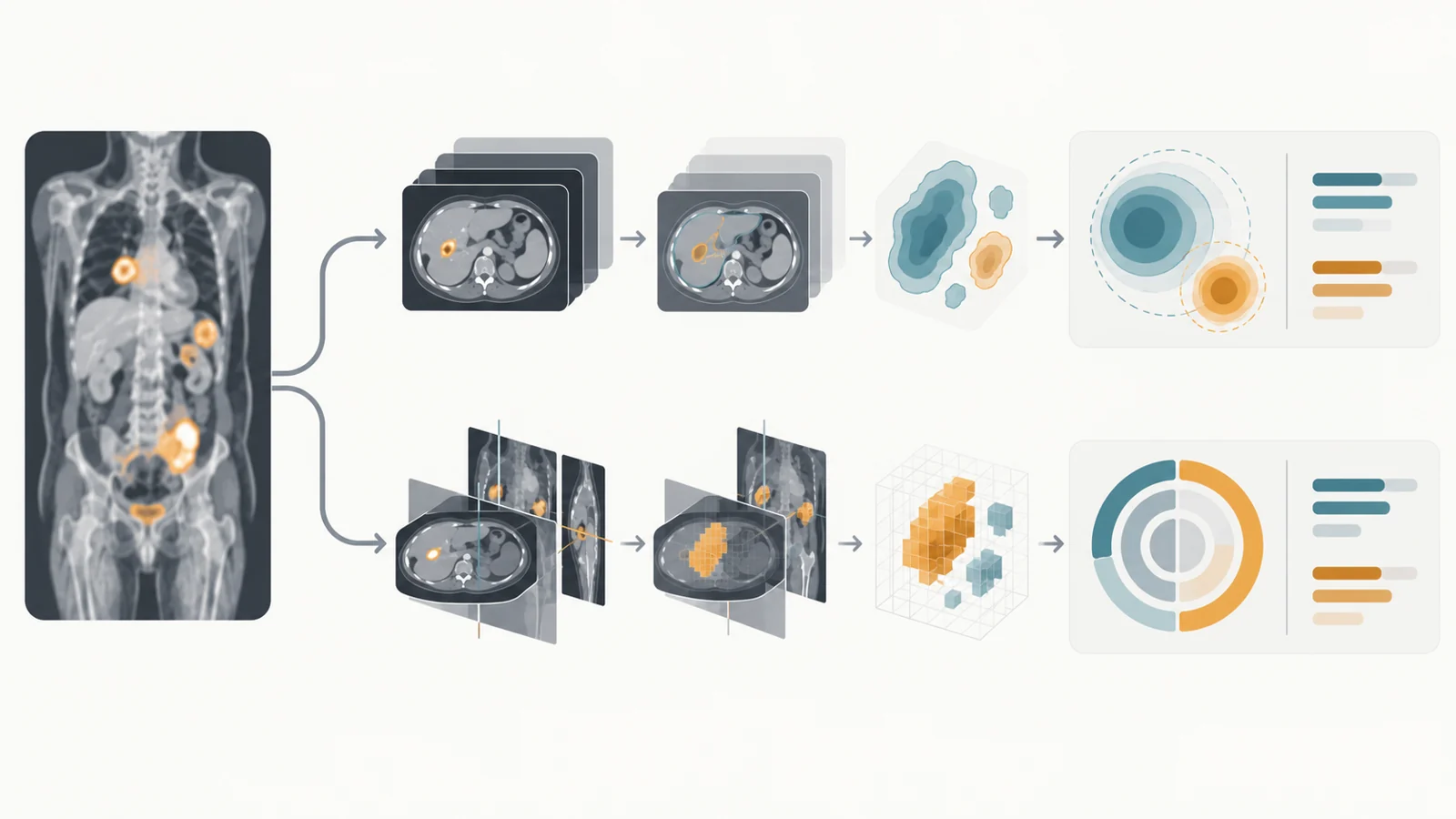
Research Signal – Source date 2021-02-01
A systematic review and meta-analysis of 24 eligible articles reported different pooled estimates for PET/CT criteria used to assess immunotherapy response in metastatic melanoma. On early scans, modified criteria had pooled sensitivity of 94%, compared with 64% for conventional criteria; pooled specificity was 84% versus 80%.
PET/CT combines images with information from a radioactive tracer, 18F-FDG, that shows where the tracer is taken up. Response criteria are the rules used to classify what those images indicate about a tumor’s response to treatment. The pooled percentages describe how often the criteria identified response or nonresponse across the studies; they are not the chance that a particular patient will benefit from immunotherapy.
A response estimate depends on what the test is asked to detect
Sensitivity is the share of cases with a response that a method correctly identifies. Specificity is the share of cases without a response that it correctly identifies. A more sensitive method may recognize more responding cases, while specificity helps show how often it correctly avoids labeling nonresponses as responses.
For early scans, the modified criteria’s pooled sensitivity was 30 percentage points higher. Specificity was also somewhat higher in the pooled estimates. These are results assembled across studies, not proof that both sets of criteria were applied head to head to the same patients under the same conditions. The review’s summary therefore supports a difference in reported estimates, while leaving the size and reliability of any direct advantage unresolved. The abstract does not define the modified rules in enough detail to explain exactly how they differ from conventional ones.
The distinction matters when reading a percentage such as 94%. It does not mean that 94% of people with metastatic melanoma will respond, or that a person whose scan meets a criterion will necessarily benefit. It describes the criteria’s pooled ability to identify response in the evidence analyzed.
Early and late scans were assessed separately
The review also reported estimates for later PET/CT scans. In that group of assessments, pooled sensitivity was 92% with modified criteria and 67% with conventional criteria. Specificity was 76% and 77%, respectively.
These early- and late-scan figures are separate pooled assessments. They do not show how the same patients’ results changed over time, and the supplied summary does not establish a common scan schedule across the included articles. The estimates point to a recurring difference in sensitivity between the criteria, but they should not be read as a direct measurement of what happens when one patient is scanned early and again later.
Baseline scans were linked to survival in different ways
The review considered another question as well: whether measurements from a scan taken before immunotherapy were associated with overall survival. These baseline associations are distinct from the criteria used to classify response on scans during treatment.
For baseline metabolic tumor volume (MTV), the volume of metabolically active tumor seen on a scan, the pooled hazard ratio for overall survival was 1.777 (95% confidence interval 1.389 to 2.275). A hazard ratio compares the rate of an event over time; 1 marks no difference in the comparison, and the confidence interval shows uncertainty around the estimate. The abstract does not give enough detail to translate this result into an individual prognosis. For SUV/SULmax, a measure of the highest reported tracer uptake, the pooled hazard ratio was 0.941 (95% confidence interval 0.599 to 1.477). Because that interval crosses 1, the pooled result does not establish a clear survival association for this measure.
The review also reported differing survival associations for other baseline scan measures. Together, these results make some baseline PET measurements promising areas for further study. They do not provide an individual patient’s response prediction or show that using a measurement to guide treatment improves survival. The summary does not supply a patient-level threshold that could turn these pooled associations into a personal forecast.
A separate clue came from immune-related side effects
The review found that immune-related adverse events visible on PET were associated with treatment response. This is a separate observation from the comparison of response criteria: it concerns a relationship between scan-detectable adverse events and response, rather than how accurately a set of reading rules classifies a scan.
The summary does not establish that these events cause a response, nor does it show how this association should change a treatment decision. It is a potential correlate in the reviewed evidence, not a stand-alone measure of benefit for an individual.
What clearer scan readings could mean for melanoma care
If modified response readings prove dependable in comparable patients and help clinicians make sound decisions, they could provide earlier, better-informed assessments of immunotherapy response and help shape follow-up. That practical benefit depends on the pooled difference holding up in direct comparisons and on the readings being useful in clinical decisions. Whether scan-guided care improves patient outcomes remains an open question in the evidence summarized here.
Key Sources
- Primary source: The value of 18 F-FDG PET/CT for predicting or monitoring immunotherapy response in patients with metastatic melanoma: a systematic review and meta-analysis.
DOI or Journal Page · Review or Meta-Analysis · 2021-02-01
Keep exploring