
Research Signal – Source date 2026-04-15
A liver can show less fat, inflammation, or injury in an experiment without having regained the resilience of a younger liver. That distinction matters when considering marine compounds such as fucoxanthin, astaxanthin, and fucoidan: promising changes in disease models raise questions about protection, but do not by themselves answer whether aging has been reversed.
A review published on 15 April 2026 brings earlier research on these compounds into an aging-focused account. It connects work on oxidative stress, mitochondria, inflammation, and energy-linked gene regulation with studies of liver dysfunction in animals and selected human studies of metabolic outcomes. The result is a useful way to frame research possibilities. It is not a clinical demonstration that a marine compound rejuvenates the liver.
Aging links energy stress to inflammation and scarring
The liver uses substantial energy and contains many mitochondria, the structures that help cells produce it. In the review’s account, aging can impair mitochondrial performance and the removal of damaged mitochondria. Less efficient energy handling can increase reactive oxygen species, or ROS: chemically reactive molecules produced as cells use oxygen. When antioxidant defenses no longer keep pace, oxidative stress can damage cellular components and disrupt normal function.
The review describes this as a reinforcing relationship rather than a single injury. Persistent oxidative stress can contribute to cellular senescence, a state in which cells stop dividing but remain active. Senescent liver cells can release a mixture of inflammatory signals and tissue-remodeling molecules known as the senescence-associated secretory phenotype, or SASP. Those signals can affect neighboring cells, sustain low-grade inflammation, and activate hepatic stellate cells. Activated stellate cells produce collagen, which can accumulate as fibrosis.
This sequence helps explain why “less oxidative stress” and “a younger liver” are not equivalent outcomes. A compound might alter one part of the chain in a particular model. The wider aging-related changes involve communication among liver cells, tissue structure, energy use, and the capacity to respond to stress.
The review also emphasizes a different connection: energy sensing and gene regulation. It describes a network involving NAD+, SIRT1, AMPK, and PGC-1α. These regulators help link a cell’s energy state with gene activity, mitochondrial maintenance, and metabolic adaptation. With age, declining NAD+ availability can weaken this coordination. The review discusses increased activity of enzymes that consume NAD+, including CD38 and PARP1, as one contributor to the reduced support for SIRT1.
These pathways matter to the aging argument because they connect fuel use with the programs that help cells maintain function. Observing a change in one regulator, however, is a mechanistic finding. It does not show that a liver has recovered a younger pattern of function, identity, or regeneration.
Different compounds meet different parts of the problem
The compounds in the review are not interchangeable antioxidants. Their structures, biological interactions, and exposure in the body differ, so a result for one cannot simply be transferred to another.
Fucoxanthin, a carotenoid associated with brown algae, is described in relation to both redox defenses and energy sensing. The review says it can promote NRF2 activity, which supports the expression of protective genes, including heme oxygenase-1, superoxide dismutase, and NQO1. It also describes fucoxanthin as an activator of AMPK in metabolically stressed or aged cells. In the reviewed account, AMPK activity is linked with less new fat production, more fatty-acid oxidation, and support for NAD+ and SIRT1-related regulation. These are pathway interactions that may connect metabolic effects to aging biology; they are not evidence that the full aging process has been reset.
Astaxanthin, another marine carotenoid, is discussed more in relation to mitochondrial membranes and oxidative damage. The review describes evidence that it can limit lipid peroxidation, help preserve mitochondrial membrane potential, and influence pathways involved in mitochondrial quality control. It also discusses NRF2 and HO-1 activity, glutathione-related redox buffering, and vulnerability to ferroptosis, a form of regulated cell death linked in the review to liver aging and chronic liver disease. These mechanisms offer reasons to investigate astaxanthin in liver models, while leaving open whether they produce lasting improvements in aging liver function.
Fucoidan is a sulfated polysaccharide found in brown seaweeds. Its branching, sugar composition, molecular weight, and sulfation pattern can vary, and the review notes that these structural features affect its biological interactions. Its large size and negative charge limit how much is absorbed after oral intake. The absorbed portion has been reported to accumulate in organs including the liver, with localization in non-parenchymal cells such as Kupffer cells, which are liver-resident immune cells. This exposure pattern differs from the carotenoids’ and makes fucoidan’s effects difficult to treat as a general version of theirs.
The review also describes fucoidan-related metabolic findings involving SIRT1 and PPARα in a non-mammalian liver model. In that work, reducing SIRT1 removed fucoidan’s lipid-lowering effect, while changes in PPARα- and PPARγ-associated signaling accompanied a shift toward lipid oxidation. The model and endpoints matter: a pathway dependency in one experimental system is informative, but it does not establish the same mechanism or outcome in aging human liver.
Animal results show protection in models of disease
The most concrete liver outcomes summarized in the review come from experimental models of metabolic or toxic liver dysfunction. In diabetic and high-fat-diet mouse models, fucoxanthin was associated with lower liver triglycerides, more normal liver weight, and improved serum transaminase levels. The review also describes better glucose tolerance, lipid profiles, and insulin sensitivity in these models.
Astaxanthin reduced fat accumulation and oxidative stress in genetic and diet-induced fatty-liver models, with lower inflammatory infiltration and improvements in tissue features such as lobular inflammation and hepatocellular ballooning. In a chemical-injury model using carbon tetrachloride, it was associated with less collagen deposition and fibrotic progression. Fucoidan likewise reduced liver injury and collagen accumulation in toxin-induced models, and lowered fat accumulation and inflammatory signals in metabolic models. Dieckol, a marine polyphenol, was also associated with reduced liver injury and inflammatory changes in several animal experiments described by the review.
These findings are relevant to conditions in which aging-related vulnerability and liver disease can overlap. They show that compounds can affect measurable disease features under experimental conditions. They do not isolate aging as the cause of those features or demonstrate that a liver’s biological age has changed. Less fat or collagen in an animal model is not the same endpoint as restored regenerative capacity, durable function in older organisms, or reversal of the cellular changes associated with aging.
That gap is central to interpreting the review. An intervention may reduce injury while leaving other age-related processes intact. A direct test of rejuvenation would need to show more than improvement in one disease measure; it would need evidence that meaningful liver function or resilience is restored in an aging context.
Human studies measured metabolic outcomes
The review recounts early human studies of astaxanthin and fucoxanthin in people with metabolic risk conditions. One placebo-controlled study of astaxanthin supplementation over 24 weeks reported lower total cholesterol and LDL cholesterol, reductions in several circulating cardiovascular-risk markers, and a favorable trend in fasting insulin action among people with prediabetes and dyslipidemia. A 12-week placebo-controlled study of fucoxanthin in people with metabolic syndrome reported changes in body weight, waist circumference, blood pressure, triglycerides, and insulin secretion.
Those are human findings, but they are metabolic and cardiovascular-related outcomes. They do not demonstrate that the participants’ livers became biologically younger, that liver aging was reversed, or that regenerative capacity improved. The review describes clinical application as exploratory and notes that late-phase clinical trials have not been conducted. The human studies therefore add early context about measured outcomes, not confirmation of liver rejuvenation.
Getting from an oral dose to a reliable liver effect
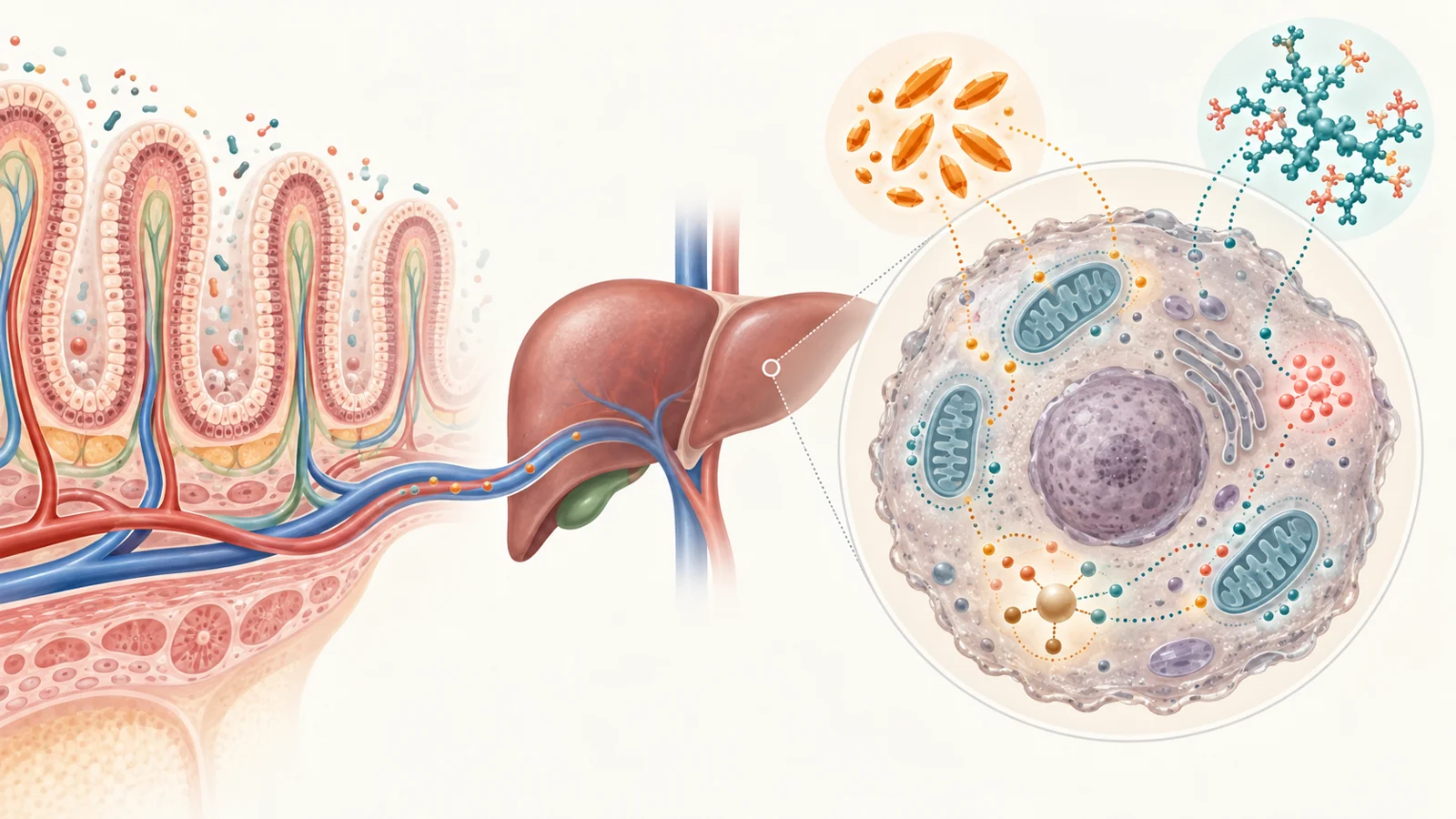
The gut-to-liver route offers a plausible reason to study orally administered compounds: substances absorbed from the intestine can reach the liver through portal circulation before entering the wider bloodstream. The review describes this as a potential advantage for hepatic exposure. It also notes that absorption and distribution vary by compound. Fucoxanthin can be converted to fucoxanthinol, while astaxanthin’s poor water solubility, limited gastrointestinal absorption, and first-pass handling can constrain systemic availability. Fucoidan’s size and charge create a different absorption challenge, even though some absorbed material has been found in liver-associated cell populations.
A plausible route is not the same as predictable delivery. Formulation approaches such as lipid carriers, self-emulsifying systems, and micellar encapsulation are being explored to improve absorption, stability, and dose consistency. The review identifies these as development challenges alongside the need for better characterization, purification, and scalable production. For any future liver-directed use, reliable exposure and consistent compound composition would be part of showing that an experimental effect can be reproduced in people.
Rejuvenation remains a research proposal
The review connects marine compounds with experimental partial cellular reprogramming, an approach that aims to alter age-associated cellular programs while retaining cell identity. It raises the possibility that compounds affecting metabolism and epigenetic regulation could be investigated as adjuncts to such strategies. The proposed connection is theoretical. The review does not present a demonstrated combined treatment or evidence that marine compounds make reprogramming safe or effective in the liver.
That proposal reflects a broader idea in the review: liver aging may involve a gradual loss of cellular identity and adaptive capacity, not only accumulated damage. Marine compounds could offer varied molecular tools for probing those processes. Establishing whether they can contribute to rejuvenation would require evidence that moves from pathway changes and disease models to sustained, age-relevant liver function, with dependable exposure and safety in people.
What marine compounds could mean for liver care as we age
If future research shows that a well-characterized marine compound can safely restore useful functions in an aging liver, the practical benefit could be a new way to reduce age-related vulnerability to metabolic disease and fibrosis. Reaching that possibility depends on more than seeing less injury in animals: the effect would need to hold in relevant aging models, translate into meaningful human liver outcomes, and be delivered consistently. For now, these compounds are candidates for investigation, while direct evidence of a younger or more resilient human liver remains to be established.
Key Sources
- Primary source: Marine Bioactives in Liver Aging: Mechanistic Insights and Translational Potential.
DOI or Journal Page · Review or Meta-Analysis · 2026-04-15
Keep exploring