
Evidence date · 2025-03-01 · Research note 2 of 3
1 2 3
See current Track status →
Since the previous research note · Partly supported
Track continuity
Since the previous research note: When kidney cancer spreads, does immunotherapy change the case for surgery?
Previous expectation: Better comparisons might show which patients gain from kidney removal alongside immunotherapy after accounting for patient selection and surgical tradeoffs.
What this study adds: This meta-analysis found a survival association across eight studies and used landmark analyses to address immortal time bias. Baseline differences between the groups leave patient selection unresolved.
What changed in this study
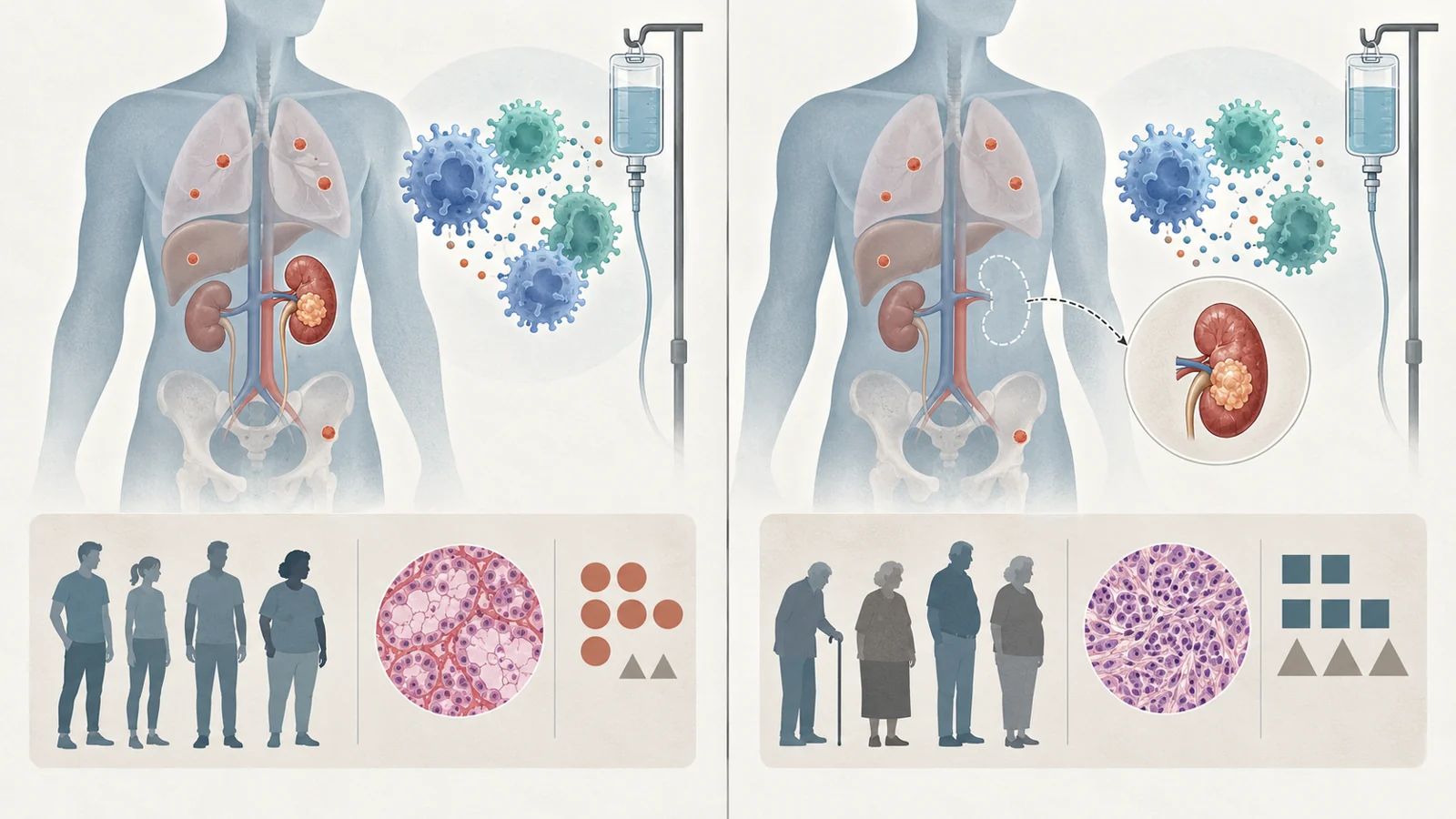
In metastatic renal cell carcinoma, cancer has spread beyond the kidney where it began. Removing that kidney is called cytoreductive nephrectomy. Immune checkpoint inhibitors are medicines that help the immune system fight cancer. The question here is whether adding kidney removal to this immune-based treatment is associated with different survival than treatment alone.
A systematic review and meta-analysis brought together eight comparative studies, covering 2,319 people. Its main result points to a lower observed hazard of death in the group that received both surgery and immune checkpoint treatment. The size of that difference is notable, but it is a relative comparison between groups, not a count of extra years lived.
A kidney can still be part of the decision after spread
Once cancer has spread, treatment is no longer focused only on the kidney. Even so, the kidney containing the primary cancer may be removed while a person receives immune checkpoint treatment. The comparison asks whether that combination is associated with better overall survival than immune checkpoint treatment alone.
This is a consequential question because it adds an operation to cancer treatment. The pooled analysis offers a way to examine the survival patterns reported across several studies, rather than relying on a result from one group of patients. It does not, by itself, answer whether surgery should be part of care for a particular person.
The pooled comparison favored the combined group
For the primary analysis, the hazard ratio was 0.45, with a 95% confidence interval of 0.37 to 0.54. A hazard ratio compares the rate at which an event occurs between groups over follow-up. Here, the estimate means the combined surgery-and-treatment group had an estimated death hazard about 55% lower than the group receiving immune checkpoint treatment alone.
That figure is not a measure of how many additional months or years someone lived. It also is not the same as saying 55% fewer people died, or that each person’s chance of survival improved by 55%. It describes a relative difference in the observed death hazard between the groups during the period studied.
The researchers reported a statistically significant association, but the comparison cannot establish that removing the kidney caused longer survival. Patients in the two groups did not have identical starting characteristics, which matters when interpreting a difference in outcomes.
Landmarks addressed a timing problem
The researchers searched EMBASE, MEDLINE, and Web of Science up to August 26, 2023 for studies comparing overall survival in the two treatment groups. They reconstructed individual patient survival information from published Kaplan–Meier curves, which show estimated survival over time. This allowed them to analyze reconstructed patient-level data across the studies rather than only compare a single summary number from each one.
They used six- and twelve-month landmark analyses to address immortal-time bias. The timing issue is straightforward: someone who receives surgery later must remain alive until the operation. If that waiting period is counted as time in the surgery group, it can make that group appear to have an advantage built into the comparison. Landmark analyses use specified points in follow-up to account for this problem.
The six- and twelve-month analyses therefore addressed a particular source of bias created by treatment timing. They do not change what the studies observed; they provide a way to examine the survival comparison while accounting for time that could otherwise favor the surgery group.
The association also appeared in two treatment settings
The researchers separately examined patients receiving immune checkpoint treatment as first-line therapy and patients in an upfront-nephrectomy subgroup. In the first-line analysis, the hazard ratio was 0.39, with a 95% confidence interval of 0.30 to 0.48. In the upfront-surgery analysis, it was 0.52, with a 95% confidence interval of 0.40 to 0.69.
These subgroup analyses ask whether the overall pattern also appears in two narrower treatment contexts: use of an immune checkpoint inhibitor in the first line, and surgery classified as upfront. They are not a direct comparison ranking one treatment sequence above another. Both showed an association between combined treatment and lower death hazard within the group examined.
The groups differed before survival was compared
The review found significant differences between the treatment groups in age, the proportion with clear-cell histology, and International mRCC Database Consortium prognostic scores. Histology describes the cancer’s cell type; prognostic scores summarize factors related to expected outlook. The reported differences mean that the groups were not the same at the outset.
Those starting differences leave open how much of the observed survival gap reflects surgery and how much reflects which patients received each approach. The landmark analyses address a timing problem, while baseline differences raise a separate patient-selection question. The subgroup results also do not identify which individual patients would benefit from an operation.
For readers, the result is best understood as a broad survival association across eight studies, strengthened by analyses that addressed immortal time bias, but still limited by differences between the groups being compared. The review does not supply an absolute survival gain or a way to tell from these results alone whether the operation’s tradeoffs would be worthwhile for a particular patient.
How kidney surgery could become a more precise treatment choice
If further comparative evidence confirms a survival benefit for a clearly defined group and resolves the role of patient selection and treatment tradeoffs, care teams could better identify who might gain enough from adding kidney removal to immune checkpoint treatment to justify the operation. That could make the decision more tailored to the people most likely to benefit, rather than relying on an average association across unlike groups.
Key Sources
- Primary source: Cytoreductive Nephrectomy in Metastatic Renal Cell Carcinoma Treated with Immune Checkpoint Inhibitors: A Systematic Review and Meta-analysis of Individual Patient Data.
DOI or Journal Page · Review or Meta-Analysis · 2025-03-01