
Evidence date · 2026-03-11 · Research note 3 of 3
1 2 3
See current Track status →
Since the previous research note · Earlier expectation not tested
Track continuity
Since the previous research note: What does an eight-study comparison say about kidney removal with immune-based treatment?
Previous expectation: Comparative evidence might show which patients gain enough survival benefit from kidney removal alongside immune-based treatment to justify surgery.
What this study adds: The March 2026 paper reports one patient's response to axitinib plus toripalimab followed by delayed kidney removal, including imaging, pathology and treatment complications. It adds a clinical feasibility example but no comparison of survival or patient-selection strategies.
What changed in this study
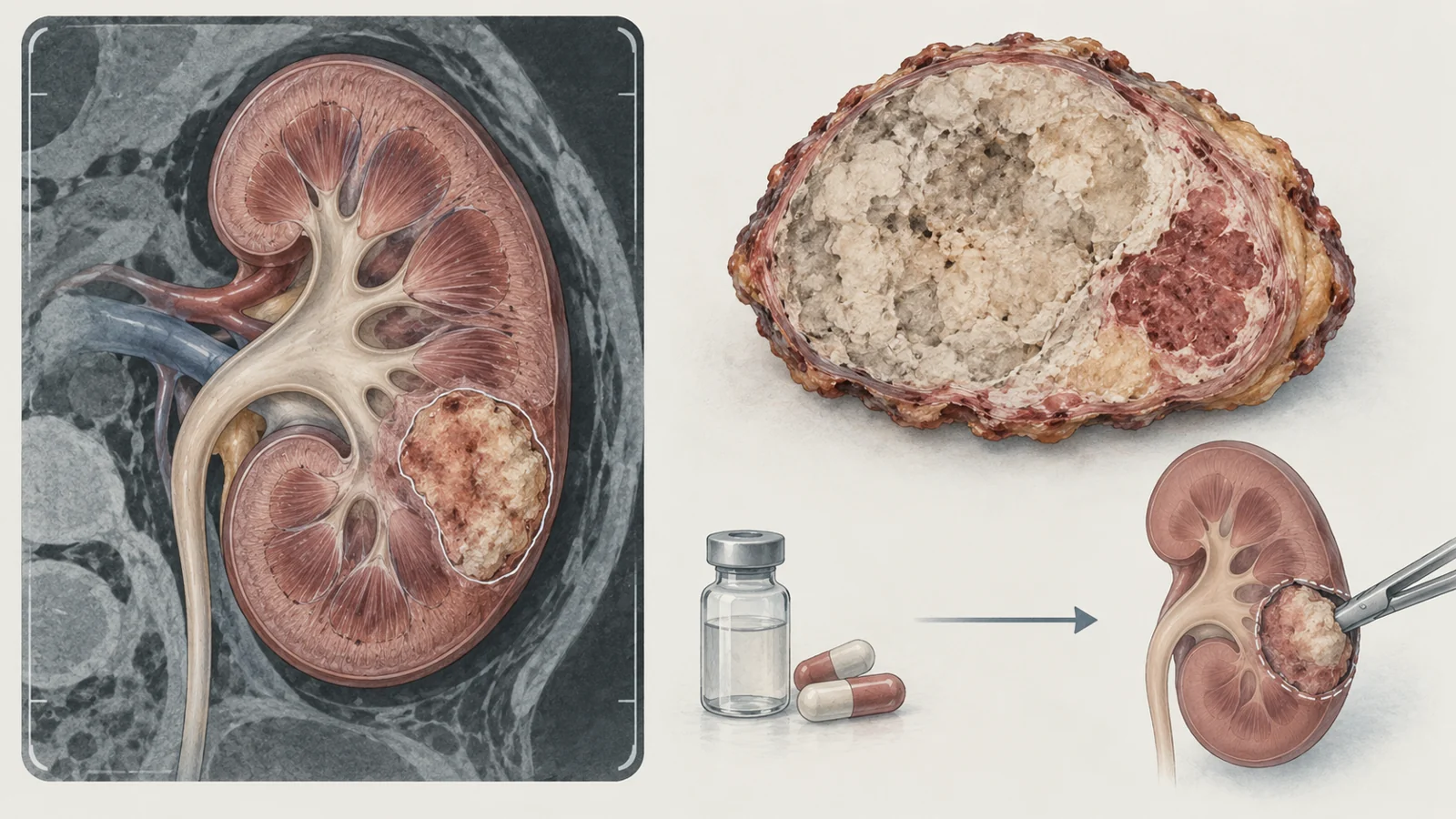
A 50-year-old man with clear-cell kidney cancer and lung metastases received three cycles of axitinib plus toripalimab before surgeons removed his left kidney. By the preoperative scan, the kidney mass had fallen from 135 mm to 98 mm in its longest diameter, a 27.4% decrease. The authors classified it as stable disease under RECIST 1.1, the scan-based response rules they used.
After surgery, examination of the removed tumor found extensive necrosis—dead tissue—with only a small amount of viable cancer remaining. These findings describe different features. The scan measured the mass’s longest diameter; pathology examined the tissue itself. A tumor can shrink without crossing into a different scan-response category, while a tissue sample can reveal how much of it remains viable.
Why doctors tried treatment before surgery
The patient’s cancer was diagnosed in May 2025 after six months of fatigue and weight loss. Imaging showed a large mass in his left kidney and multiple nodules in both lungs, some considered metastases. A needle biopsy supported clear-cell renal cell carcinoma, and clinicians placed him in high-risk categories using two clinical risk systems.
Cytoreductive nephrectomy means removing the kidney tumor even though cancer has spread elsewhere. In an immediate-surgery sequence, the kidney is removed first and drug treatment follows. In a delayed sequence, systemic treatment begins first, and doctors later reconsider surgery. The rationale is that treatment circulating through the body may control cancer beyond the kidney while reducing the primary tumor burden enough to make surgery a reasonable next step for selected patients.
Beginning May 27, the man received axitinib with toripalimab. Axitinib blocks signals through receptors involved in tumor blood-vessel growth. Toripalimab blocks PD-1, an immune checkpoint that can restrain immune cells. Combining the drugs offered a way to target two different processes involved in cancer growth and immune response. That rationale does not reveal which drug contributed to the changes seen in this patient, or how much each contributed.
The scan comparison focused on the kidney mass as the target lesion; the lung nodules were not measurable for that assessment. Its longest diameter was 135 mm on May 16 and 98 mm on August 26. The smaller measurement was a 27.4% reduction, which the authors classified as stable disease. That label describes the scan-based category for size change, not whether the removed tissue would later prove alive or necrotic.
Anemia and adhesions complicated the route to surgery
The treatment course included a serious blood-count problem. On August 1, after the patient was admitted with lower back pain and fatigue, his hemoglobin had fallen to 63 g/L. Doctors temporarily held both medicines after consulting hematology and gave erythropoietin. The authors discussed several possible contributors, including the large tumor, illness or nutritional effects, and a possible effect of axitinib on blood-cell production. They could not identify one definite cause. The patient was later treated for a fever, which improved with anti-infective care.
After a multidisciplinary review and improvement in his general condition, he underwent robot-assisted removal of the left kidney on September 2. During the operation, the tumor was closely attached to the colon, the lining of the abdomen, and the spleen. Intestinal contents leaked during separation, and the surgical team removed nearby colon tissue because invasion was suspected. Pathology found no cancer in that tissue. The authors considered whether treatment-related fibrosis and tissue hardening could have contributed to the adhesions, but presented this as a possible explanation, not a confirmed cause.
A separate incision problem appeared on September 20, with mild drainage and changes on imaging around the operation site. It improved with wound care, anti-infective treatment, and nutritional support. The case therefore records a surgery that was completed after drug treatment, alongside anemia, difficult dissection, and a postoperative wound issue. It does not describe a risk-free route to delayed surgery.
Later lung scans were taken during resumed treatment
A November 21 PET-CT showed smaller, less active nodules in both lungs compared with imaging from May; some nodules had disappeared. The kidney operation did not remove these lung lesions. The authors reported that axitinib and toripalimab resumed after surgery, with further treatment in December and January. At the time they wrote the paper, imaging showed no recurrence or new metastases, and blood counts had returned to normal.
Those are observations from a short period while systemic treatment continued. They do not show that all metastatic disease was eliminated, establish durable remission, or tell how much of the course followed from the medicines versus surgery. With one patient and no comparison group, the report cannot determine whether removing the kidney improved survival compared with continuing drug treatment or operating first.
Earlier timing studies used different treatment settings
The paper discusses earlier work on when to perform cytoreductive nephrectomy. One example, the SURTIME trial, compared immediate surgery followed by sunitinib with sunitinib first and delayed surgery. The trial ended early because enrollment was slow. An analysis of the enrolled patients reported median overall survival of 32.4 months in the delayed-surgery group and 15.0 months in the immediate-surgery group. This finding is part of the rationale for studying treatment before surgery, but it came from a different drug and a different comparison. It cannot establish the effect of axitinib plus toripalimab followed by surgery.
The 2026 paper is a one-patient feasibility example, not a survival comparison or a method for selecting future patients. Its authors describe plans for longer follow-up and a small prospective observational study; those plans supply no additional patient outcomes in this report.
What delayed kidney surgery could offer selected patients
If comparative studies show which people with metastatic kidney cancer benefit from treatment before kidney removal, and care teams can manage the blood-count and surgical risks, doctors could make more reliable choices about who should undergo surgery later. That could make some difficult operations more feasible after systemic treatment while helping clinicians avoid surgery for patients unlikely to benefit. This case illustrates the possibility; it does not yet provide a survival advantage or a dependable selection rule.
Key Sources
- Primary source: The role of delayed cytoreductive nephrectomy following axitinib-toripalimab for the mRCC patient in current immunotherapy era: a case report and literature review.
DOI or Journal Page · Review or Meta-Analysis · 2026-03-11